



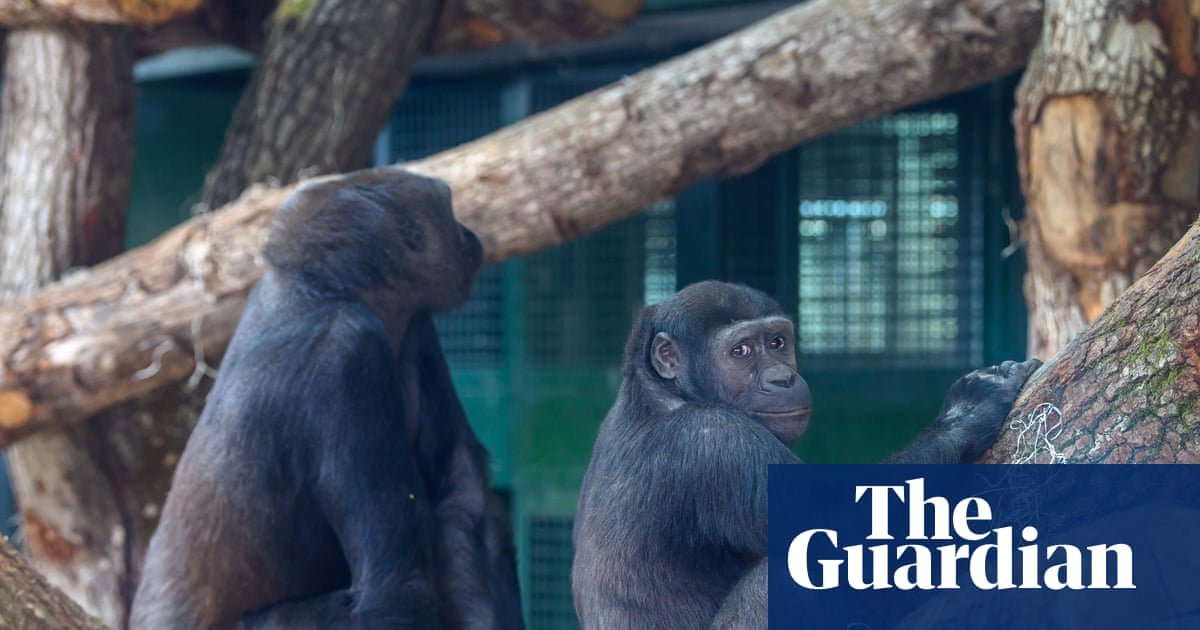
It has been an eventful few months for Bristol’s gorillas. The troop made headlines around the world when an urban explorer snapped pictures of them looking downbeat in their old, almost deserted home near the city centre. Then they were moved – under armed police escort – to a new out-of-town base and promptly suffered a shock bereavement.
On Monday, in warm spring sunshine, the western lowland gorillas were to be found exploring a new woodland habitat at Bristol Zoo Project, five miles from their former city home. They clambered up the horse chestnut tree, as tall as a three-storey building, sampled the green shoots of a hawthorn and scanned the floor for treats.
Sarah Gedman, the project’s curator of mammals, who has worked with the troop for a decade, beamed as she watched the seven gorillas exploring their new “African forest” home.
“It’s a larger area, four and a half times their old home,” she said. “But the most striking aspect of it is just how much more complex it is. We’ve offered them a life among the trees here. They literally disappear into the trees.”
Hasani, a five-year-old male, was the first to dash out into the new home. “He is full of confidence,” Gedman said. “But the best climbers are our adult females because they’ve had a little bit more practice. Touni, one of our adult females, is an amazing tree climber.”
However, the transfer has not been without sadness. The gorillas were moved in February, a complex operation involving more than 40 people including keepers, vets and relocation experts, as well as a police escort. Ten days later, silverback Jock, who was 42 and the oldest male gorilla in the UK, became lethargic and lost his appetite. The difficult decision was taken to euthanise him. A postmortem found he had an aortic dissection – a tear in the artery.
“It was a sad time for the keepers and for the gorillas alike,” Gedman said. She was proud of how Jock had helped the troop adapt. “He did amazingly well, he explored the whole space, he offered that reassurance to the troop as they settled in, and it was almost as if once he’d done that, he’d made his peace.”
The gorillas were kept inside for a while as they grew accustomed to their new place. But over the last few days they have been allowed out into the sunshine. The media were invited in on Monday and visitors will be able to see them for the first time on Wednesday.
The troop will eventually share their enclosure with endangered cherry-crowned mangabeys, and close by is a flock of African grey parrots rescued from illegal pet traders in eastern Europe.
Bristol’s link with gorillas has been long. In 1930, a gorilla given the name Alfred arrived at the Clifton site. He was led around the zoo on a lead and was celebrated for taking part in snowball fights with visitors.
In more recent years, Jock and the rest of the troop lived on “gorilla island” in Clifton. The site closed to the public in September 2022 and many of the animals were moved to the Bristol Zoo Project, on the edge of the city.
The eight gorillas were left behind while their new home was built. In October 2025, an “urban explorer” broke into the zoo and posted a video of one of the apes tapping a glass window in the gorilla house and looking – to the amateur animal watcher – sorrowful. The zoo insisted the animals were content and that what to an untrained human eye looked like a mournful expression was in fact relaxed.
There remains upset over the move from Clifton. The zoo says the animals have a much better home but some critics say it was all about making money from selling the city site for housing in one of the UK’s most desirable neighbourhoods.
This year there have been demonstrations against plans by property developer Acorn to build homes on the site. The Save Bristol Gardens Alliance argues the development will destroy a site of huge cultural, historical and environmental importance.
There are those who think gorillas ought not be held in captivity at all. In a report published last year called Captive Cousins, the charity Born Free said that keeping great apes in zoos was not ethically defensible and should be phased out.
Born Free’s captivity research and policy manager, Chris Lewis, said the Bristol gorillas’ new enclosure was an improvement but “it does not eliminate the fundamental issues great apes face when kept in captivity. The needs of such intelligent, sentient beings simply cannot be met in a zoo environment.”
Justin Morris, the chief executive of Bristol Zoo Project, argued the captive gorillas played a vital role in a coordinated breeding programme for the critically endangered species. “Until we’ve solved the problems that these animals face in the wild, then the reality is that we’ve got to have these insurance populations,” he said. “I really do genuinely believe that zoos have got an important part to play.”


