



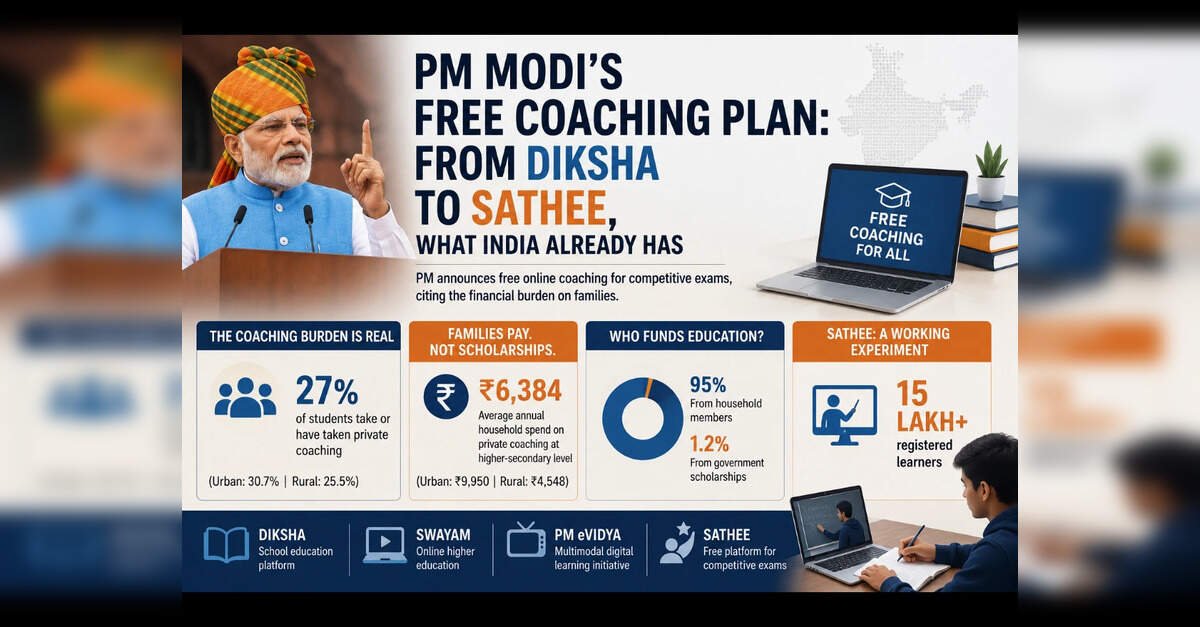
PM’s free coaching promise comes as 27% of students already use private coaching, while SATHEE has crossed 15 lakh registered learners.
Prime Minister Narendra Modi’s Independence Day announcement of a nationwide network of free online coaching for competitive examinations has opened a larger question than how the new initiative will be implemented: does India really need to build a new system, or does it need to connect and scale the one it has already spent years creating?
In his address from the Red Fort on Saturday, Modi said the pressure of coaching classes had become a major burden on poor and middle-class families. He said families were spending “thousands of crores of rupees” on coaching and announced that the government would bring together its digital public infrastructure, teachers and available talent to build an extensive network of free coaching for young people preparing for various examinations.
The timing is significant. India already has a national digital education architecture built during and after the COVID-19 pandemic, and one of its newest components, SATHEE, is already providing free competitive-exam preparation at considerable scale.
The question is whether Saturday’s announcement represents a new platform, a major expansion of SATHEE, or an attempt to bring these existing pieces together into a national public coaching system.
The coaching race already has a measurable cost
The financial burden Modi referred to is not merely a perception. The latest Comprehensive Modular Survey: Education, conducted by the National Statistical Office in April-June 2025, found that 27% of students were taking or had taken private coaching during the academic year. The proportion was 30.7% in urban areas and 25.5% in rural India.
The survey also provides a more granular picture of the cost.
Average annual household expenditure on private coaching per student was ₹3,988 in urban areas, compared with ₹1,793 in rural areas. At the higher-secondary level, the gap widened sharply: urban households spent an average ₹9,950 per student on private coaching, against ₹4,548 in rural areas. The all-India average at the higher-secondary level was ₹6,384.
These figures do not capture the entire economics of India’s competitive-examination coaching market. JEE and NEET aspirants who move to coaching hubs can incur additional costs for accommodation, food, travel, study material and test series.
But they establish something important: private coaching has become a mainstream household education expense, not a marginal supplement.
And families are largely financing education themselves. The same survey found that 95% of students reported other household members as their first major source of education funding, compared with just 1.2% reporting government scholarships as the first major source.
That makes the government’s free-coaching proposition economically relevant.
But India is not starting from zero
The infrastructure Modi referred to has a history. During the COVID-19 pandemic, the government assembled PM eVIDYA as a multimodal digital education initiative, bringing together platforms including DIKSHA and SWAYAM, along with television, radio and other channels. The objective was not simply to put classroom content online, but to create multiple routes to education for students with different levels of digital access.
DIKSHA subsequently evolved from a pandemic-era education response into a national digital platform for school education.
That evolution matters for the latest announcement.
It demonstrates that a government digital education platform can survive beyond the emergency that initially accelerates its adoption. Instead of shutting down when classrooms reopened, the infrastructure became part of the continuing education system.
The free-coaching proposal is now attempting to take that logic into a different part of the education market: competitive examinations.
SATHEE is already the closest experiment
If Modi’s proposed model is digital infrastructure plus teachers plus talent, SATHEE is arguably the government’s clearest existing test case.
Developed by the Ministry of Education with IIT Kanpur, SATHEE was launched in November 2023 as a free platform for competitive-exam preparation. Its coverage has expanded to JEE, NEET, CUET, ICAR, SSC, banking and other examinations, with multilingual resources and AI-enabled assessments and guidance.
The scale has grown quickly.
IIT Kanpur says SATHEE has crossed 15 lakh registered learners. The platform is no longer limited to students independently accessing online material. It has also been integrated into government-school systems.
In Punjab, SATHEE was implemented across 569 government non-School of Eminence institutions. IIT Kanpur reported that JEE Main qualifiers from these schools increased from 49 in 2024 to 85 in 2025, while NEET qualifiers rose from 335 to 497.
Those numbers cannot by themselves establish that SATHEE caused the improvement. It is a single-state comparison over one year and other factors may have contributed.
But it does show that the government already has a working experiment in delivering structured competitive-exam preparation through public digital infrastructure.
And that makes the next question unavoidable:
What exactly will the new national coaching network do that SATHEE does not already do?
COVID quietly created the blueprint
The answer may lie in scale rather than invention. COVID forced the government to solve a problem that had previously been treated as largely physical: how to deliver education to millions of students when classrooms could not function.
DIKSHA, SWAYAM, television channels, radio and other components of PM eVIDYA became part of that response. The post-COVID evolution of these platforms created something potentially more valuable than a collection of educational websites: a public digital layer for education.
Modi’s announcement appears to be asking the government to use that layer for another high-stakes problem.
This time, however, the benchmark is much harder.
School content can be distributed digitally. Competitive-exam preparation is more demanding because students are competing against one another for a limited number of seats.
Free content is not necessarily free coaching
This is where the debate around the announcement becomes more complicated.
A coaching institute does not sell only lectures.
Families pay for a combination of teaching, testing, doubt resolution, mentoring, schedules, peer competition, performance tracking and, increasingly, personalised preparation.
SATHEE already provides several of these components, including live and recorded lectures, practice questions, mock tests, assessments and mentoring resources.
But the national programme will be judged on whether it can deliver these services consistently at scale.
A student watching a free JEE lecture is not necessarily equivalent to a student enrolled in a full-time coaching programme.
The distinction matters because the government’s objective is not merely to increase access to educational content. Modi explicitly linked the initiative to the financial burden of the coaching race and to keeping children closer to their families rather than sending them away to coaching centres.
That makes outcomes more important than registrations.
The eventual questions will be: How many students actively use the platform? How many complete courses? How do they perform in mock examinations? How many qualify for JEE, NEET or other competitive examinations? And, most importantly, how many of those students would otherwise have been unable to afford private coaching?
The digital model could also change where coaching happens
There is another economic dimension to Modi’s announcement.
The cost of coaching is not always the fee charged by the institute.
For students from smaller towns, preparing for a national competitive examination can mean moving to Kota, Delhi, Hyderabad or another coaching centre. That can turn a coaching decision into a family relocation decision.
A credible national online system could change that equation. If a student can access high-quality teaching, tests and mentoring from home, the potential saving is not limited to tuition. It can include hostel accommodation, food, travel and the disruption of moving a teenager away from home.
But that benefit will materialise only if the digital alternative is good enough to compete with the ecosystem students are currently travelling for.
The real challenge is not building another portal
India has already demonstrated that it can create digital education infrastructure at national scale. It has DIKSHA for school education, SWAYAM for online higher education, PM eVIDYA as a multimodal framework and SATHEE as a free competitive-exam preparation platform.
What it has not yet demonstrated is that these pieces can be converted into a credible public alternative to the private coaching ecosystem.
That requires more than another launch.
It requires sustained funding, high-quality teachers, multilingual content, reliable technology, state-level integration, mechanisms for doubt resolution and mentoring, and rigorous measurement of student outcomes.
It also requires confronting the digital divide. A free online course has limited value to a student without a suitable device, reliable connectivity or a place to study.
From COVID’s digital experiment to a national coaching system?
That is ultimately what makes Modi’s announcement interesting. The government is not building its free-coaching promise on a blank slate. It is building on an education infrastructure that expanded dramatically during COVID and continued to evolve after the pandemic.
SATHEE has already shown that the model can reach more than 15 lakh registered learners and move into government schools. The latest NSS data shows that more than one in four students uses private coaching and that the financial burden rises with educational level.
So the debate following Modi’s speech should perhaps move beyond whether India needs free coaching.
The more important question is whether India can turn the digital public infrastructure it has already built into a genuine public alternative to the coaching race.
The answer will not be visible in the announcement. It will be visible in the budget, the architecture of the programme, the teachers brought into it, the students who actually use it and, ultimately, the examination results.
Modi has announced free coaching. India already has much of the infrastructure. Now it has to prove that the infrastructure can actually compete with coaching.


