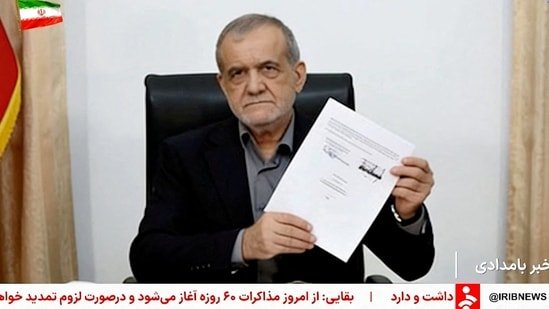
It was a moment both historic and anticlimactic. Overnight on June 17th, both Donald Trump and Masoud Pezeshkian (pictured) signed a memorandum of understanding (mou) that they claim will end their war. Never before, in 47 years of hostility, have American and Iranian presidents put their names to an accord.
A screen grab shows Iran’s President Masoud Pezeshkian holding a signed memorandum with US President Donald Trump, in Tehran, Iran. (REUTERS)
Yet they did so at a distance: Mr Trump in Versailles, Mr Pezeshkian in Iran. It is a bare-bones agreement, barely a dozen paragraphs. It will pause, not end, the hostility, and ultimately will be judged by what comes next. The Trump administration hopes it will transform America’s tortured relationship with Iran. But in the Middle East, hopeful visions have a way of crashing into hard reality.
After days of delay, America has finally released the text of the deal. The key points are as expected. The Strait of Hormuz should reopen. America and Iran will extend their truce and start 60 days of talks over a final pact to restrict Iran’s nuclear programme. Iran will receive limited economic benefits up front: a sanctions waiver allowing oil exports, and the release of billions of dollars frozen in foreign banks.
The details of all this are vague and contested. America insists it will unlock Iranian assets only if the regime meets certain commitments over the next 60 days. No one can say what those commitments are. The mou mentions a plan for a reconstruction fund of “at least $300bn” to be developed “with regional partners”. Gulf officials say they are hardly keen to pour money into a country that spent the past months bombing them.
Similarly, Iran has pledged in the MOU that it will never build a nuclear bomb. That promise seems important to Mr Trump, who touts it at every turn—never mind that an identical one appeared in the first paragraph of America’s previous deal with Iran, which he abandoned in 2018. Yet it is meaningless without a comprehensive accord that imposes real, verifiable limits on Iran’s nuclear programme.
At best, then, this is a deal that allows oil to start flowing. In the short term, that should give both sides an incentive to abide by it. Mr Trump needs to get petrol prices down before midterm elections in November. Iran needs revenue to tackle a worsening economic crisis.
Beyond the next two months, three starkly different scenarios seem possible. Most optimistic is a profound change in the region. “The coolest thing about the progress we’ve made over the last few weeks,” gushes J.D. Vance, the American vice-president, is hearing the Iranians say “The way that we’ve done business with the United States for 47 years is a mistake, let’s try something else.”
In this scenario, Iran would agree to halt uranium enrichment, grant unfettered access to nuclear inspectors and stop trying to export its revolution. America would lift decades of sanctions and allow Iran to integrate with the global economy. Instead of trying to topple the regime, Mr Trump would offer it a chance to become like its Arab Gulf neighbours: autocratic, yes, but prosperous and stable. Perhaps a few Iranian officials share Mr Trump’s sentiments. But “I don’t think the Revolutionary Guards dream about turning Tehran into Dubai,” says a diplomat in the Gulf.
A second option, then, is that the interim deal congeals into something more permanent. The 60-day period of talks and truce can be extended indefinitely by mutual agreement. Iran could keep selling oil, and America could try to monitor Iran’s uranium stockpile from afar.
Yet this seems an unstable equilibrium. America and its allies would retain well-founded fears about whether Iran was pursuing a bomb in secret. Iran would remain subject to a thicket of other sanctions. The reconstruction fund would be stillborn. Gulf states fear this would leave them vulnerable to endless Iranian extortion.
That leaves the gloomiest scenario: the MOU proves a half-time break rather than a final whistle. Wars end when the combatants believe the costs outweigh the possible benefits. Today, Iran’s leaders feel triumphant. But a lengthy pause will force them to confront a people exhausted by conflict and collapse. “A system that has spent the last several months on war footing will now have to try governing after it,” says Ali Vaez of the International Crisis Group, a think-tank. That will be hard without sustained sanctions relief. The regime might see a new round of fighting as a way to force more American concessions.
As for America, it will have an erratic president, perhaps humiliated by defeat in the midterms. He will have an eye on his legacy—and little to show for his war. Israel will try to convince Mr Trump that Iran deceived him, and that he risks unflattering comparisons to Barack Obama.
For now, almost everyone in the region is breathing a sigh of relief. The mou may be flawed but the alternative was more war. And yet it is unlikely to be the end of the hostility—and time will tell if it is even the beginning of the end.
Sign up to the Middle East Dispatch, a weekly newsletter that keeps you in the loop on a fascinating, complex and consequential part of the world.