



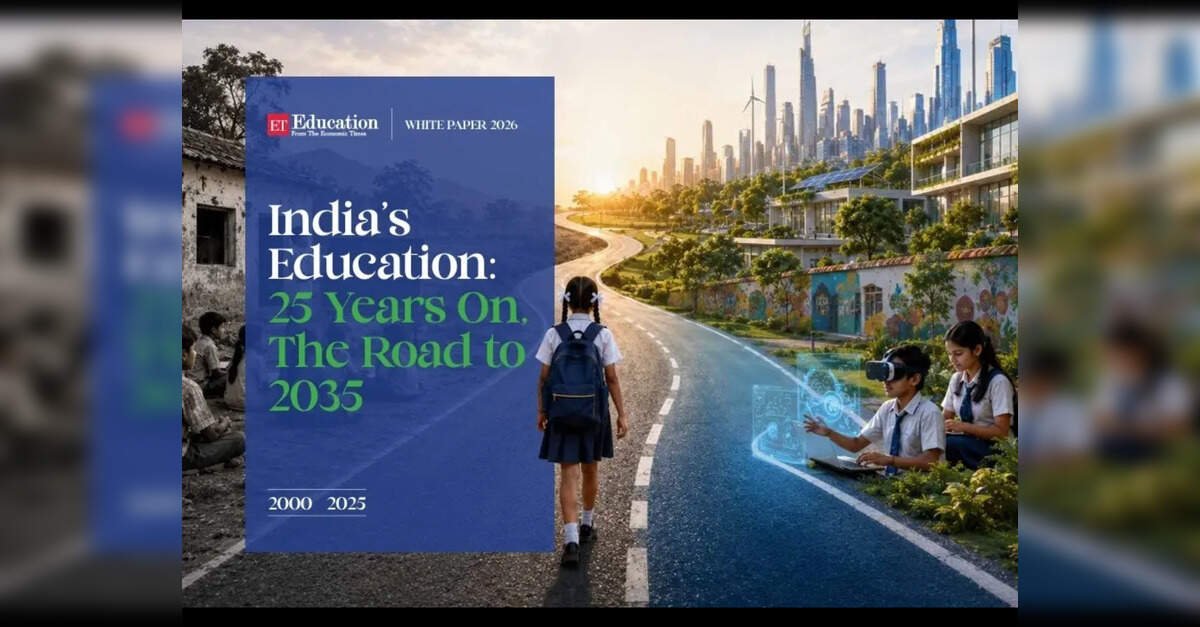
India has spent the last 25 years building one of the world’s largest education systems. The next decade will determine whether that scale can translate into learning, employability, innovation and long-term economic advantage.
That is the central message of ETEducation Outlook 2026, India’s Education: 25 Years On, The Road to 2035, launched at the third edition of the ETEducation Annual Education Summit 2026 at Yashobhoomi, New Delhi.
Positioned as a landmark review of India’s education journey between 2000 and 2025 and a roadmap for the decade ahead, the report combines analysis from more than 100 authenticated sources with a national survey of 200+ senior education practitioners across 15 cities, spanning school education, higher education, skilling and EdTech.
Its conclusion is both optimistic and cautionary: India has achieved unprecedented expansion in education access, but the next phase must focus on quality, outcomes and future readiness.
The report captures the scale of India’s transformation over the last quarter century.
School enrolment for children aged 6–14 rose from an estimated 65–70% in 2000 to 98.1% in 2024. Higher education expanded from 256 universities to more than 1,200 institutions, while enrolment increased from nearly 1 crore students to 4.33 crore. India emerged as the world’s second-largest EdTech market at US$7.5 billion and improved its position in the Global Innovation Index from 81st in 2015 to 39th in 2024.
Yet the report argues that access alone can no longer be the measure of success.
One of its most striking findings is that only 8.9% of education practitioners believe Indian higher education currently prepares graduates “very effectively” for work, despite decades of expansion.
The survey also found that 69.1% identified curriculum misalignment as the biggest barrier to graduate employability, reflecting growing concern that degree growth has outpaced changes in learning design and labour market expectations.
The findings mirror broader concerns around workforce preparedness. External estimates cited in the report suggest that 45.19% of graduates are not considered employer-ready, raising questions about whether education systems are equipping learners with practical capabilities, adaptability and higher-order thinking.
Challenges persist even at the school level.
According to the report, 44.8% of Class 5 students in government schools are able to read at grade level, indicating that foundational learning remains unfinished despite major improvements in access and enrolment.
The report also highlights structural issues that could influence India’s long-term competitiveness.
Public expenditure on education has remained between 3.9% and 4.6% of GDP, below the long-standing target of 6%, while national investment in research and development stands at 0.7% of GDP, significantly lower than global benchmarks.
At the same time, technological disruption is expected to redefine education and work.
The practitioner survey found that 71.5% believe artificial intelligence will be the single most influential technology shaping the future of education, while global projections referenced in the report suggest that automation and AI could significantly restructure employment patterns over the coming decade.
Perhaps the report’s most important message is that India now stands at an inflection point.
Nearly one in five respondents (19.8%) believe India’s education system will remain largely unchanged by 2035, suggesting concerns around the pace of implementation and institutional transformation.
The Outlook argues that the next chapter of India’s education journey must move from access to quality, from enrolment to learning outcomes, from credentials to competence, and from scale to substance.
Framed around the broader vision discussed at the ETEducation Annual Education Summit 2026, “India’s Education Revolution: For the World, With the World”, the report positions education not merely as a social sector priority, but as the foundation for India’s future economic growth, innovation capacity and global leadership.
As India enters the next decade of educational transformation, the report argues that the question is no longer whether the country can educate at scale, but whether it can educate for the future.


