Salt, oil, fat, grease: Languages tend to draw phrases that relate to effort and industry, from elements that fuel their civilisations.
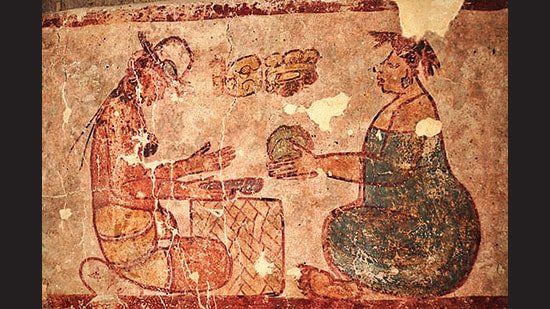
A 2,500-year-old mural at the Mayan site of Calakmul in Mexico shows salt being traded. It is believed to have served as a form of money and a vital commodity here. The man in the broad-brimmed hat (likely made from vegetable fibre) was likely the buyer in this transaction. (Rogelio Valencia, Proyecto Arqueológico Calakmul via Louisiana State University)
Salt, for instance, gives us a myriad of terms. In Ancient Rome, this seasoning was so expensive and so highly valued — mainly as a means of preserving foods — that rations of it were handed out to soldiers, civil servants and others in plum positions, in a stipend called a salarium (from the Latin “sal”, for salt), and from that word we get “salary”.
“To sit above the salt”, meanwhile, meant to sit in a position of distinction. This derives from noble houses where it was customary to place the salt in its large silver container in the top centre of a long dinner table.Guests of honour were seated between the container and the head of the table, while those of less importance were seated further from the exorbitant garnish.
“Salt of the earth” has been used to describe a reliable, trustworthy and straightforward person all the way back to the New Testament.
“Taken with a pinch of salt”, interestingly, comes not from the idea of something being over-seasoned (ie, exaggerated), but from the use of salt as an antidote to poisons.It was thought, in the 17th century, that taking a small amount of salt with other ingredients was a good antidote for any toxins that might have crept into food, and so it became a term for threats or statements that may be taken less seriously.
Salt was key to a number of medical remedies; it was when Napoleon’s army ran out of salt to preserve meat and sterilise wounds, in fact, that he suffered some of his most crippling losses in his disastrous six-month campaign in Russia, in 1812.
The catalysts of fat and fire have given us a fair share of idioms too.
“Too many irons in the fire” comes from a time long before the industrial revolution, when an inexperienced blacksmith might place too many of his irons in the forge at the same time, leaving none cool enough to work with. It remains a warning for trying, in the wrong way, to do too much at once.
“Slush fund”, meanwhile, isn’t money so dirty it’s being compared to the grey-black mess of a post-snow day. It is money so tainted, it is being likened to the scum atop a cauldron of boiling meat. Slush was the term for the fat skimmed from the tops of such dishes, to be sold to tallow-makers. It was a filthy business, but it did bring in the bucks.
“The fat is in the fire” indicates something has been utterly mishandled. Dropping this precious material onto an open flame made a mess, was a waste of good calories, and has indicated, since the 16th century, the complete failure of an enterprise.
By the time of the industrial revolution, salt and fat were being replaced by oil and grease.
“Greased lightning” is an intriguing example, dating to the 1830s. The scale of what greased machines could now do was so dramatic that the fastest thing one could imagine was no longer lightning itself, but a greased version.
“Firing on all four cylinders” has similar roots. I know many who think it has something to do with weaponry and certain kinds of guns. It really originates in the four cylinders of an internal-combustion engine, which is said to be firing when the fuel inside it has been ignited. So, functioning at peak capacity.
My favourites remain the terms linked to salt. Salary, but also “salad” from the Latin “herba salata” or “salted vegetables” (though it was usually not salt being used, but brine). Salami, from the Italian salame, for salted meat. “Sauce”, from the Latin “salsus”, for salted condiments. Zoom in further and “salsus”, via the Old French “saucier”, also gives us the term for the small plates once used to hold portions of such condiments… which we still call saucers.
(Adam Jacot de Boinod is author of The Meaning of Tingo. The views expressed are personal)