



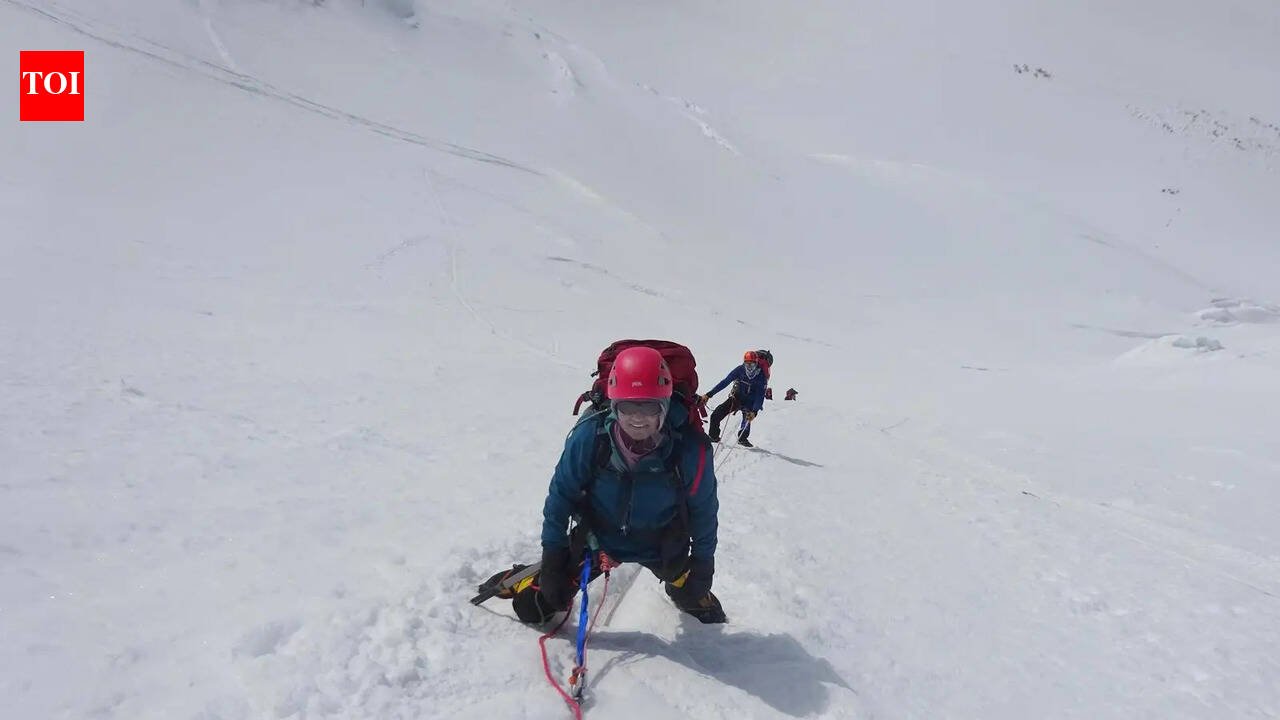
Lucknow: May 21 is a summit day for IPS officer Aparna Kumar, literally and metaphorically. Ten years ago on this day in 2106 the UP cadre officer created history by becoming the nation’s first IPS to scale Mount Everest — a feat achieved after overcoming two failed attempts triggered by devastating natural disasters in Nepal.Currently posted as Joint Commissioner of Police (Crime) in Lucknow, Aparna’s Everest odyssey remains one of the most inspiring mountaineering stories in Indian policing and civil services.What makes Aparna’s story more inspirational is that she conquered Everest not in her 20s, but in her mid-thirties when she was the mother to two children aged nine and six.At an age when many people begin limiting their dreams to family responsibilities, she chose to challenge the world’s deadliest peaks.“Born and raised in Bengaluru, I had never seen snow during childhood. I first saw the snowfall while attending the IPS training in Mussoorie in 2002,” Aparna told TOI.Balancing motherhood, policing and extreme mountaineering, she trained relentlessly while raising her children and discharging her police duties.“I remember standing at the foot of Everest for the first time, carrying the Indian tricolour and believing that no mountain was impossible if the mind refused to surrender. But Everest had other plans for me,” said Aparna.During her first attempt in 2015, the mountain turned into a graveyard as a massive avalanche ripped through the Khumbu Icefall, killing 16 Sherpas. “We watched fear, chaos and helplessness unfold before our eyes. The expedition was called off. I returned home carrying heartbreak instead of victory. People asked me if I would try again and I said yes,” she recalled.A few months later, she began preparing for the second attempt.“I trained harder, mentally and physically. But just when the dream seemed alive again, Nepal was struck by a devastating earthquake. More than 20,000 people died. Everest shook violently. Avalanches thundered down the slopes. Once again, the mountain closed and we were forced to return. Two attempts. Two disasters. Two unfinished dreams,” she recalled.“There were moments when I questioned myself. Maybe Everest did not want me there. Maybe it was a sign to stop. But somewhere deep inside, I knew I could not quit,” she said.“I was not climbing Everest only for myself. I was climbing for every woman told she started too late. So I returned in 2016. This time from the tougher North Face route through Tibet,” she told.The climb was brutal. Freezing winds cut through the body like blades. Oxygen levels dropped. There were moments of fear, exhaustion and silence where the mountain tests not your strength, but your soul. And then came the final push.“When I finally stood atop Mount Everest on May 21, 2016, the world below looked impossibly small. I held the tricolour tightly in my hands and cried. Not because I had conquered the mountain. But because the mountain could not conquer my will,” Aparna shared.“That moment taught me the greatest lesson of my life — sometimes courage is not about winning the first battle. Courage is returning after life breaks you twice… and still daring to dream again,” she said.Aparna is the first IPS officer and civil servant in India to complete the prestigious Seven Summits challenge by scaling the highest peaks in all seven continents.She also became the first civil servant and IPS officer to ski to the South Pole in Jan 2019, after battling extreme Antarctic conditions.As DIG, Sector Headquarters Dehradun in the ITBP, she successfully led a Special Long-Range Patrol expedition along the Indo-Tibetan border in Uttarakhand in 2020, during which her team scaled six previously unclimbed peaks above 6,000 metres.Her major expeditions include Mount Kilimanjaro (2014), Carstensz Pyramid (2014), Aconcagua (2015), Mount Elbrus (2015), Mount Vinson (2016), Mount Everest via the North Face in 2016, and Mount Manaslu in 2017, where she became the first Indian woman to summit the peak.For her achievements, she was conferred the prestigious Tenzing Norgay National Adventure Award by the President of India and the Rani Lakshmi Bai Award by UP govt.


