


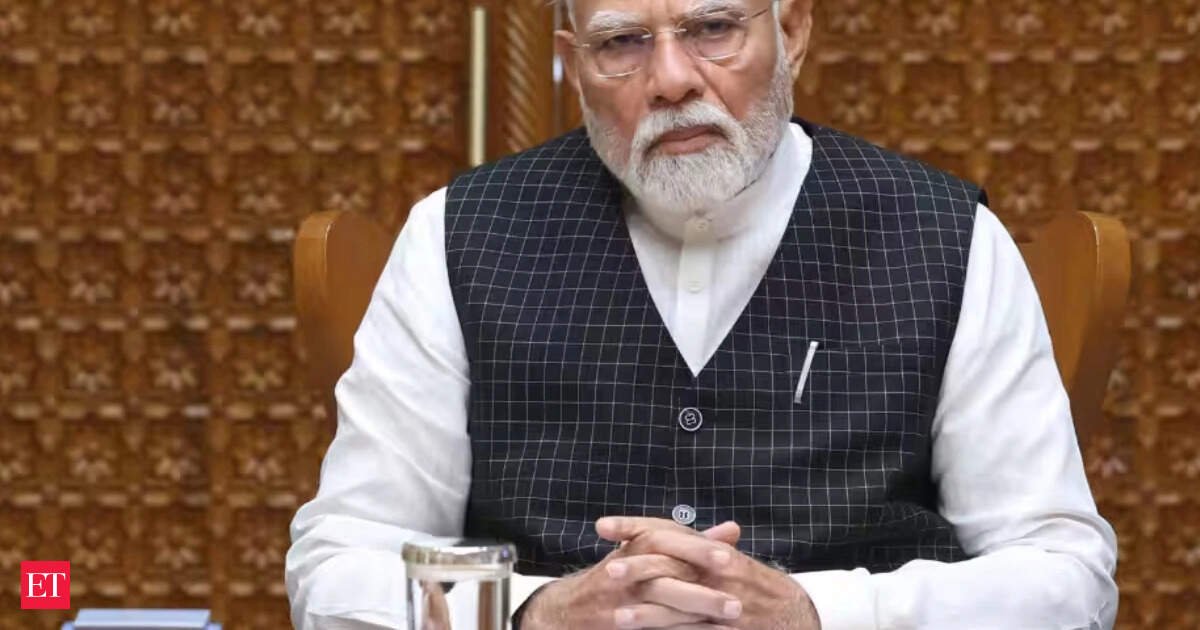
Addressing the nation a day after the bill failed to pass, the prime minister said the outcome was a setback for women’s empowerment and held opposition parties responsible for blocking the measure.
Also Read | Lok Sabha rejects women’s reservation proposals under the Constitution (131st Amendment) Bill 2026
“All Indian citizens are seeing how the aspirations of Indian women were curtailed. Their dreams were shattered. Despite our best efforts, we could not succeed. I apologise to all the women of India,” he said.
Stressing that national interest should come before political considerations, the prime minister added that “for us, the country is everything,” but alleged that some parties placed politics above progress. “When party politics becomes bigger than everything, the nation and women’s empowerment have to bear the cost,” he said.
“Congress, DMK, TMC and Samajwadi party’s selfish politics has led to Indian women bearing the brunt of it,” he alleged.
Also Read | Opposition to urge Narendra Modi to implement earlier women’s reservation billSharpening his attack, the BJP supremo said that the “21st-century woman is watching everything closely” and suggested that opposition parties would face consequences for their actions.
He accused the Indian National Congress and its allies of deliberately derailing the proposal, claiming they had “killed the dream” of women’s representation.
“Congress and its supporters have killed this dream. These people are criminals of Indian Constitution and of nari shakti, they hate women’s representation, they have always conspired against this,” he said while addressing the nation.
The prime minister further alleged that these parties had consistently opposed greater participation of women in governance, describing their actions as an affront to both the Constitution and “nari shakti”. “Congress and its allies have tried to misguide the country. their real face has been exposed.”
Opposition Fuelling Division Over Delimitation’: PM Modi
Continuing his criticism, PM Modi accused opposition parties of stoking fears around the issue of delimitation for political gain. He said the Congress and its allies have repeatedly raised concerns to “fuel divisions” among states, drawing a parallel with colonial-era tactics.
“They have learnt the politics of divide and rule from the British,” the prime minister said, alleging that misleading narratives were being spread about delimitation being disadvantageous to certain regions.
The saffron party leader argued that the proposed framework was, in fact, an opportunity for all states to enhance their representation in Parliament. “This was a chance for every state to increase its number of seats, but due to selfish politics, these parties have betrayed their own states,” he said.
Taking aim at regional parties, he said the DMK had an opportunity to expand Tamil Nadu’s representation but failed to seize it, and made a similar charge against the All India Trinamool Congress for West Bengal.
Lok Sabha rejects 33% reservation for women
The prime minister’s remarks follow the Lok Sabha’s decision to turn down the proposal to introduce 33% reservation for women in legislative bodies, after the government’s package failed to muster enough support during voting.
The motion received 278 votes in favour out of 489 members present, falling short of the numbers required for approval.
Even so, the proposal was designed to accelerate a reform that has remained pending for decades, with the government aiming to bring the quota into effect by the 2029 General Elections
A central feature of the plan was to separate the rollout of reservations from the census-based delimitation exercise mandated under the 2023 law-an attempt to avoid delays that could otherwise defer implementation until 2034.
Officials had indicated that, if passed, the changes could have reshaped the composition of the Lok Sabha, potentially increasing its strength to about 850 seats.
Within this expanded framework, nearly 273 constituencies would have been earmarked for women, with corresponding provisions extending to state assemblies and Union Territories.
The proposal has, however, sharpened political fault lines. While opposition parties have largely backed the idea of reserving seats for women, leaders from several southern states have voiced reservations about the population-linked delimitation model.
Tamil Nadu CM and DMK leader MK Stalin and others have argued that such an approach could penalise states that have successfully stabilised population growth.
