



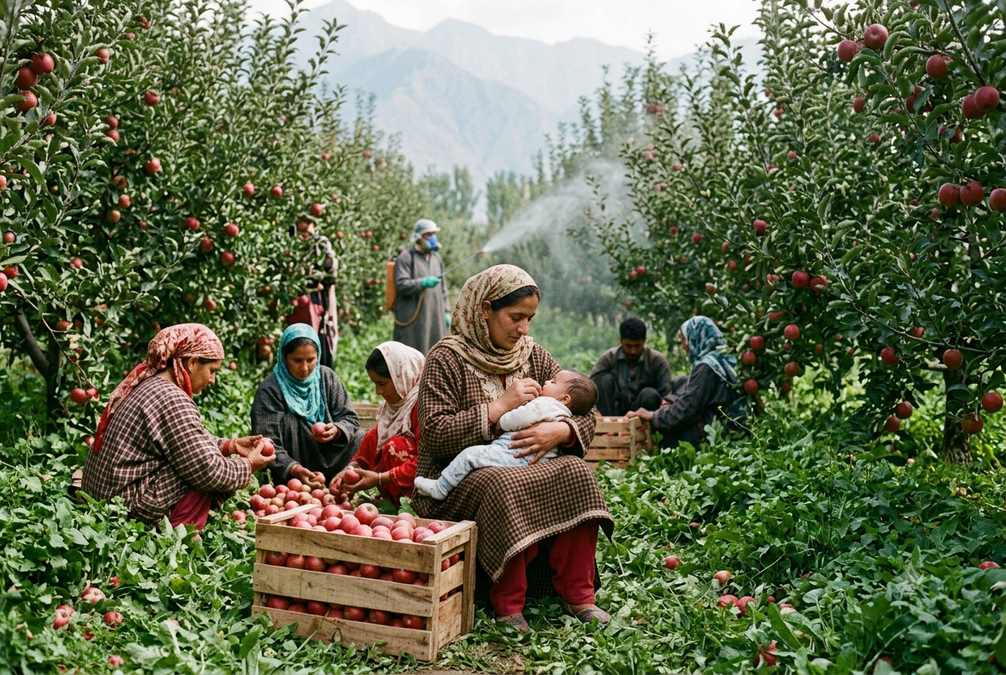
Srinagar, Oct 09: As chemical pesticides remain part of crop protection in Kashmir’s apple-growing belt, an important environmental health question remains unanswered: are women who work in or live near orchards exposed to pesticides that can be detected in their breast milk?
Research conducted in other parts of India has found pesticide residues in breast-milk samples collected from nursing mothers. However, comparable published evidence establishing the presence and concentrations of such residues among lactating women in Jammu and Kashmir was not identified in the literature reviewed for this report.
The gap is significant for a region where horticulture supports thousands of farming households and women participate in a range of agricultural activities, including pruning, picking, sorting and handling harvested produce.
Although these activities do not necessarily involve direct pesticide application, exposure may occur through contact with recently treated plants, contaminated surfaces or soil, spray drift and other environmental pathways. The extent of such exposure depends on the chemicals used, application practices, protective measures and the time elapsed since spraying.
The absence of local breast-milk data means that the nature and extent of this potential exposure remain uncertain.
Studies elsewhere in India detect pesticide residues
Several peer-reviewed studies have investigated pesticide residues in human breast milk across India.
A study published in Environmental Pollution in 2021 analysed 81 breast-milk samples collected from Kolkata and Nadia in West Bengal. Researchers detected organochlorine pesticides and selected newer compounds, including pyrethroids and neonicotinoids. Most of the substances investigated showed higher average concentrations in samples from Kolkata than in those from Nadia.
In Assam, a study published in Science of the Total Environment in 2011 reported residues of DDT and HCH in breast milk collected from Dibrugarh and Nagaon.
Another study, published in the same journal in 2013, analysed 53 breast-milk samples from Punjab and reported several pesticide compounds, including DDT and its metabolites, HCH isomers, endrin, endosulfan, cypermethrin and chlorpyrifos.
Research published in Environmental Pollution in 2009 also documented persistent organochlorine compounds in breast milk collected from Delhi, Mumbai and Kolkata.
The findings establish that selected pesticide compounds and their metabolites can be detected in human milk. However, the studies examined different populations under different conditions and cannot be used to estimate the prevalence of pesticide residues among mothers in Jammu and Kashmir.
Nor do they establish that the same compounds or concentrations occur in Kashmiri women.
Kashmir’s horticultural sector warrants investigation
The question assumes particular relevance in Kashmir, where apple cultivation is an important source of income and agricultural chemicals are used to protect crops against pests and fungal diseases.
A study published in the Indian Journal of Medical and Paediatric Oncology in 2010 cited estimates of approximately 7,750 metric tonnes of fungicides and 3,186 metric tonnes of insecticides used annually in Kashmir’s orchards. These are historical estimates and should not be treated as current consumption figures without verification against more recent official records.
Pesticide-use figures alone cannot establish the level of exposure experienced by farmers or their families. The risks associated with individual chemicals differ, as do the ways in which they enter the environment and human body.
For orchard workers, relevant exposure factors include pesticide handling, the use of protective equipment, the interval between spraying and returning to treated areas, and contact with treated crops. Residential proximity to orchards, dietary sources and drinking water may also be relevant.
A local investigation would need to account for these factors rather than assume that orchard work is the sole source of exposure.
Why breast-milk monitoring matters
Certain persistent pesticides, including some organochlorine compounds, can remain in the environment for long periods and accumulate in fatty tissues. Some may subsequently be detected in human breast milk.
Other pesticides have different chemical properties and may break down more rapidly. Their presence in breast milk cannot be assumed simply because they are used in agriculture.
Scientists would therefore need to identify the chemicals currently used in Kashmir’s horticulture and select a suitable laboratory testing panel. Samples would need to be analysed using validated methods, with results reported alongside laboratory detection limits and appropriate quality controls.
A study could compare samples from lactating women directly involved in orchard work with those from women who live near orchards but do not handle pesticides, as well as women from areas with less direct horticultural exposure.
Researchers could collect information on agricultural activities, pesticide-handling practices, protective equipment, residential location, diet and drinking-water sources. This would help examine whether detected residues are associated with particular exposure patterns.
The findings would establish a baseline for the study population, although a cross-sectional study alone could not prove that orchard work caused a particular residue concentration.
Detection does not automatically mean harm
The detection of pesticide residues in breast milk does not, by itself, establish that a concentration is harmful to an infant. Health risks depend on the chemical, the concentration, the duration and route of exposure, and the available toxicological evidence.
Public-health communication must therefore avoid equating the presence of a residue with a confirmed health effect.
Breastfeeding should not be discontinued solely because of general reports about environmental pesticide contamination. Women concerned about a specific or substantial exposure should seek advice from qualified healthcare professionals.
The more immediate priority is to reduce avoidable exposure among agricultural workers through appropriate protective equipment, adherence to product-specific safety instructions, observance of re-entry intervals and improved pesticide management.
Integrated pest management, which combines pest monitoring, preventive measures and targeted chemical treatment, could also help reduce unnecessary pesticide applications.
A research gap that needs attention
For Jammu and Kashmir, the central question remains unresolved. The studies reviewed for this report do not establish whether pesticide residues are present in the breast milk of women working in the region’s orchards, how frequently they might occur or which compounds warrant particular attention.
Addressing the gap would require collaboration among agricultural scientists, public-health researchers, environmental laboratories and relevant government departments. Any study involving lactating women would also require ethics approval, informed consent, reliable laboratory procedures and safeguards for participants’ privacy.
Alongside biological monitoring, authorities could improve records of pesticide use and strengthen environmental monitoring to help researchers identify locally relevant exposure pathways.
For a region whose agricultural economy depends heavily on horticulture, measuring potential exposure is an important step towards understanding the wider environmental implications of pesticide use.
Studies from other Indian states provide a basis for asking the question. Only systematic testing in Jammu and Kashmir can establish what, if anything, is present in the breast milk of women living and working around its orchards.
