



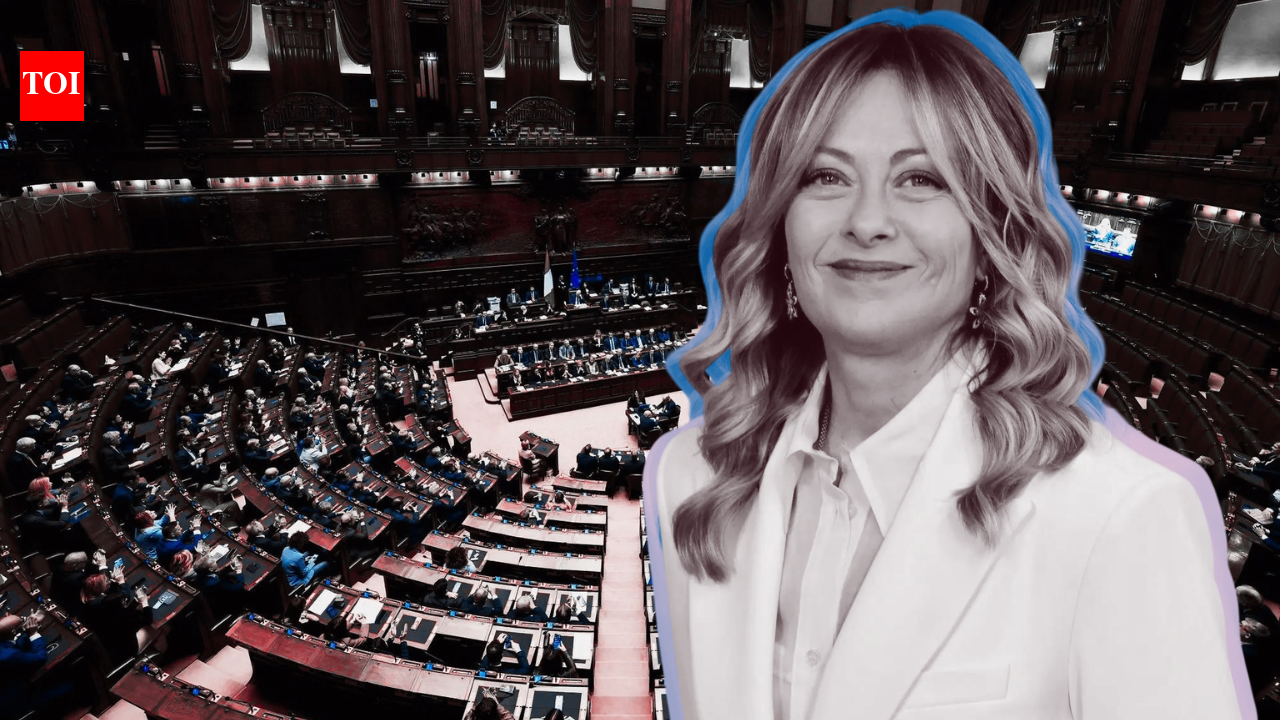
Italy’s parliament on Thursday gave final approval to an electoral reform championed by Prime Minister Giorgia Meloni. The reform introduces a fully proportional voting system that gives a parliamentary majority to alliances winning more than 42% of the vote ahead of a national election due by the end of next year.It was approved by the lower house in a secret ballot by 227 votes to 164, despite strong opposition from centre-left parties. Meloni had warned that she would resign if the legislation failed, making the vote a key test of her governing coalition.The Italian PM said the new system would help deliver more stable governments and give voters a greater say in choosing political programmes and prime ministerial candidates.“Stable governments and greater participation mean more continuity, more accountability and a greater ability to provide concrete answers to Italians,” Meloni wrote on X after the vote.The opposition, however, accused Meloni’s government of changing the rules to improve its chances of staying in power. Democratic Party leader Elly Schlein rejected that argument and said the centre-left would win regardless of the voting system.“Go ahead and change the electoral law, we will win in any case under any voting system,” Schlein said.Under the new system, an alliance that wins more than 42% of the vote will receive a seat bonus guaranteeing it a parliamentary majority. It will gain an additional 70 seats in the lower house and 35 in the Senate.The reform also requires parties and alliances to set out their governing programme and name their candidate for prime minister before an election. Supporters say this will make voters’ choices clearer.Giovanni Donzelli, a senior lawmaker from Meloni’s Brothers of Italy party, described the changes as “a revolution”.“Italians will finally have real weight with their vote, as they will choose the coalition, the platform, and the candidate for prime minister,” he said.Opposition Five Star Movement leader and former prime minister Giuseppe Conte criticised the legislation, saying it had been designed to give Meloni an electoral advantage.“This is a mess, a convoluted scheme, devised solely to find a formula to gain an advantage in the upcoming elections,” he said.The reform could nevertheless create an opportunity for the centre-left if its parties can overcome their differences and form a broad alliance. Recent polls put Meloni’s Brothers of Italy at about 28%, followed by the Democratic Party at around 20% and Five Star at 12.5%.The new rules have already exposed divisions between Schlein and Conte over who should lead a possible opposition alliance. Schlein argues that leadership should go to the party winning the most votes, while Conte wants voters to choose the coalition’s prime ministerial candidate through a primary.“The leadership belongs to the party that gets one vote more. That’s not hegemony, it’s democracy,” Schlein told a PD meeting last week.“If there are those who do not recognise this democratic principle, then we will hold primaries,” she added.Political scientist Piero Ignazi said a primary could deepen tensions within the opposition.“Primaries will probably make life worse for the left, because they are a contest in which one person says, ‘I’m better than the other,’ and that doesn’t make cooperation any easier,” he said.The centre-left’s ability to unite could be crucial. Neither side is currently expected to easily cross the 42% threshold, but an Ipsos Doxa survey suggested the opposition could do so if it brings smaller parties into a common alliance.The reform replaces a hybrid electoral system in which around two-thirds of lawmakers were elected through proportional representation and the remainder through first-past-the-post constituencies. Analysts had said the previous system could favour the opposition when parties coordinated their candidates.Meloni’s coalition has also faced pressure from the rise of former army general Roberto Vannacci’s far-right National Future party, which has drawn support away from her allies, the League and Forza Italia.Meloni’s term formally runs until October 2027, although she could call an earlier election in April or May. Opposition parties have said they will challenge the new electoral law in court.
