



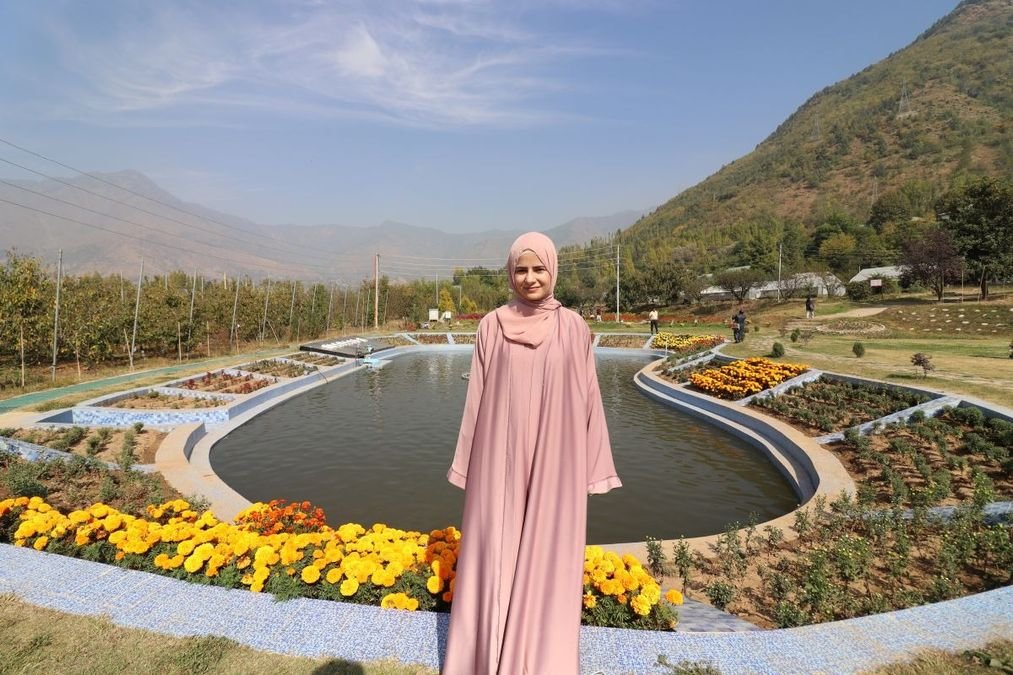
Srinagar, Oct 05: In an effort to extend Kashmir’s floral beauty beyond the spring tulip season, a student of Sher-e-Kashmir University of Agricultural Sciences and Technology-Kashmir (SKUAST-K), Shalimar, has developed and propagated 19 varieties of chrysanthemum, aiming to bring colour and commercial floriculture to Kashmir’s gardens during autumn.
Jaan Arbina Rouf, a Bachelor of Honours student in Horticulture from South Kashmir, said the initiative was inspired by the idea of making Kashmir bloom not only in spring with tulips but also in autumn with chrysanthemums.
“From spring to autumn, spring has its bloom through tulips and autumn can have its bloom through chrysanthemum,” Arbina said, describing the vision behind her project.
According to Rouf, the project began as an academic and practical initiative at SKUAST-K but gradually developed into a potential startup. She said the university’s emphasis on applying classroom knowledge at the field level encouraged her to assess the propagation techniques, yield and commercial potential of the crop.
The journey, however, was not without challenges. From propagation and taking cuttings to monitoring plant growth and maintaining the plants in polyhouses, Rouf said every stage presented new difficulties.
“Now these plants have grown up, and I feel those difficulties are gradually reducing. I am growing myself with their growth,” she said.
Arbina has so far planted around 1.5 lakh chrysanthemum planting materials, with an estimated outcome of around Rs 11 lakh in two months. She attributed the progress to the support and facilities provided by SKUAST-K, particularly its incubation and innovation ecosystem.
She expressed gratitude to Vice Chancellor Prof. Nazir Ahmad Ganai for providing the facilities and institutional support required to undertake the project, while also acknowledging the mentorship of faculty members in the Division of Floriculture and Landscape Architecture.
She particularly credited Dr. Qazi Altaf, describing him as a key mentor who guided her through the technical aspects of chrysanthemum propagation, including taking cuttings and preparing planting material.
According to Rouf, the project also received support from the SKUAST-K Innovation and Entrepreneurship (SKIE) Centre, where CEO Dr. Naveed Hamid provided guidance related to marketing and commercialisation.
With autumn approaching its peak, Rouf expects the chrysanthemum plants to begin flowering within the next one to two weeks. Being a short-day plant, chrysanthemum naturally responds to shortening day lengths, making the approaching winter season suitable for flowering.
For Rouf, the project is not merely about commercial returns but also about changing the way Kashmir’s gardens are maintained after the summer season.
“Why should we clean out our gardens in autumn and leave them as they are? Why not make them bloom again, plant flowers again and regenerate the ambience?” she said.
She has also extended an invitation to the public to visit SKUAST-K, obtain chrysanthemum planting material and use the flowers to beautify their gardens.
“Come to SKUAST-K, take your planting material and decorate your gardens. Let’s make Kashmir beautiful once again,” Arbina said.
