



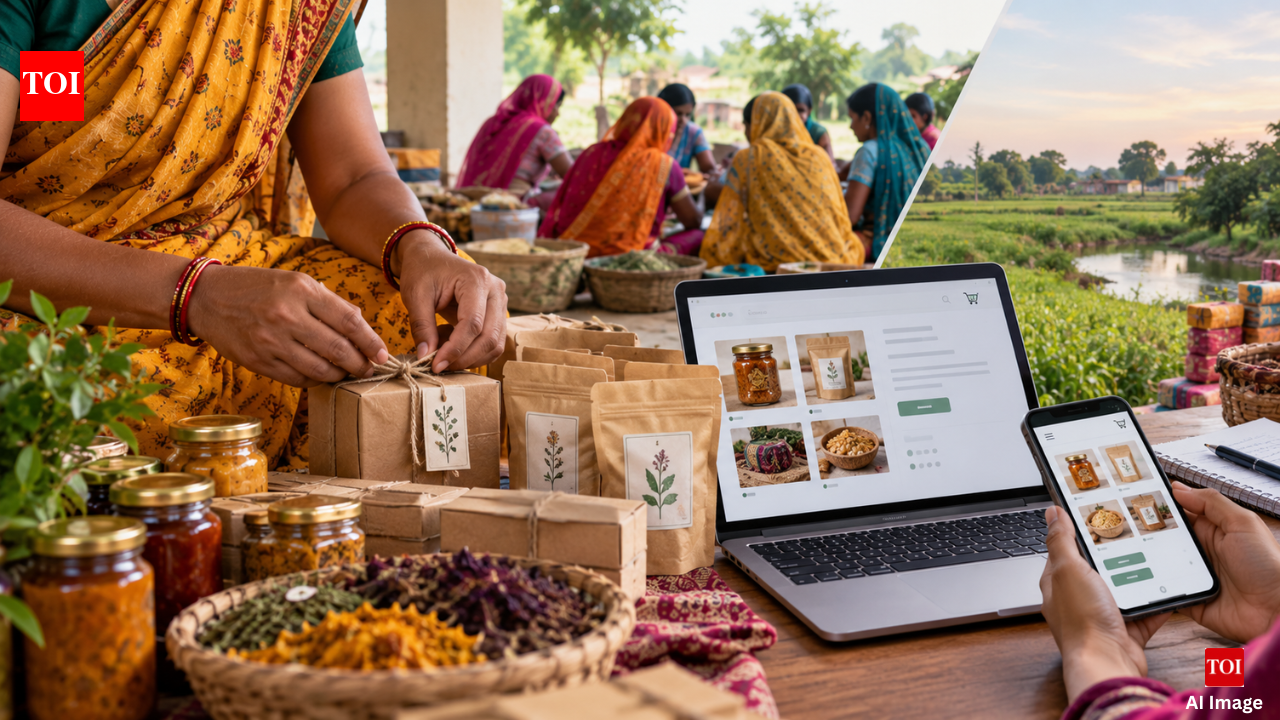
LUCKNOW: The story of rural women in Uttar Pradesh is undergoing a significant transformation. From managing household responsibilities and participating in small livelihood activities, women associated with self-help groups are increasingly emerging as entrepreneurs, producers and business owners. Their products, once largely confined to village markets and local fairs, are now being prepared for wider markets through organised branding, packaging, marketing and digital sales platforms.Under the direction of Chief Minister Yogi Adityanath, the Uttar Pradesh government is strengthening the market ecosystem for products made by self-help groups. More than 3,000 products are being connected with online and offline marketing platforms, while 543 Prerna SARAS Stores have been established across the state to provide structured market access to local products. Through these initiatives, the government is seeking to give rural women the opportunity to move from local production to larger business ventures and, ultimately, compete in national and international markets.Products made by self-help groups can now reach customers through platforms such as the Open Network for Digital Commerce (ONDC), e-SARAS, Prerna Mart, Meesho, Amazon and Flipkart. These platforms are helping bridge the gap between rural producers and consumers beyond their immediate geographical areas. At the same time, Prerna SARAS Stores at the district and block levels are creating physical spaces where local products can be displayed, promoted and sold.The initiative reflects a broader change in the government’s approach to rural livelihoods. Self-help groups are no longer being viewed merely as instruments for savings, credit and financial assistance. They are increasingly being developed as platforms for enterprise development, product creation, employment generation and women-led economic growth.
From self-help groups to a movement of rural entrepreneurship
Self-help groups have become an important foundation of women’s economic empowerment in Uttar Pradesh. By bringing women together into organised collectives, these groups provide members with opportunities to save regularly, access credit, receive training and undertake income-generating activities. Over time, many groups have expanded their work into agriculture, dairy farming, food processing, handicrafts, tailoring, traditional crafts, retail and other small businesses.The Yogi government has placed considerable emphasis on strengthening these groups and connecting them with livelihood opportunities. Through the Uttar Pradesh State Rural Livelihood Mission, women in rural areas are being encouraged to participate in economic activities that can generate sustainable incomes for their families.Today, approximately 1.05 crore women are associated with nearly 9 lakh self-help groups in Uttar Pradesh. This extensive network provides a significant base for women-led economic development in the state. It also creates the possibility of developing local production clusters, strengthening traditional skills and bringing village-based enterprises into organised supply chains.The expansion of self-help groups has helped women develop greater confidence in handling financial transactions, managing small businesses and participating in economic decision-making. For many members, the group serves as a first step towards financial independence. It provides a collective platform through which women can access training, share resources, understand business practices and explore new opportunities.The government’s present focus is to take this foundation further by ensuring that production is accompanied by market access. The objective is not simply to encourage women to make products, but also to help them understand what consumers want, how products should be packaged, how prices should be determined and how goods can be sold beyond the local market.
A new market network for rural products
One of the major challenges faced by rural entrepreneurs is the gap between production and sales. Women may possess traditional skills and produce quality goods, but limited access to markets, inadequate packaging, lack of branding and restricted information about consumer demand often prevent their enterprises from growing.The establishment of 543 Prerna SARAS Stores seeks to address this challenge by creating an organised retail network for products made by self-help groups. These stores provide an opportunity to bring together products from different groups and display them in a more systematic manner.The stores can help rural producers gain visibility, showcase their products to a wider customer base and establish a stronger connection between production centres and consumers. They also provide a platform for promoting products associated with particular districts, regions and local traditions.For consumers, such stores offer access to a range of locally produced goods at organised sales points. For women entrepreneurs, they create an opportunity to move beyond informal sales and develop a more structured approach to business.The Prerna SARAS network is particularly significant because Uttar Pradesh has a diverse rural economy and a rich tradition of local skills. Different districts are known for distinctive agricultural products, food items, handicrafts, textiles and other traditional goods. Organised marketing can help these products acquire a stronger identity and reach customers who may otherwise have little access to them.
Digital platforms open the doors to larger markets
The growth of digital commerce is creating new opportunities for rural women entrepreneurs. A product made in a village no longer needs to depend entirely on customers visiting a local market. Through online platforms, it can be displayed before consumers in other districts, states and, subject to applicable market and delivery arrangements, international markets.Products of self-help groups in Uttar Pradesh can now be promoted and sold through platforms such as ONDC, e-SARAS, Prerna Mart, Meesho, Amazon and Flipkart. These platforms provide different avenues for product discovery, ordering and sales.The Bijnor State Aggregation Center has already begun online marketing activities. The aggregation model brings products made by different groups together on a common platform, helping organise product presentation and sales. This approach can make it easier to showcase a wider range of goods and create a more systematic connection between producers and customers.Aggregation is particularly useful for small producers who may not have the capacity to independently manage online listings, packaging, order processing and customer outreach. By bringing products together, the system can help create greater visibility and facilitate access to larger markets.Digital marketing also enables women’s groups to learn about consumer preferences. Information about the kinds of products customers are searching for, the response to different designs and the demand for particular items can help producers make better business decisions. This can gradually encourage a shift from production based only on local needs to production based on market opportunities.The government’s effort to connect self-help group products with digital platforms therefore represents more than a change in the method of selling. It can help introduce rural women to new forms of business management, customer engagement, branding and market analysis.
Branding and packaging to create product identity
For a small rural enterprise, the quality of a product is important, but the way it is presented can also influence its market potential. Packaging, labelling, product identity and consistent quality can help consumers recognise a product and develop confidence in it.The Yogi government is focusing on strengthening these aspects of self-help group enterprises. The objective is to ensure that women are supported not only in producing goods but also in preparing them for sale in competitive markets.Branding can give products a distinct identity. A product associated with a particular district or community may gain greater recognition when it is presented under a common brand or through an organised marketing network. Packaging can improve product presentation, facilitate transportation and help communicate information about the goods to consumers.For food products, proper packaging and compliance with applicable safety and regulatory requirements are especially important. For handicrafts, textiles and traditional goods, attractive presentation, product descriptions and consistent quality can help improve their appeal in wider markets.This emphasis on branding and packaging can also encourage self-help groups to think of themselves as business entities rather than only production units. Women can begin to consider questions such as the identity of their product, its target customers, the price it can command and the markets in which it can be sold.Mission Director, Rural Livelihood Mission, Arun Kumar, has emphasised that the objective is to provide women in self-help groups with opportunities for entrepreneurship rather than limiting their activities to savings and loans. According to this approach, production, branding, packaging and market linkages must develop together so that rural women can expand their enterprises.
Strengthening the foundations of women’s economic empowerment
The development of market linkages for self-help group products is part of a wider effort to strengthen women’s livelihoods in Uttar Pradesh. The state’s self-help group network has created a large base of women who can participate in different economic activities. Through collective action, women can pool savings, access financial services and undertake activities that may be difficult to manage individually.Group-based work can also support the sharing of knowledge, resources and responsibilities.The government’s emphasis on livelihood diversification has encouraged women to explore a variety of sectors. Dairy farming, food processing, agricultural activities, handicrafts, tailoring, small manufacturing and service-based enterprises can provide opportunities suited to local resources and skills.The women’s dairy model is one example of efforts to strengthen rural livelihoods. Approximately 4 lakh women in 31 districts are associated with this initiative, which has been linked to milk production and collection activities. Such models demonstrate how organised participation can help women become part of larger economic systems.Similarly, the promotion of Lakhpati Didis seeks to encourage women associated with self-help groups to achieve higher annual household incomes through livelihood activities and enterprise development. More than 73,000 Lakhpati Didis have been reported in the state. These efforts reflect the broader objective of enabling women to move from subsistence-level activities towards stronger and more sustainable sources of income.The expansion of markets for self-help group products can complement these livelihood initiatives. When women have better access to customers, their production activities can become more viable. Higher sales can create opportunities for reinvestment, improved equipment, better packaging and expansion of business operations.
Local skills, traditional products and the rural economy
Uttar Pradesh’s villages possess a wide range of traditional skills and local production capabilities. These include food preparation, handicrafts, weaving, embroidery, agricultural processing and other activities passed down through generations.However, traditional skills alone do not always guarantee commercial success. Producers need access to markets, information about consumer preferences, reliable supply chains and opportunities to improve the quality of their products.The Prerna SARAS network and digital marketing platforms can help address some of these requirements. They provide avenues through which local products can be introduced to customers outside their immediate areas.Products identified with particular districts or regions may benefit from organised promotion. When such goods are brought together, their distinctive characteristics can be highlighted and their market potential explored.The approach also aligns with the broader idea of promoting local production and encouraging economic activity within rural communities. As sales increase, the benefits can extend beyond individual women to other members of the production chain, including suppliers of raw materials, transport providers, packaging workers and other service providers.In this way, the development of women-led enterprises can contribute to the strengthening of the rural economy.
From producers to businesswomen
The most important aspect of the initiative is the change in the role of women within the local economy. A woman who previously produced goods primarily for household use or limited local sales may now have an opportunity to manage a more organised enterprise.Market access can encourage women to develop skills in pricing, inventory management, customer service, product design and financial planning. It can also create opportunities to employ other women and expand production.The process of becoming an entrepreneur is not limited to earning income. It can also strengthen decision-making abilities, confidence and participation in household and community affairs.For many women, the self-help group is the starting point. The group provides a collective environment in which members can learn from one another and take their first steps towards enterprise development. Market linkages can then help them translate these activities into more sustainable businesses.The government’s emphasis on branding, sales and digital marketing is aimed at supporting this transition. By helping women understand that the market is as important as production, the initiative seeks to create a more complete ecosystem for rural entrepreneurship.
The road from local to global
The expansion of self-help group products through 543 Prerna SARAS Stores and online and offline marketing platforms for more than 3,000 products marks an important step in the development of women-led enterprises in Uttar Pradesh.The initiative creates a connection between village production centres, organised retail outlets and digital marketplaces. It also offers an opportunity to build stronger product identities and promote local goods beyond their traditional markets.For the Yogi government, the broader objective is to make rural women active participants in the state’s economic growth. By strengthening self-help groups, supporting livelihood activities and improving access to markets, the government is seeking to create opportunities for women to become financially independent and develop sustainable enterprises.The success of this effort will depend on continued attention to product quality, reliable supply, competitive pricing, timely delivery, packaging, digital literacy and customer satisfaction. With these elements in place, rural producers can gain a stronger foothold in the marketplace.The journey of ‘UP Ki Didi’ is thus moving beyond the boundaries of the village. From self-help groups to organised stores, and from local sales to digital platforms, rural women are being given new opportunities to build businesses around their skills and products.With branding, market access and digital commerce becoming important parts of their entrepreneurial journey, the products of Uttar Pradesh’s rural women are poised to travel farther—from local markets to national customers and towards the possibilities of global business.
