



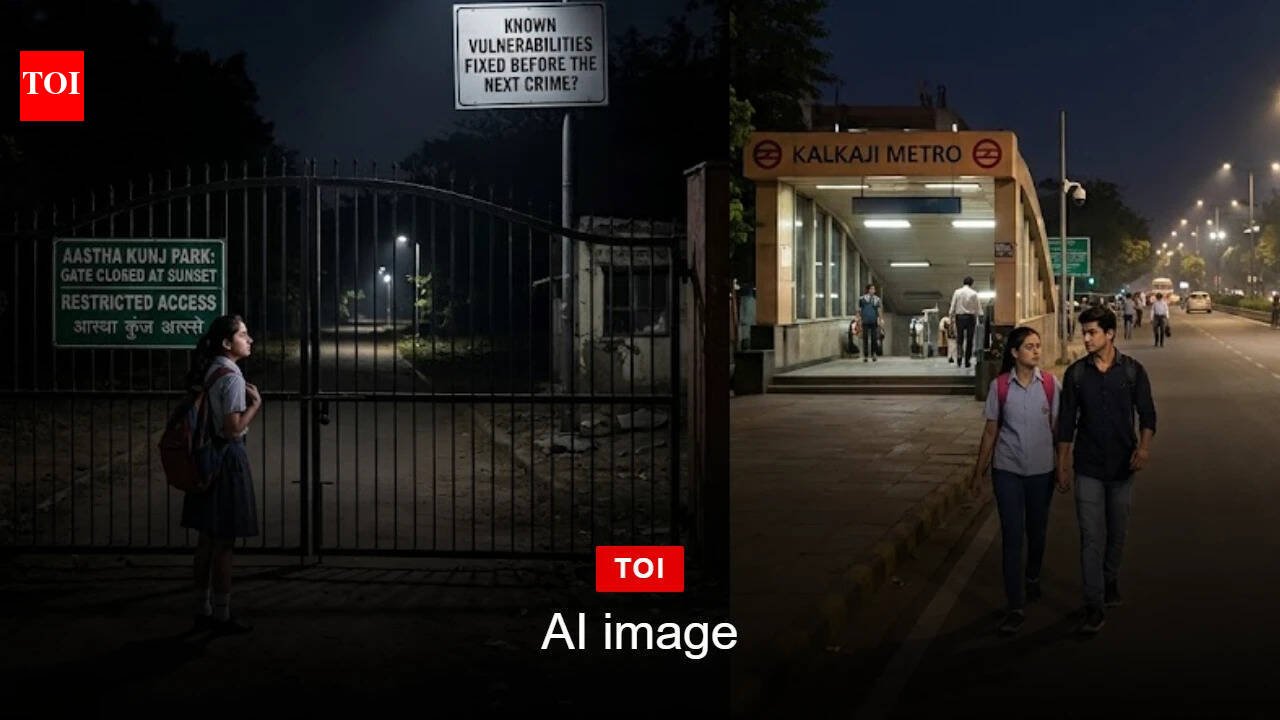
When a public space becomes unsafe, one of the quickest responses from authorities is often to make it less accessible.A woman is assaulted while travelling at night, and the answer is to restrict when she can work. A student is raped after leaving campus, and the response is to tell students not to venture out. Delivery agents are barred from hostel buildings. Visitors face tighter entry rules. A park becomes the site of a gang rape, and access after sunset is restricted.The measures are generally presented as safety precautions. Some clearly have a preventive logic. But they raise a larger question: When a crime exposes a failure in security, is the solution to make the space safer — or to reduce who can use it and when?Delhi’s latest response to the alleged gang rape of a 17-year-old girl at Aastha Kunj Park brings that question into sharp focus.
From parks to campuses: How safety measures after rape can end up restricting access
A park with 29 access points — and dark, deserted stretches
The girl, a Class XI student from Faridabad, had gone to Aastha Kunj Park with a male friend after visiting Kalkaji Temple on Monday evening. Police said three men posing as policemen approached the teenagers, threatened them and took the girl to a secluded part of the 143-acre park, where she was allegedly gang-raped.The crime took place between around 7.30pm and 8pm.But TOI’s reporting from the park after the incident found a security landscape in which a guarded entrance at one end could be followed by an unmanned gate or a dark stretch at another. A guardpost just metres from where the alleged assault took place had no guard.A nearby tea seller told TOI that there had never been a security guard there and that thieves had stripped the guardpost bare.The park is officially open from 4am to 9pm, but a police officer told TOI that its gates remained open through the night because the park doubles as a shortcut for people travelling between the metro station, Garhi village and Okhla mandi. Closing the gates, he said, could simply lead to people jumping over the barriers.The problem was not simply that people were entering after dark.Regular visitors told TOI about suspected drug users, harassment and people recording couples on their phones. Some residents had stopped using the park as a shortcut after dark because they feared robbery or harassment.And police found another important detail: The three accused were familiar with the park. They had played cricket there and knew its layout and secluded stretches.
The first response: Control the gates
Three days after the incident, the DDA announced a set of measures for all its parks.The Lieutenant Governor directed a comprehensive safety audit of Delhi’s parks within a week. In the interim, DDA ordered increased evening vigilance, restricted access after sunset, CCTV cameras at entry gates and additional security personnel at vulnerable entry points and poorly lit locations.It also ordered identification of dark spots and installation of additional lighting and floodlights where required.Parks with multiple gates would adopt controlled entry after sunset, with access restricted through selected gates before closing time. Visitors would be encouraged to use well-lit pathways. Safety boards carrying park rules and emergency contacts were also to be installed.There is a clear logic to some of these measures. Fewer open gates can make a sprawling park easier to monitor. Better lighting and CCTV can reduce blind spots. More guards can increase visibility.But Aastha Kunj also raises a more uncomfortable question: Why did so many of these vulnerabilities exist in a park where security concerns had already been raised?TOI found that police had no working CCTV footage from the park’s entrance at the time of the crime, while the secluded stretches where the alleged assault occurred had little or no lighting. Investigators instead had to work from the survivor’s descriptions of the accused — their clothes, nicknames, physical features and other details.Police teams eventually traced the accused through local inquiries, CCTV from outside the park, phone-location data and other evidence.
The moving bus: Remove the curtains
The same question has emerged in Delhi’s buses.On August 4, a 16-year-old girl who had become stranded near Greater Noida allegedly boarded a sleeper bus after the driver and conductor told her it was headed towards her destination. Police alleged that the two men sexually assaulted her inside the moving bus and later abandoned her near Kashmere Gate.The bus had curtains covering its windows, meaning that what was happening inside could not be seen from the road. The vehicle was also reportedly being taken for repairs rather than operating on a passenger route. Police later seized the bus and collected CCTV footage from the route.Days later, Delhi’s Transport Department tightened safety norms.Curtains and films on bus glass were prohibited. Operators were ordered to ensure functional panic buttons and Vehicle Location Tracking Devices, stop only at authorised and safe locations, park buses at secure and adequately lit locations, verify drivers and conductors, and sensitise crew about women’s safety.Here, too, removing the curtain is a logical visibility measure.But the case also exposed other questions: A private bus that was not operating a normal passenger route had picked up a stranded teenager; the vehicle was being taken for repairs; and officials themselves have acknowledged that verification requirements for private bus staff are not always effectively enforced.So the curtain may remove one blind spot. It does not, by itself, answer the larger question of how an unauthorised or improperly operated vehicle should be prevented from picking up vulnerable passengers.
Kolkata: Don’t leave campus
The pattern has appeared more recently inside educational institutions.In July 2025, after a rape allegation involving a second-year student at a Kolkata management institute, the institute temporarily restricted guest entry to its campus and hostel and asked students not to venture outside the campus for a few days.It also moved all deliveries to the gate, changed entry and exit arrangements and asked students to avoid interaction with external stakeholders while the investigation was under way.The irony was that the institute already had a formal guest-entry system. Guests had to be emailed in advance, sign at the main gate and hostel entrance, and record their departure.What happens when an existing security system exists on paper but still fails to prevent a crime?
Nagpur: Delivery agents stop at the gate
In October 2025, after the gang rape and assault of a second-year MBBS student in West Bengal, Nagpur’s Mayo hospital banned food-delivery agents from entering hostel buildings.The regular tiffin provider was to be accompanied by a guard while delivering food to hostel rooms. GMCH, meanwhile, said it had already prohibited entry into hostel buildings and required deliveries to be made at the guard post. Women doctors were accompanied by women guards when moving between hostels and wards at night.Again, there were several layers to the response: Security guards, CCTV, lighting and restricted access.But the visible behavioural change was simple: Delivery worker no longer crosses the gate.
Bhopal, 2017: The 8pm solution
After a 19-year-old woman was allegedly gang-raped while returning from UPSC coaching near Habibganj station in Bhopal, the government decided that coaching institutes would have to wind up by 8pm.The government also proposed an SOS and location-tracking app for students. But the minister went further, saying evening coaching sessions could be restricted to boys rather than both boys and girls.The location of the crime made the restriction particularly striking: The assault occurred close to an RPF post and the railway station.Students quoted at the time questioned whether an 8pm cut-off could prevent crimes that can happen even during daylight.Again, a safety problem produced a change in when women and girls could use a service.
Gurgaon, 2012: When the victim’s clock became the problem
The instinct to restrict movement after sexual violence is not new.In March 2012, after a 23-year-old woman was abducted and gang-raped in Gurgaon, the district administration told malls, commercial establishments and pubs that women employees could not work beyond 8pm without permission from the labour department.For women permitted to work later, employers had to provide transport home and maintain records of the vehicle and driver.The order also included genuine security measures: CCTV cameras at pick-up points, visitor records at pubs, 360-degree CCTV surveillance, verification of bouncers and increased police vigilance against drunken driving.But the central restriction was on women’s working hours.The crime had happened to a woman. The administrative response therefore partly changed the conditions under which other women could work.That is the recurring pattern worth examining: When a woman is unsafe in a public space, the rules governing other women’s use of that space can change almost immediately.
What happens outside the gate?
That question matters because women’s vulnerability rarely begins or ends at the entrance of a park, college or hostel.After the Aastha Kunj incident, women students from Delhi colleges told TOI about dark approach roads, harassment and anxiety about getting home.A Gargi College student who had to reach college at 5am for NCC activities said there were not enough lights outside the college gate. A PCR vehicle had been stationed nearby for a few days after a harassment incident but was no longer there.A Bhagini Nivedita College student said she sometimes felt uneasy waiting for a DTC bus after dark because buses could be late or drivers sometimes failed to stop.The point is crucial: The safety of a public institution cannot be measured only inside its boundary wall.
Restriction versus prevention
None of this means every access restriction is wrong.A park with multiple entrances may genuinely be easier to secure if fewer gates are open at night. A hostel may reasonably prevent delivery agents from entering residential buildings. A bus without curtains is easier for people outside to monitor. Visitor registers can help investigators establish who entered a campus.The problem is when restriction becomes the most visible response while the underlying environment remains unchanged.The Aastha Kunj case shows why.The park’s official response now includes controlled gates, CCTV, more guards and better lighting. But TOI’s ground reporting found a guardpost without a guard, large unlit stretches, uncertainty over closing times and people continuing to enter through or over boundaries.At other parks, the same pattern appears in different forms: a well-lit entrance followed by dark trails; guards at one point but no visible security deeper inside; official closing times that don’t match what visitors believe; and boundaries that people can climb over.The issue, then, is not simply whether authorities close the gate.It is whether they can make the space behind the gate safe.
The recurring administrative reflex
Across the cases, the pattern can be reduced to a simple sequence:In Bhopal, coaching centres were told to close by 8pm.In Kolkata, students were told not to venture outside campus and guests were restricted.In Nagpur, delivery workers were stopped at hostel gates.In Delhi, access to parks after sunset is being controlled.In buses, curtains — which concealed what happened inside — have been prohibited.Each measure has its own justification. They are not identical, and several are accompanied by legitimate investments in surveillance, lighting, transport safety or policing.But taken together, they raise a persistent question:When authorities respond to a dangerous environment by limiting people’s access to it, who is ultimately being asked to change — the person at risk, or the environment putting that person at risk?That may be the more important test of any safety response.A woman should not become safer merely because she is told not to work after 8pm.A student should not become safer merely because she is told not to leave campus.A park should not become safer merely because fewer people are allowed inside it after sunset.And a bus should not become safer merely because its curtains have been removed.The real measure is what happens next: Are the dark spots illuminated? Are cameras working? Are guards actually present? Are unsafe routes addressed? Are vehicles and their crews properly verified? Are known vulnerabilities fixed before the next crime?Because a public space is not made safe by making it empty.It is made safe when people can use it without having to calculate whether entering it is worth the risk.
