



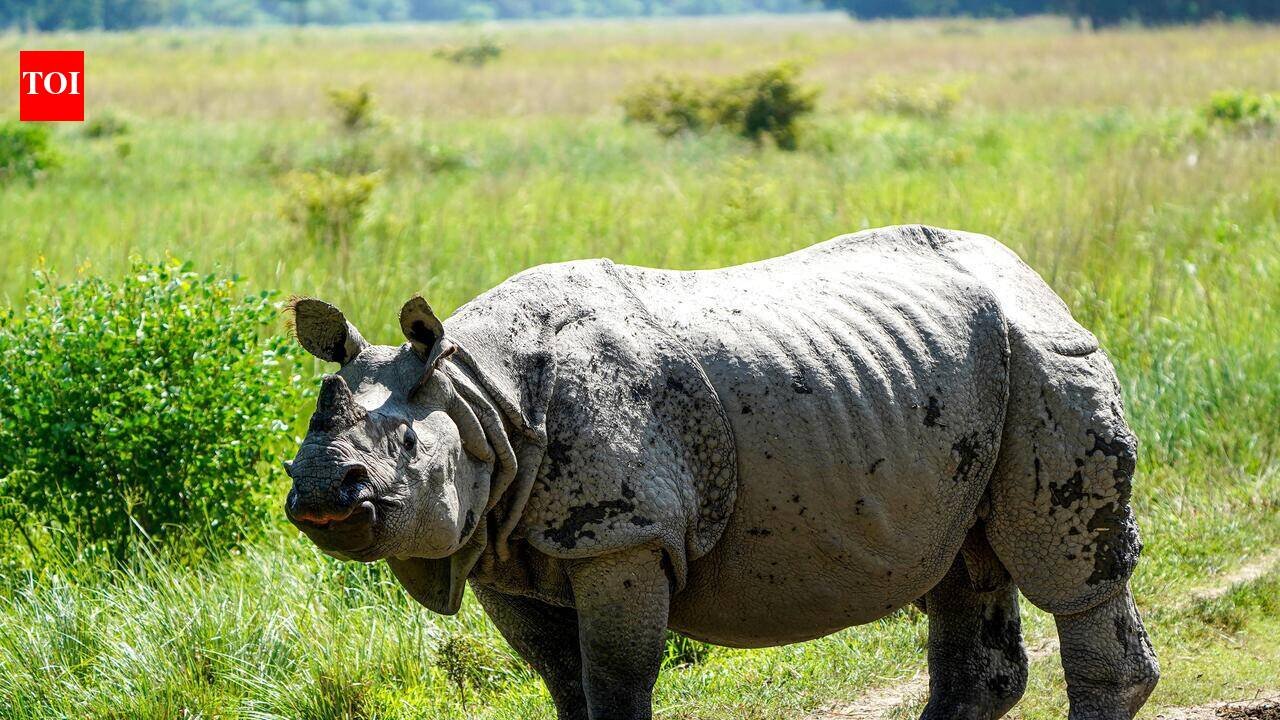
Guwahati: Assam has emerged as a global stronghold for the greater one-horned rhinoceros, holding nearly 80% of the world’s population of the species even as three of the five surviving rhino species remain critically endangered.On World Rhino Day on Tuesday, the global call goes out to all the five species alive. Three species — the black rhino, Sumatran rhino and Javan rhino — are critically endangered on the IUCN list, genuinely teetering on the edge of extinction. The greater one-horned rhino is vulnerable (recovering), and the white rhino is near threatened, the most stable of the five.Prime Minister Narendra Modi on Tuesday praised all those at the forefront of protection of the greater one-horned rhinoceros and said “Kaziranga’s efforts to end rhino poaching have been extensively appreciated.” He announced the initiation of Project Rhino — a new conservation initiative aimed at providing financial and technical support to states that harbour the greater one-horned rhinoceros.Modi said rhinos had either returned or were being well protected in parts of Bihar and West Bengal, while the successful reintroduction of rhinos in Dudhwa, Uttar Pradesh, was “creating history”. He said these developments reflected sustained efforts by people and wildlife managers in the rhino-range states.The announcement comes against the backdrop of a significant recovery in India’s greater one-horned rhino population.The global population of greater one-horned rhinoceros has reached an estimated 4,075, with 3,323 in India, Assam holding nearly 80% of them, and the rest — 752 — in Nepal. Kaziranga National Park alone holds more than 2,600 of the global population.Chief minister Himanta Biswa Sarma wrote on X, “Assam is proud to host nearly 80% of the world’s rhino population, and we remain committed to their protection, safeguarding them from encroachment, maintaining zero poaching and continuously enhancing their habitat to ensure a thriving environment for their survival.”The International Rhino Foundation’s “State of the Rhino Report 2026” acknowledged that both Assam and Nepal reported zero known poaching of greater one-horned rhinos in 2025. The report calls it a milestone that demonstrates the powerful effects of integrated law enforcement, frontline vigilance and community-centred conservation.The report described the scale of the turnaround as “striking”. In the mid-2010s, Assam recorded nearly 30 poached rhinos in a single year, but through closer collaboration between law enforcement agencies and upgraded surveillance technology, the numbers have since fallen sharply. Assam achieved zero known rhino poaching in 2022 — its first such year since the 1970s — and repeated that milestone again in 2025. Within Manas National Park specifically, zero poaching of rhinos or tigers has now been recorded for three consecutive years.Kaziranga’s success has not stayed within its own boundaries. Rhinos translocated from the park have helped repopulate Manas National Park, where the species had nearly vanished, as well as Orang National Park.
