



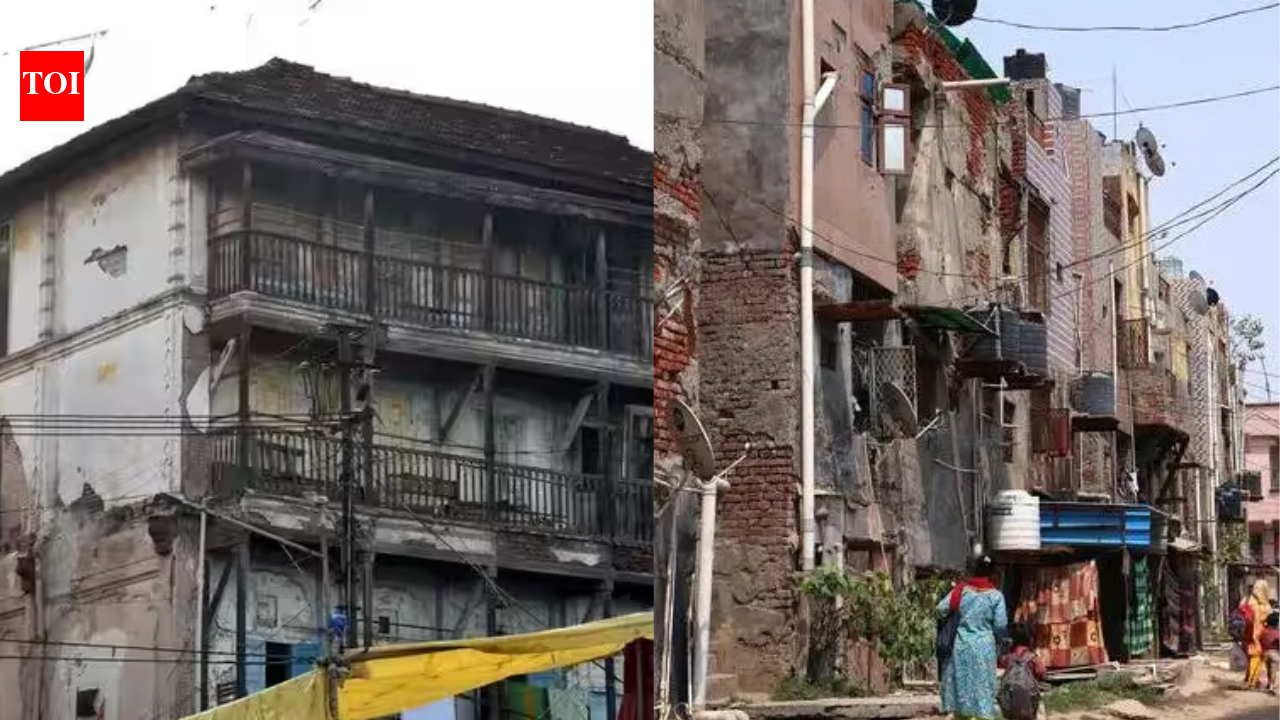
NEW DELHI: The collapse of a five-storey paying guest accommodation in Delhi’s Satya Niketan killing seven people has once again brought the spotlight back on a danger that is lurking in plain sight in India’s fast growing cities.The tragedy had not been of one building, or one locality.All over India, old buildings, illegal additions, bad maintenance and changing uses of residential properties are creating a widening gap between where people live and how safely those buildings are being used.
Warning signs
Unsafe building warning
The crackdown in Delhi post-collapse exposes the scale of the problem. Between June 1 and September 9, the Municipal Corporation of Delhi took action on 1,053 properties for demolition, sealed 491 properties, and issued 2,316 show-cause notices and 757 notices for demolition.The civic body also surveyed 1,252 PG buildings between September 7 and 9, demonstrating the scale of the accommodation and enforcement challenge in the capital.But the worry is not confined to the borders of Delhi. More than 150 buildings in Ghaziabad have been declared unsafe or dangerous, compared to 26 in a 2018 survey and 102 in 2020.More than 500 people are still living in a dilapidated colony at Tulsi Niketan where there are 220 LIG flats, 2,004 EWS flats and 60 shops. The numbers demonstrate just how quickly a known structural problem can become a long-term habitation issue.
Noida reveals the cost of acting too late
Delhi’s Satya Niketan building collapse
Noida also throws up an uncomfortable question: what do you do when the authorities know that buildings are unsafe but people continue to live in them? After Satya Niketan fell, the Noida Authority started serving notices to vacate 56 buildings which it had declared years ago as dilapidated and unsafe.Following the Shahberi collapse in a 2018 survey, the authority identified 1,757 unauthorized structures including 56 dilapidated buildings.Evacuation alone is not the complete answer to safety for residents. Families need alternative accommodation, rehabilitation and a clear timeline for repair or redevelopment. This is all the more important in the case of older neighborhoods and economically weaker settlements, where residents have nowhere else to go.A building may stay occupied not because it is safe but because it is financially and practically impossible to leave.
Problem spreading to older urban housing
Problem spreading across cities
Other cities are under similar threats. The 2025 survey in Chennai identified 337 dilapidated structures including 130 buildings of the Greater Chennai Corporation.The civic body has now planned inspections ahead of the northeast monsoon and is seeking help from IIT-Madras, Anna University or PWD to check structural safety.Earlier this year, the civic body had declared over 500 buildings in Navi Mumbai as unsafe for living. As per the relevant Maharashtra provisions, buildings over 30 years old need to get structural audits done.Civic action in Mumbai itself has also tackled unauthorized alterations in high-rises, pointing to another facet of the problem: even relatively new buildings can pose safety risks if sanctioned plans are changed or common areas are repurposed without proper clearance.
Don’t wait for the next collapse
Don’t wait for a collapse
The bigger safety issue is stark in its size. The Times of India reported recently, citing government data, that nearly 33,000 people died in India in building collapses, fires and falls into pits and manholes between 2020 and 2024.The majority of these deaths occurred in urban areas, reflecting the effects of poor maintenance, enforcement and compliance of safety regulations.So the real challenge for the Indian cities is not only to identify unsafe buildings post-disaster. It is creating a system where structural audits are done on a regular basis, changes in building use are detected early, illegal construction is stopped before it becomes permanent and redevelopment does not get stuck for years.The collapse of Satya Niketan should not be viewed as an isolated incident but as a warning signal that the next urban disaster is already present in a street near us.
