



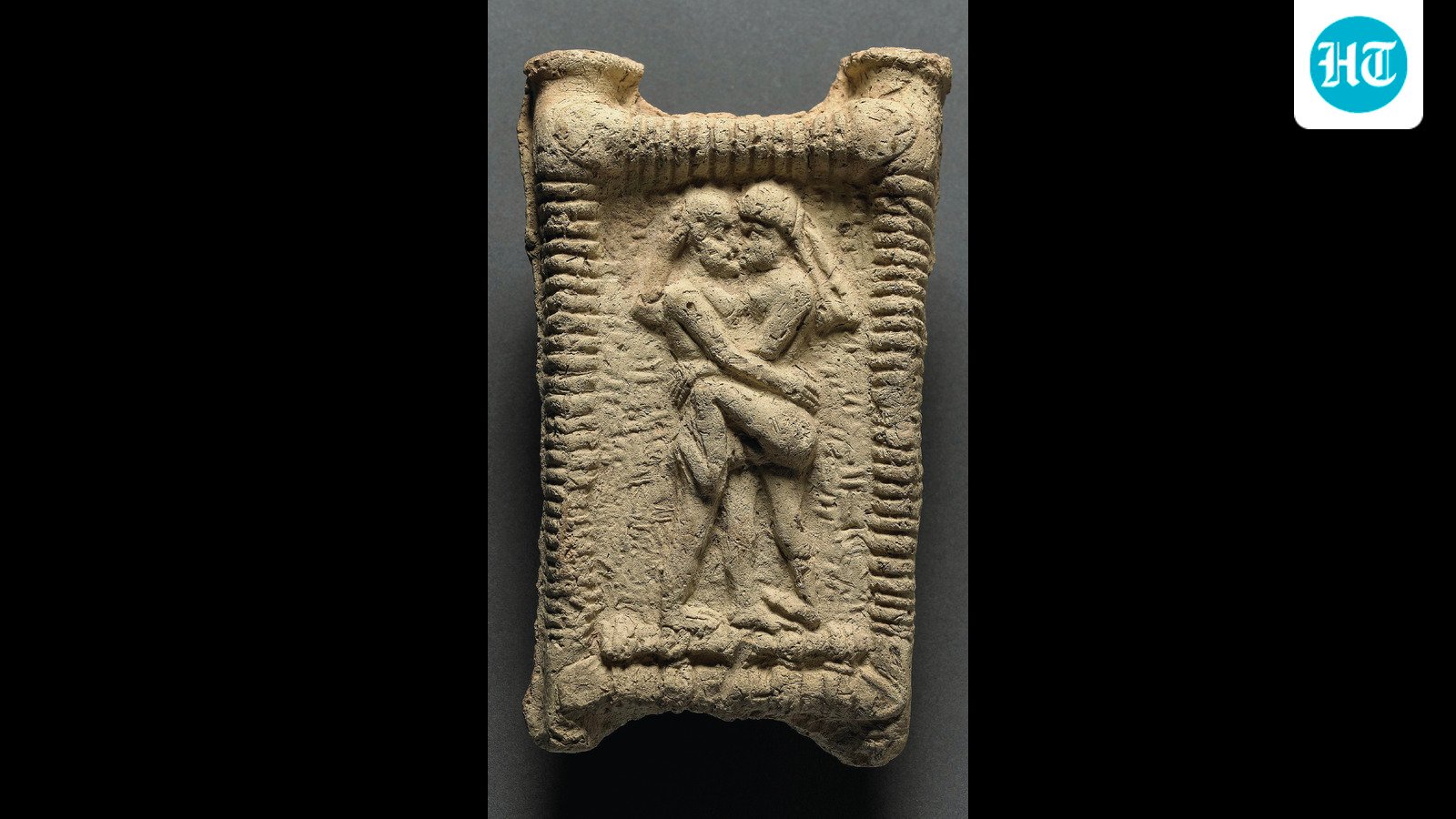
The oldest known reference to a kiss comes via a clay model from Mesopotamia, dated to 1800 BCE. It takes the form of an image of a couple, on a cuneiform clay tablet, in a story about two Mesopotamian deities. The Rig Veda, dated to at least 1500 BCE, describes the meeting of the lips too. By the 1st century CE, it had become a rampant act that the Roman Emperor Tiberius (14-37 CE) tried to ban at public functions, to control the spread of infections such as herpes. By the 3rd century CE, the Kama Sutra was dedicating entire chapters to the art of kissing.
.
The concept of fraternity,one of the three core values of the French Revolution, was often represented by this gesture. In the painting above by Rene Duchemin, titled Fraternity (1794), a Black child and a White child kiss as a symbol of the equality envisioned within the French Empire after the abolition of slavery. Behind the children is a woman, the personification of Fraternity, wraps them in her cloak. “In one of her hands she holds two hearts; as with other kisses, the fraternal kiss unifies two spirits and makes them one,” writes historian Katie Barclay, professor at Macquarie University in Australia, in her book, The Kiss: A History of Passion and Power (2026).
.
The kiss has served as a powerful tool of rebellion. Kiss-ins, associated with the gay civil-rights movement, became popular in the 1970s. In response to discrimination, queer demonstrators held hands, embraced and kissed, in what were then punishable acts. Kissing friends and lovers with HIV served as a symbol of inclusion, underlining the ways in which the virus cannot be spread. (Above) Scenes at a marriage equality rally in front of the US Supreme Court in Washington DC in 2015 .
.
In Europe and the US, censorship norms in the early 1900s meant that the kiss was one of the few forms of sexual activity allowed on screen. But rules and conventions governed how this gesture was portrayed too. All that changed with this historic kiss (above) between Captain Kirk (William Shatner) and Lieutenant Uhura (Nichelle Nichols) in a Season 3 episode of Star Trek, in 1968. An interracial kiss was thought impossible on mainstream American television, until this. The episode aired at the height of the US civil rights movement.
.
Same-sex kisses tended to be used to depict intense fraternal love, as in this battlefield scene from the 1927 silent film, Wings. Fighter pilot David Armstrong (Richard Arlen) is fatally injured. As he lies dying, pilot Jack Powell (Charles Rogers) cradles his head and kisses him. Though not a romantic gesture, it is considered the first same-sex kiss in Hollywood.
An early historic kiss in Indian cinema showed a princess resuscitating and then embracing her lover, after he is bitten by a snake, in the 1933 film Karma. The actors were real-life couple Devika Rani and Himanshu Rai. As censorship norms changed, kissing would, in later years, be replaced by images of flowers touching, a pair of lovebirds, or a smouldering fire. All that changed in the age of streaming platforms. Today, the kiss merely signals a beginning.
