



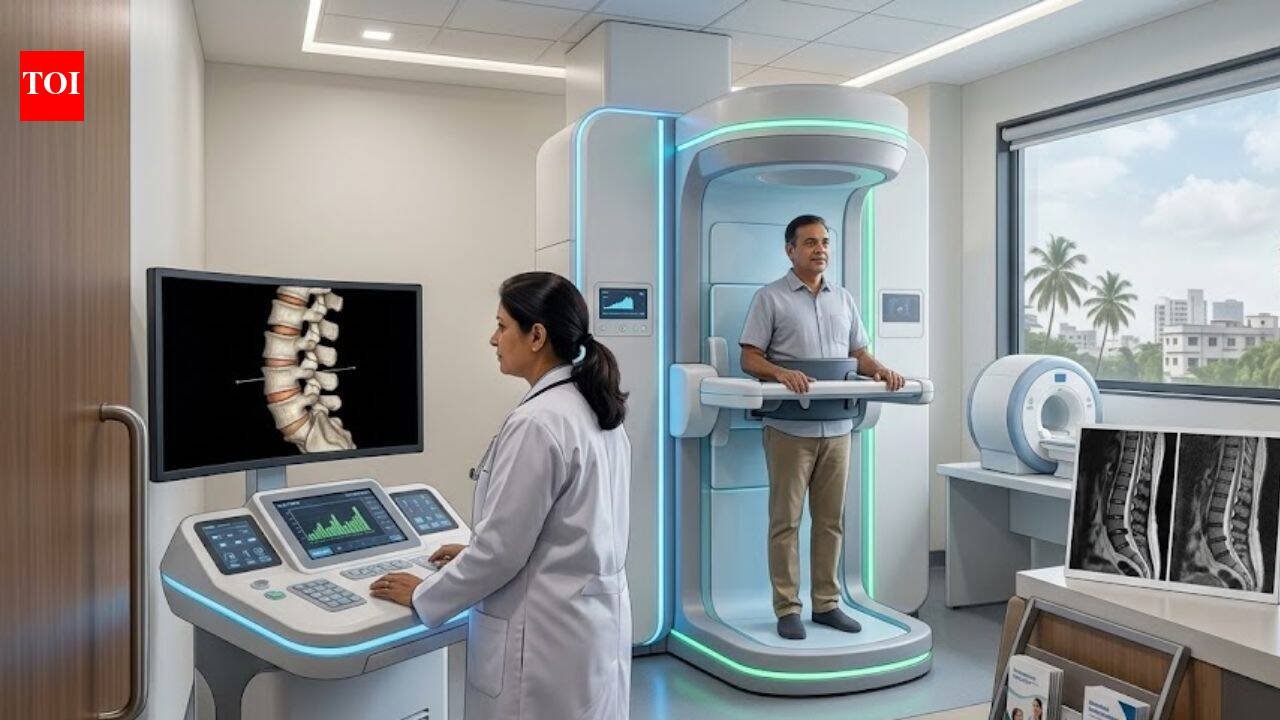
MUMBAI: Rajesh had been living with back pain for over a year but kept postponing an MRI due to fear of claustrophobia. On Thursday, the Marol resident underwent a standing MRI scan in south Mumbai after seeing a social media post by actor Sharat Saxena about the technology.“I had asked my orthopaedic doctor to treat me based on X-rays, but after a year of exercises and medicines, the pain hasn’t reduced. An MRI became necessary,” said Rajesh (name changed). He found the standing MRI easy, with less noise and without having to be “moved into a tube”.
This technology provides valuable weight-bearing information for diagnosing back pain issues.
Radiologist Dr Pallavi Nagare said standing MRI can provide additional information under weight-bearing conditions, particularly in back pain. Spine surgeon Dr Arvind Kulkarni, who performed lumbar spine surgery on Saxena at Bombay Hospital, New Marine Lines, said, “In certain cases, particularly when symptoms appear on standing or movement, a weight-bearing MRI can add useful additional information.” Having the option alongside standard imaging, he said, “gives doctors more ways to support treatment decisions, including when weighing conservative care against surgery”.Rahil Shah of N M Centre said its standing MRI, opened three months ago following feedback from orthopaedic surgeons, was the first of its kind in Mumbai. Around 20 open MRI machines are available in India, he said.But senior radiologist Dr Bhavin Jhankaria said image resolution remains a key limitation of open MRI. Conventional 1.5T and 3T (where T stands for tesla, the unit used to measure the strength of the magnetic field in an MRI scanner) scanners remain the standard because they provide better resolution. They also offer lumbar axial-loading options to simulate weight-bearing, he said. “Standing or open MRI would be recommended for people with claustrophobia or anxiety,” Jhankaria said.Another radiologist said open MRI machines generally operate at 0.3T-0.5T and are much cheaper than conventional scanners. “If they provided better images, there would be more open MRIs across the world,” he said.
