



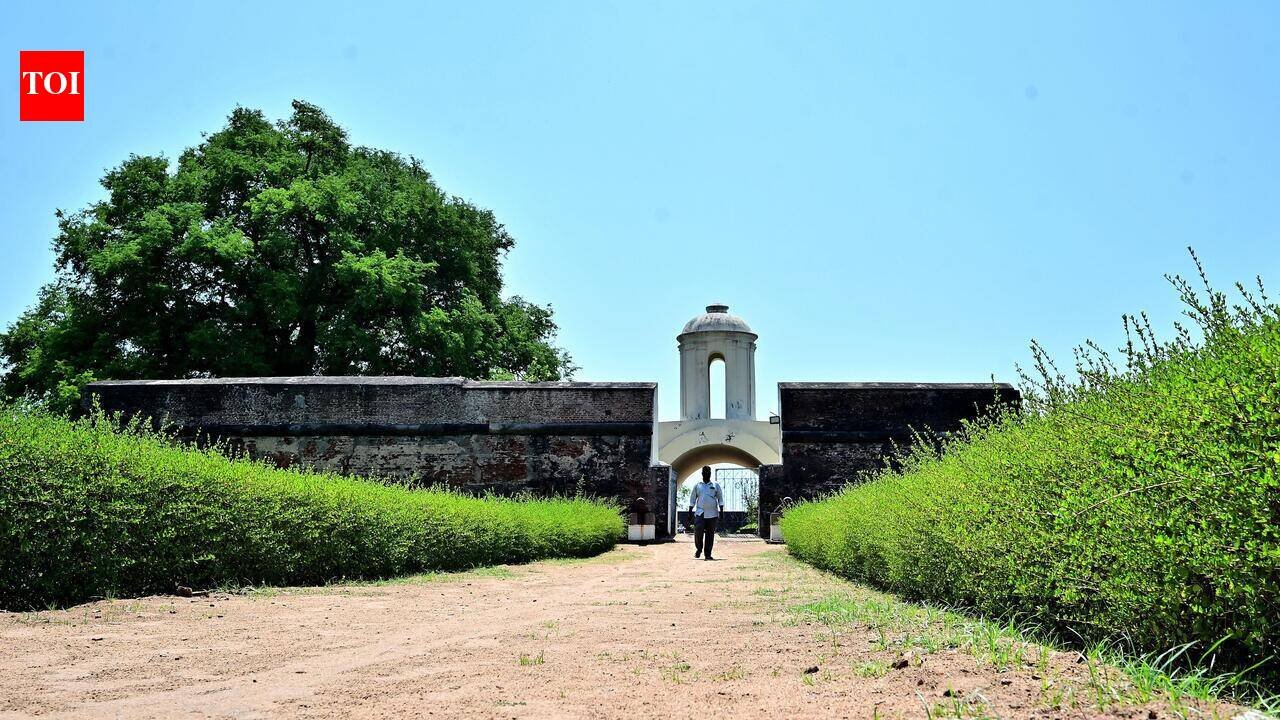
Chennai: On a Friday afternoon, fishermen were seen sifting through their day’s catch on a small fibre boat against the backdrop of a 17th century Dutch fort at Sadras (Sadurangapattinam) 70km south of Chennai. They were oblivious to the fact that about 244 years ago, the fort witnessed a sea battle between British and French fleets. Now, Archaeological Survey of India (ASI) has decided to re-excavate and preserve the colonial-era monument, about 2km from the Madras Atomic Power Station at Kalpakkam.
Remains of a warehouse
“We plan to excavate the mound inside the fort and put up displays with information about the structures. We are also planning to create facilities for visitors, such as toilets and drinking water,” said Sushanta Kumar Kar, superintending archaeologist, Chennai Circle, ASI.In a previous excavation, in 2002-03, ASI unearthed Gouda smoking pipes, arrack glass jars and gaming tiles from the fort. The planned excavation is expected to provide more insights into how Dutch traders, soldiers and locals lived in those times.
Dutch plan of the fort of Sadras | S Jeyaseela Stephen
Occupying around 10 acres, the fort had a trading settlement and played a key role in Dutch East India Company’s trade activities in the 17th and 18th centuries, when they exported high quality muslin and other cloths to other countries. It was also famous for exporting rice, bricks and edible oil.
A tunnel leading to secret chambers located below the southwest bastion where gunpowder and ammunition were stored
A tunnel leading to secret chambers located below the southwest bastion where gunpowder and ammunition were stored
“A Dutch official, Hendrik Adriaan Van Reede, who visited Sadras in 1688, praised its screen paintings for the fine designs and brightness. Several varieties of cloths were exported by the Dutch from the Coromandel coast to European countries, including Sadras,” said professor S Jeyaseela Stephen, former director, Institute for Indo-European Studies (Institut Pour Etudes Indo-Europeens) in France.“The native settlement near the Dutch fort was not large, except where weavers and merchants lived. The Dutch East India Company (VOC) had stationed troops inside the fort when they were moving from Sadurangapattinam to Pulicat in the north and to Nagapattinam in the south, during military requirements. Thus the place became a garrison town under the Dutch,” he said.
Dutch cemetery inside the fort which has round 20 graves of Dutch men and women who lived in the fort
Today, there is no weavers’ community living in Sadras. “There are, however, many weavers residing at Thirukazhukundram which is some 15km from Sadras,” said Anand, an engineer from Sadras.The Sadras fort has several structures still standing, including warehouses, secret tunnels, a Dutch cemetery, prison cells, a colonial-era well and a structure from which people could mount elephants. The fort now has few visitors, except for a few foreign visitors to the cemetery or school students on field trips.
A prison cell inside the fort
