



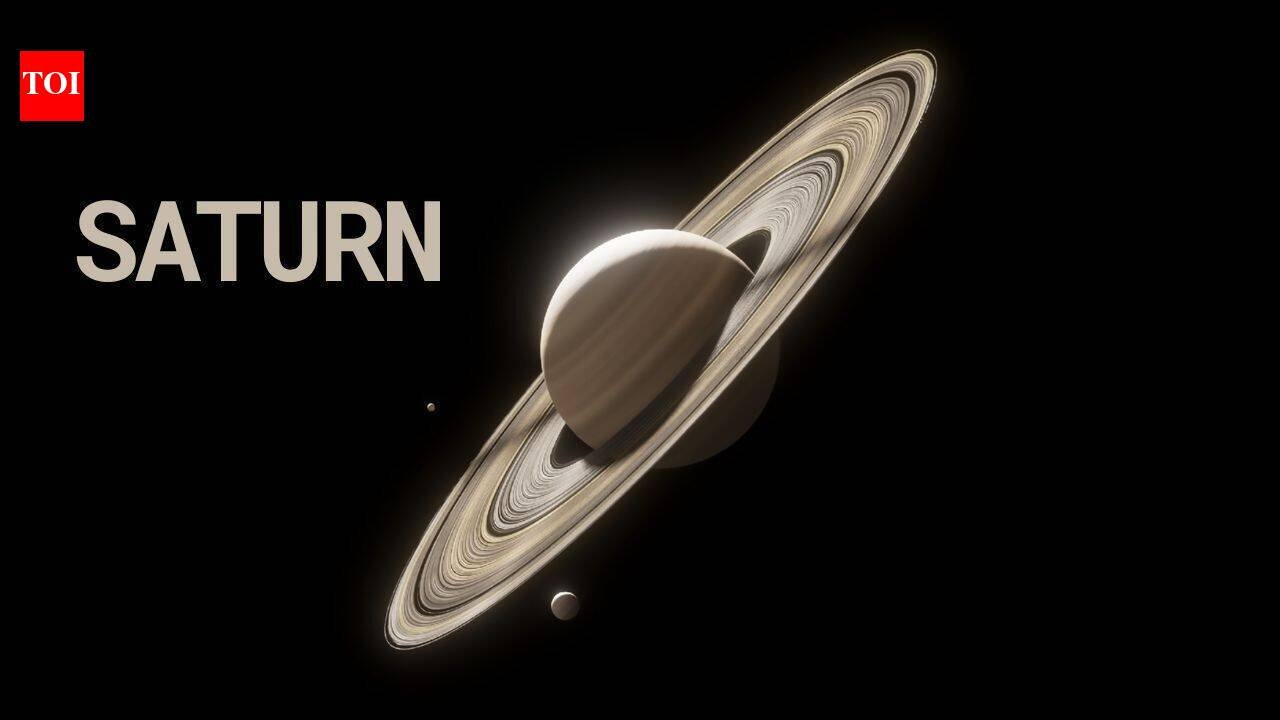
Saturn is known for its strange, six-sided hexagon swirling around its north pole. Astronomers have detected an enormous 10-sided pattern encircling Saturn’s southern skies, a striking feature known as a decagon. The shape, defined by its 10 corners and elongated sides, stretches across Saturn’s southern mid-latitudes, where a powerful jet stream circles the planet.Saturn’s poles are not always visible from Earth because of the planet’s axial tilt. As Saturn moves through its long seasons, its poles alternately tilt toward and away from Earth. For more than a decade, the planet’s southern regions were tilted away from us, making them difficult to observe even with powerful telescopes.That changed as Saturn’s southern pole gradually tilted back toward Earth. Between 2023 and 2025, NASA’s Hubble Space Telescope and large ground-based observatories were able to obtain clearer views of the previously obscured latitudes.This is a great opportunity for the scientists to study this unusual decagon and they can also analyse the atmosphere of a giant planet and the planet can shape powerful winds into sharply defined, angular patterns.What is decagon?The decagon is not a solid ring of clouds hanging over Saturn. Instead, it is a massive atmospheric wave — a repeating pattern in the planet’s winds that stretches around the entire globe. Atmospheric waves work much like waves on an ocean. The water itself does not move across the sea as one giant mass; instead, it rises and falls as the wave travels through it.Saturn, by contrast, has no continents or mountain ranges — only vast layers of gas. This uninterrupted environment allows atmospheric waves within its jet streams to settle into more regular patterns.Within the southern jet stream where the decagon appears, winds shift slightly toward the pole and then toward the equator as they move around the planet. In areas where the wave bends in one direction, clouds can accumulate or become brighter, while bends in the opposite direction can cause clouds to thin or darken.The boundaries are not actually sharp lines or perfect corners. Rather, the repeating changes in cloud density and brightness create the striking geometric appearance of a decagon when viewed from afar. The decagon is enormous, with each of its sides stretching roughly 10,000 miles.Northern HexagonAfter establishing the southern decagon, researchers compared it with Saturn’s better-known northern hexagon — another striking geometric atmospheric pattern near the planet’s pole.The hexagon, which has six sides, has remained remarkably stable since NASA’s Voyager spacecraft observed it in the early 1980s. It rotates almost in step with Saturn and has relatively uniform sides and corners.The southern decagon appears far less stable. It was first clearly observed only in recent years, and its corners vary in strength and position, with some sections of the pattern considerably weaker than others. These differences suggest that the southern wave could be a temporary feature rather than a long-lasting structure.By monitoring Saturn’s 10-sided wave as the planet moves through different seasons and receives changing amounts of sunlight, researchers hope to understand why some jet streams on giant planets settle into orderly geometric patterns while others become chaotic and develop into turbulent storms.Why Scientists are excited?This structure was absent from NASA’s Cassini spacecraft’s orbit around Saturn from 2004 to 2017. Scientists are able to observe a large planet sculpting its winds into a vast geometric design in real time because Saturn’s seasonal tilt has lately placed the south pole back into direct view from Earth.Using Hubble and the James Webb Space Telescope, researchers from NASA and international observatories will continue to monitor the decagon to determine if it melts back into chaotic storms or stabilizes for decades like its northern six-sided brother.
