



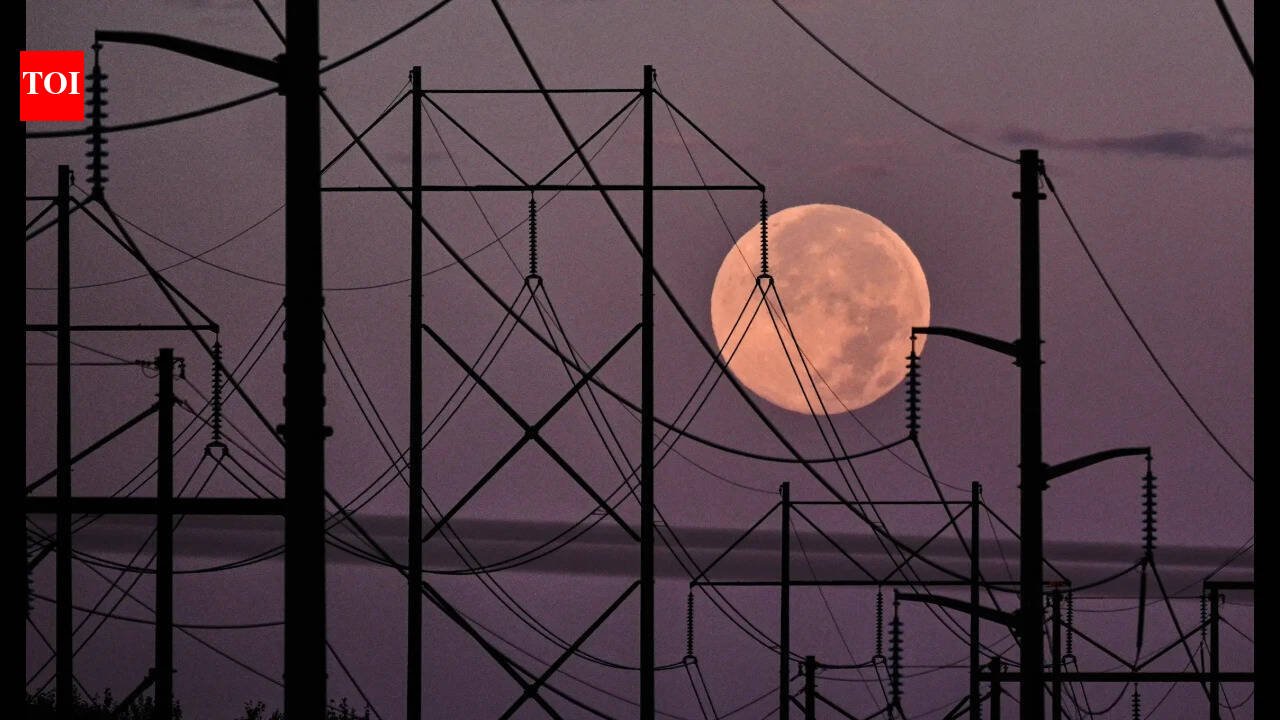
The American naturalist Hal Borland once argued that anyone who wished for a full moon every single night would end up missing the actual rhythm of the seasons. September’s full moon is proof of his point. Its value lies precisely in the fact that it shows up only once, right when farmers needed it most.This moon has a proper name, a fairly precise date and an actual explanation rooted in orbital geometry.
What is a full moon?
A full moon happens once every 29.5 days, when the Moon sits directly opposite the Sun in the sky, with Earth in between. From our view on Earth, the entire side of the Moon facing us is lit up. This is one of eight phases the Moon passes through in its monthly orbit around Earth.
What is the Harvest Moon ?
The Harvest Moon is not a separate object or a rare event. It is simply a name given to one specific full moon each year, the one that falls closest to the autumnal equinox. The autumnal equinox marks the start of astronomical autumn in the Northern Hemisphere and usually falls on September 22 or 23.Most years, this full moon lands in September. Roughly once every three years, the closest full moon to the equinox actually falls in October instead. When that happens, the October full moon takes the Harvest Moon title, and September’s full moon is called the Corn Moon instead.In 2026, the September full moon is the Harvest Moon.
Why is it called the Harvest Moon?
The name comes from farming, not folklore. Before electric lighting existed, farmers depended on daylight to bring in crops such as corn, squash, pumpkins and beans before the first hard frost of the season arrived. Around the time of this particular full moon, something unusual happens with moonrise timing, and it gave farmers extra light to keep working after sunset. That practical use is where the name comes from, and it has stayed in use since at least the early 1700s in English.
The science behind the Harvest Moon
This is the part most people skip, but it is the actual reason the Harvest Moon is different from every other full moon of the year.Normally, the Moon rises about 50 minutes later each night than it did the night before. This is because the Moon moves eastward along its orbit, and Earth has to rotate a bit further each day to “catch up” to it.But around the autumnal equinox, the angle between the Moon’s path and the horizon becomes unusually shallow. Because of this shallow angle, the Moon does not need to climb as far below the horizon to rise. The result is that moonrise happens only 20 to 30 minutes later each night instead of 50, for several nights in a row. In parts of Europe, at higher latitudes, the gap can shrink to just 10 to 15 minutes.This is called the Harvest Moon effect, and it is confirmed by NASA Science and by astronomers who track lunar orbits.
Why does it look bigger and orange?
Two separate things are happening here, and neither of them means the Moon has actually changed.The orange or golden colour comes from the atmosphere. When the Moon is low near the horizon, its light has to pass through a much thicker layer of Earth’s atmosphere to reach your eyes. Shorter wavelengths of light, like blue, scatter away, while longer wavelengths, like red and orange, pass through. This is the same reason sunsets look orange.The larger size is an optical illusion known as the Moon illusion. When the Moon is near the horizon, our brain compares it to nearby trees, buildings or hills and perceives it as bigger than it really is. If you measure it with a camera or a ruler held at arm’s length, the Moon is the same size near the horizon as it is high in the sky.
The Harvest Moon in September 2026
This year’s Harvest Moon peaks on Saturday, September 26, at 12:49 p.m. Eastern Daylight Time (EDT), which is 16:49 Coordinated Universal Time (UTC). The autumnal equinox falls four days earlier, on Tuesday, September 22.The best viewing time is after sunset on September 26, or the evenings of September 25 and 27, when the Moon will still look completely full to the naked eye. The Moon will appear in the constellation Pisces and will rise close to Saturn.This is the tenth full moon of 2026, since the year has 13 full moons instead of the usual 12. The Harvest Moon will be followed by October’s Hunter’s Moon, the first of three supermoons expected later in the year.
Other names for this Moon
Different cultures and Indigenous nations have their own names for this time of year’s full moon, often tied to what was being harvested locally. These include the Corn Moon, Barley Moon, Wine Moon and Falling Leaves Moon. Some Anishinaabe communities call it the Turning Leaves Moon, while the Assiniboine people call it the Yellow Leaves Moon.
