


New Delhi: Prime Minister Narendra Modi‘s message to India’s colleges is moving beyond employability and placement outcomes: the country’s leading institutions should create the ambition, networks and talent needed to build companies capable of competing globally.
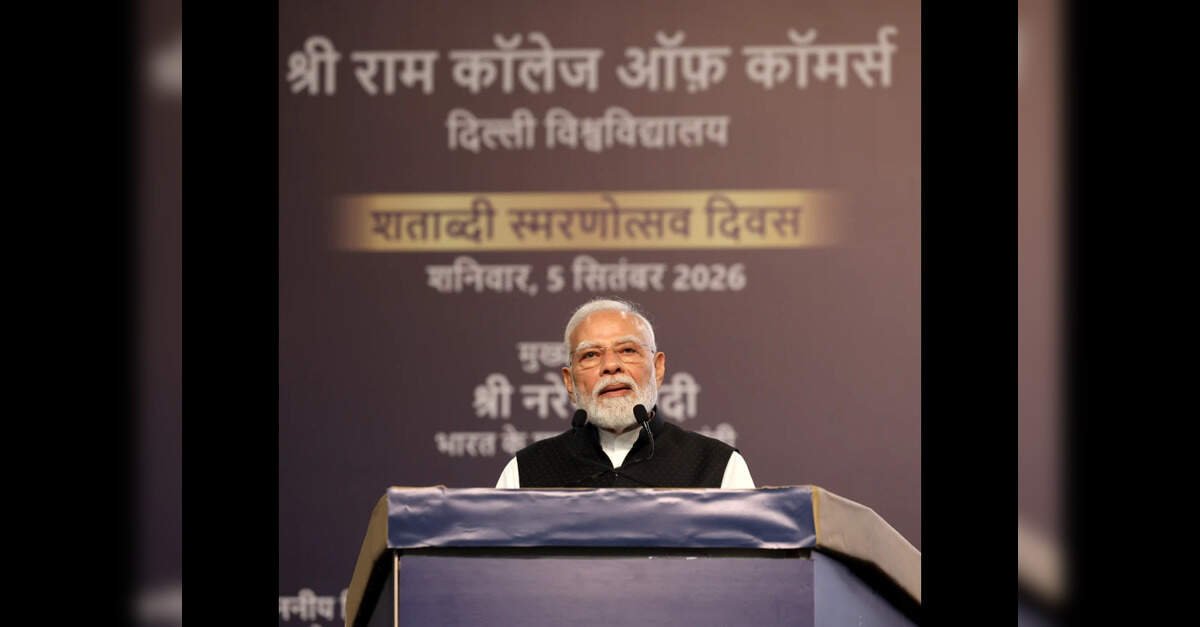
Speaking at the centenary celebrations of Shri Ram College of Commerce (SRCC), Modi challenged students to think beyond becoming leaders in global companies and asked why Indian professionals could not build firms that lead the world.
“Indian people are leading the top companies of the world, then why shouldn’t Indian-made companies lead the world?” he said, while urging students to consider whether India’s consulting, accounting, legal and financial firms could become global leaders.
The message puts a different expectation on India’s higher education institutions. Colleges and universities, in this framing, are not only places that prepare students for existing jobs but ecosystems that can give young people the networks, knowledge and confidence to create new businesses and compete in global markets.
“It’s all possible, you have networks and knowledge,” Modi told students at SRCC.
The Prime Minister linked that ambition to the wider ecosystem emerging around new-age sectors. He said today’s students are aspiring to start companies, build unicorns and work in areas such as space, drones and cutting-edge artificial intelligence, as well as develop innovations in agriculture.
“Ambition cannot be taught from a textbook,” Modi said, arguing that ambitious thinking comes from an environment that encourages young people to dream bigger.
From campus recruitment to company creation
The shift is significant for India’s top colleges, where the traditional markers of institutional success have often centred on academic outcomes, placements, salaries and the strength of corporate recruiters.
Modi’s SRCC address points towards another measure: whether institutions can help create founders, intellectual property, globally competitive professional firms and businesses that originate in India.
His argument was also rooted in SRCC’s own alumni network. The Prime Minister highlighted the college’s alumni across business, politics, law, the judiciary and other fields, and later told students that the institution’s networks and knowledge give them an advantage that can be used to pursue larger ambitions.
The challenge, therefore, is not simply to produce graduates who can access the global economy, but graduates who can shape it.
AI and startups enter the ambition equation
AI featured prominently in Modi’s vision of what India’s young people can build next. Alongside startups, he identified cutting-edge AI solutions, space, drones and agricultural innovation as areas where students could pursue large ambitions.
That places new pressure on higher education institutions to create environments where students can move from learning technologies to building with them.
The Prime Minister’s argument was that the ecosystem supporting such ambitions is already changing. Students today, he said, can contemplate starting companies and building unicorns in ways that previous generations could not easily imagine.
The question for India’s colleges is whether that ecosystem can be translated into campus-level outcomes: more research-led ventures, stronger university-industry links, greater support for student entrepreneurship and more Indian firms emerging from academic talent.
A bigger ambition for Indian higher education
Modi’s speech also set out a broader national ambition, with India positioned as a future hub for manufacturing, research and innovation and agricultural exports. He told students that India should not settle for being a source of talent for the world’s leading companies.
For India’s universities and colleges, that creates a more demanding proposition.
The objective is no longer only to prepare young Indians to participate in global markets. It is to give them the capabilities, networks and ambition to create the companies, technologies and professional institutions that can lead those markets.
For institutions such as SRCC, the message is particularly relevant: the next measure of their influence may not be how many of their graduates enter the world’s biggest companies, but how many go on to build companies of their own.
