


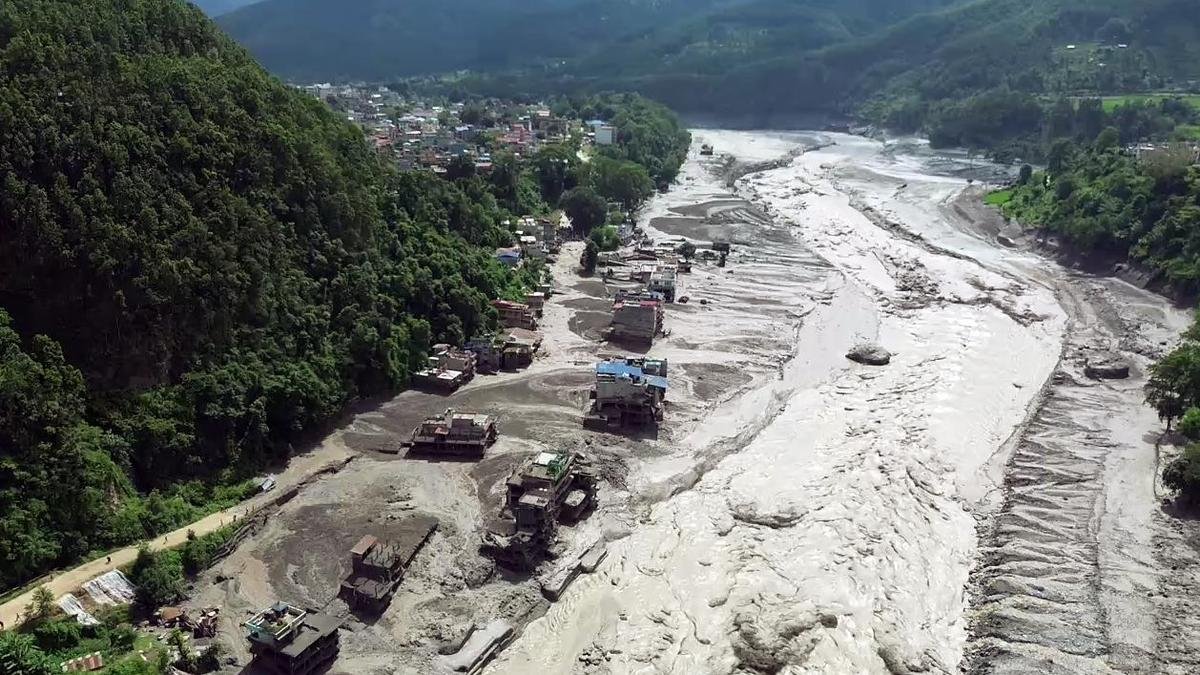
At least nine people have been killed in the massive flash flood that swept through two central Nepal districts bordering Tibet early Wednesday (August 26, 2206), officials said.
At least 105 Indians are among the nearly 400 persons missing after the devastating flash floods in Nepal’s Rasuwa district bordering Tibet.
A sudden, massive flood swept through two central Nepal districts bordering Tibet killing four people, causing extensive devastation at settlements along the river and damaging at least a dozen hydropower projects early on Wednesday (August 26, 2026).
A flooded road following a flash flood in Galchhi in the Dhading district, Nepal, on August 26, 2026.
| Photo Credit:
Reuters
The flood surged through the Bhote Koshi River at around 9 a.m. (local time) coming from the Tibet side affecting Rasuwa and Dhading districts bordering Tibet and Nuwakot district, southwest of Kathmandu, officials said.
According to a statement by Nepal Tourism Board (NTB), a total of 384 travellers, 291 foreigners and 93 Nepalese nationals, have gone missing due to the Rasuwa floods.
These travellers include 105 Indian tourists, 37 NRIs and remaining tourists from USA, Malaysia, UK, South Africa, Australia and Netherlands.
The Nepal Tourism Board also issued a toll free emergency number 1234 or hotline 1144 or tourist police 9851289445 for help.
Villages washed away, roads, bridges and power projects damaged
The massive flash flood washed away villages while damaging roads, bridges and power projects in a region bordering Tibet, authorities said. The flooding was not caused by local rains in Rasuwa but possibly because of the heavy rainfall or avalanche on the Tibetan side, they said, but the exact cause is yet to be ascertained.
In this screengrab from a video posted on August 26, 2026, Floodwater flows across a residential area, in Nepal. Photo:X/@NepalPoliceHQ via PTI
The areas of Syapru Besi and Timure in the mountainous district of Rasuwa, with a population of about 50,000, were severely affected, officials said, while urging those living on the banks of the Bhote Koshi river to seek higher ground. The Bhote Koshi river originates in Tibet and empties into Nepal’s Trishuli river that eventually flows into India as the Gandak river.
The sudden rise in water caused widespread destruction in Timure in Rasuwa district and the nearby Syafrubesi area, with vehicles, goods and other property washed away, the Nepal Army said in a statement.
In this image received on August 26, 2026, Debris lies scattered after a sudden and massive flood surged through the Bhote Koshi River, killing four people, in Rasuwa, Nepal. Photo: Handout via PTI
‘Real cause not yet known’
The National Disaster Risk Reduction and Management Authority (NDRRM) of Nepal, in a statement, called people residing near river banks of Rasuwa, Nuwakot, Dhading, Chitawan and Gorkha to remain on high alert and take safety measures until further notice.
According to the Department of Hydrology and Meteorology, the flooding was not caused by rainfall in Rasuwa. The flooding did not appear to have been caused by heavy rainfall in Rasuwa itself, according to Dinkar Kayastha, information officer at the Department of Hydrology and Meteorology.
It might have been caused by either formation of a new glacier or bursting of the old one, he added. “We are still studying the matter, so the real cause is not yet known,” he said and maintained that the risk of the flood from the Tibetan side has not yet vanished, so “we need to be cautious.” Investigations are under way to determine the cause of the sudden surge, with officials examining whether it was triggered by a glacial lake outburst flood (GLOF) or another factor, The Himalayan Times said.
Eight hydropower projects damaged
The flash flood damaged in-operation eight hydropower projects with a total capacity of 354 MW and five under construction projects located in Nuwakot and Rasuwa districts, according to a statement by Independent Power Producers’ Association Nepal (IPPAN).
The major in-operation hydropower projects damaged by the floods include Rasuwagadhi Hydropower Project (111 MW), Sanjen Khola Hydropower Project (78 MW) and Upper Trishuli 3A (60 MW).
The Kathmandu Post quoted Chameli Gurung, deputy chair of Uttargaya Rural Municipality, who said around a dozen settlements, including Syaphrubesi, Betrawati, Mailung, Salletar, Shantibazar, Pairebesi, Khalti Basti, Sole, Trishuli and Battar, had been affected.
Nepal Army, Armed Police Force and Nepal Police personnel were mobilised in the affected areas to carry out rescue and relief works after an emergency meeting chaired by Prime Minister Balendra Shah to assess the situation.
Nepal Army mobilised 12 helicopters to conduct search and rescue operations after the flash flood. Six people were rescued from Syafrubesi, two from Mailung, and four from Dhunche, all in Rasuwa district, according to a Nepal Army statement.
The Nepal Army has also established a treatment centre at the Military Training Centre No 1 in Trishuli, where medical personnel from Nepal Army are providing emergency medical treatment to the affected people, the statement said. An Army helicopter (MI17) equipped with an Emergency Medical Rescue Team was also mobilised towards the district hospital in Trishuli, it added.
Prime Minister Balendra Shah said rescue and relief teams, as well as police and the military had been dispatched to help in the aid effort. “Instructions have been given … to move the people living in the lower areas to safer places,” he said. “People along the river are advised to exercise extra caution and remain alert.”
(With inputs from Agencies)
Published – August 26, 2026 12:06 pm IST
