


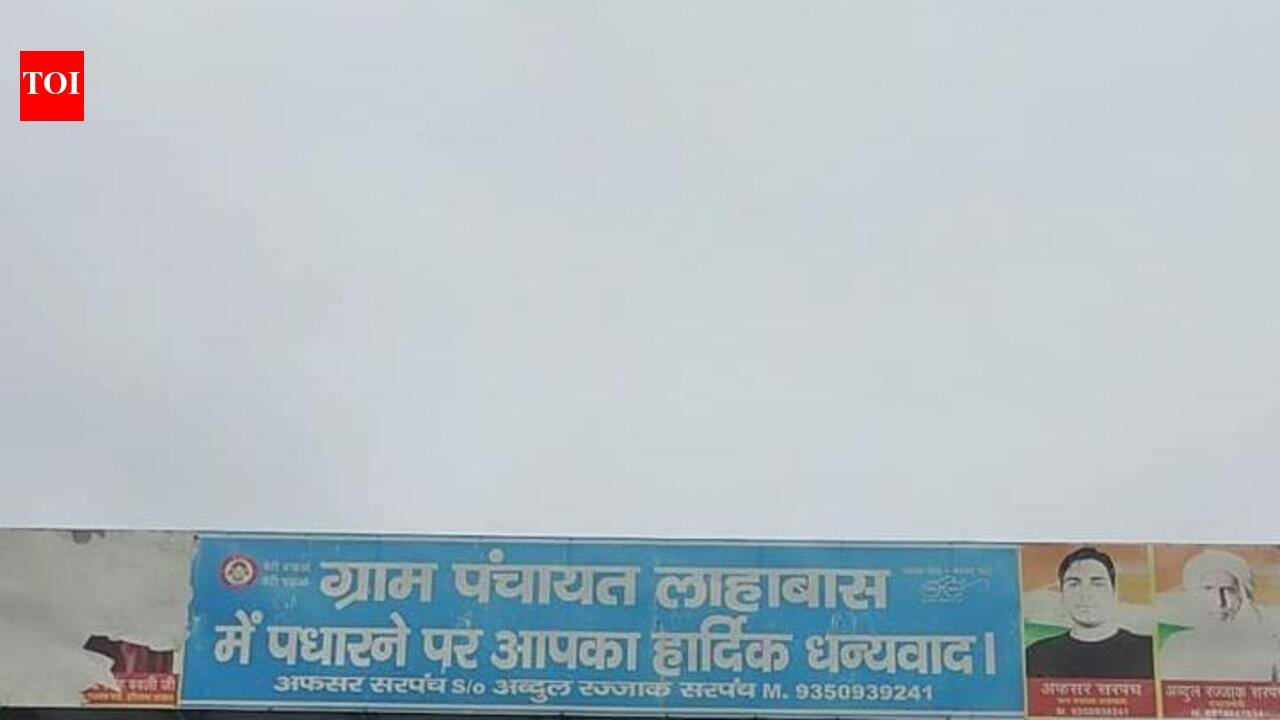
Gurgaon: A village in Nuh has been trapped in an administrative anomaly for over four decades, with three different names — ‘Lahabas’, ‘Allahabad’ and ‘Allahbas’ — coexisting across govt records. Panchayat documents use ‘Lahabas’, revenue records and other govt databases call it ‘Allahabad’, while education department records list it as ‘Allahbas’.The mismatch has real consequences. Certificates, job applications and verification processes such as the family ID are repeatedly flagged, forcing students and jobseekers in particular to furnish multiple supporting documents and make repeated trips to govt offices just to prove their identity. Applying for govt jobs, securing domicile and caste certificates and verifying identity documents have all been complicated by what residents describe as a “seemingly small” spelling variation.The origin of the discrepancy, according to officials, is down to an administrative separation over three decades ago. Before 1991, the village was part of Rahapwa panchayat in Pinangwan block and was recorded as ‘Allahabad’, carrying the local govt (LG) code 063384. The village broke away from Rahapwa in 1991, and following the 1995 panchayat elections, a new, independent panchayat was formed — but registered under the name ‘Lahbas’ instead of ‘Allahabad’, the name already in use in earlier records.Today, the village carries three separate identities: revenue records list it as ‘Allahabad’ (LG code 063371); the panchayat is registered as ‘Lahbas’ (village code 29550 on the e-Gram Swaraj portal); and the education department records it as ‘Allahbas’ (school code 06132). The local patwari confirmed that ‘Allahabad’ and ‘Lahbas’ refer to the same village.While the administrative split dates back to the 1990s, residents say the discrepancy remained largely dormant until the govt middle school was built roughly two decades ago — after which certificate mismatches began surfacing regularly for students.Residents insist the revenue record is the sole authoritative source, and that other departments simply need to align with it — though repeated requests to do so have gone nowhere.Explaining how the discrepancy has persisted, a villager said the revenue record’s name, Allahabad, forms the basis for the voter list, property registry and all official documents such as domicile or caste certificates issued by the tehsildar. “The panchayat’s use of ‘Lahabas’ on its stamp was simply a mistake, since elections are conducted using the same voter list that reads ‘Allahabad’. The school’s use of ‘Allahbas’ — differing by a single letter — was likely just a spelling error,” he said.While the panchayat itself does not issue certificates, he said it must still align its records with the revenue department if it wants to correct the discrepancy. He noted that revenue records can only be changed through a formal govt notification, drawing a parallel with Allahabad’s renaming to Prayagraj, and maintained that there are, in effect, no “three names” — only a panchayat error and a school spelling mistake, with the revenue record remaining the sole authority.Deputy commissioner Akhil Pilani acknowledged the discrepancy and said the name would be verified and corrected. He noted that such mismatches often arise when new panchayats are formed but older names continue to be used in practice — Nuh district, still commonly referred to by its former name Mewat, being a case in point. “The matter was brought up only last week,” he said.To correct a village name in revenue records, the gram panchayat needs to pass an official resolution detailing the discrepancy and submit a formal application to the tehsildar or the DC. Revenue officers then verify historical land records, after which the tehsildar approves a fard badar (correction memorandum) to update digital portals like Web-HALRIS. However, if the correction requires officially altering the statutory revenue estate name to match the panchayat name, the DC forwards the proposal to the state revenue department for approval and official publication in the State Gazette.
