


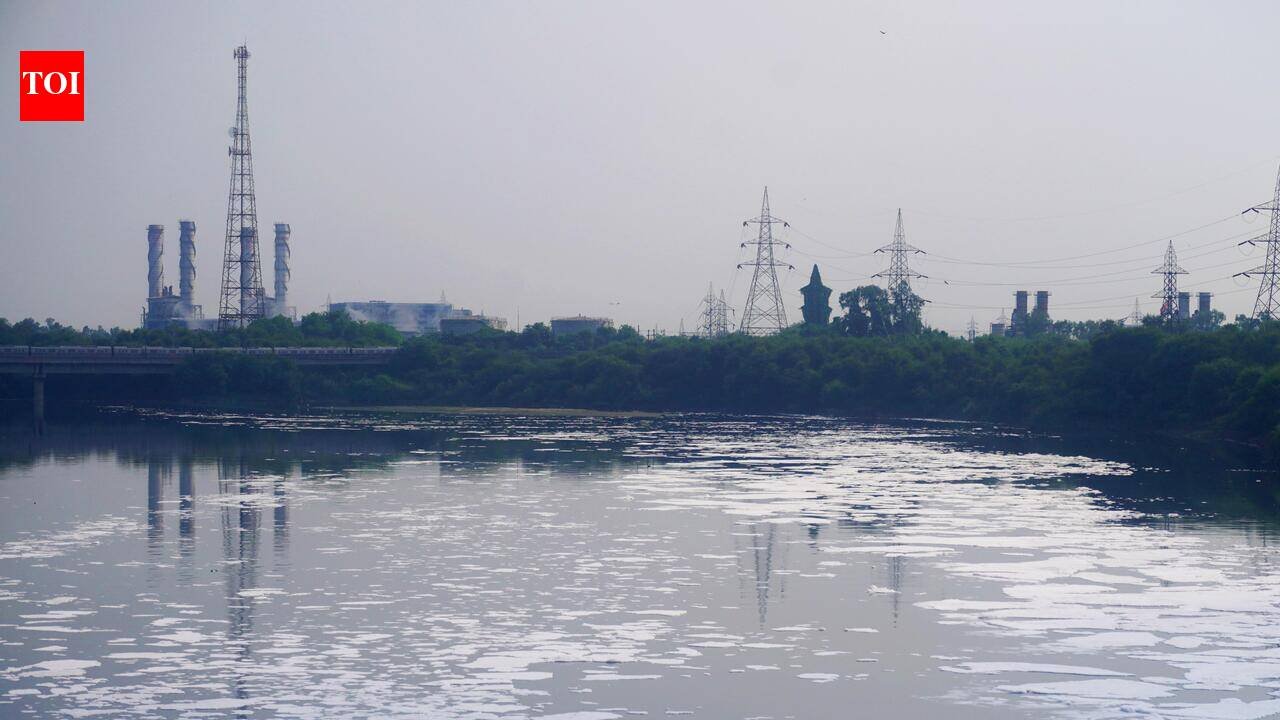
Gurgaon: It’s safe to take a dip in the Yamuna when it enters Haryana at Kalanaur. But by the time it reaches Palwal, its pollution level has shot up nearly ninefold — with some drains recording BOD levels more than 30 times the prescribed limit.At Dhanaura Escape in Karnal, for instance, BOD (biochemical oxygen demand) touched 110 mg/l in Jan 2026 — nearly 37 times the prescribed limit — with faecal coliform, a marker of sewage contamination, reaching 4,800 MPN/100 ml. The data is just an indication of how the river picks up a heavy pollution load from drains as it crosses the state.An analysis of data collated by Haryana State Pollution Control Board between Jan 2021 and June 2026 — covering 14 monitoring points in Yamunanagar, Karnal, Panipat, Sonipat, Palwal and Faridabad — found several pollution hotspots along the river and its feeder drains. Of 57 samples with BOD readings in 2026, 38 breached the Central Pollution Control Board’s bathing-water limit of 3 mg/l. Faecal coliform exceeded the desirable 500 MPN/100 ml in 35 of 55 samples.BOD is simply the amount of oxygen microbes need to break down organic waste in water. The higher it is, the heavier the organic pollution and less the oxygen that remains for fish and other aquatic life. CPCB’s bathing-water standard sets BOD at 3 mg/l or less and dissolved oxygen at 5 mg/l or more. Faecal coliform, on the other hand, indicates contamination by human or animal waste and can signal the presence of disease-causing organisms.According to the data, the sharpest contrast came at Dhanaura Escape in Karnal. Before the drain joined the river, BOD at the upstream Yamuna point was just 1.8 mg/l on the same sampling date. But the drain recorded 104 mg/l in June, and the river downstream also hit 104 mg/l — nearly 35 times the CPCB limit. In Jan, the drain recorded 110 mg/l. Its June sample also had 27,300 MPN/100 ml total coliform.Panipat’s drain no. 2 near Khojkipur was another hotspot, with BOD reaching 68 mg/l in 2026. Faecal coliform rose to 4,800 MPN/100 ml and total coliform to 27,800, while dissolved oxygen fell to 2.6 mg/l in one sample. Yet, the river’s BOD near the drain was lower, ranging from 1.2 to 4.2 mg/l downstream.The deterioration continued downstream. In Palwal, median BOD rose from 23 mg/l before Gaunchi drain to 28 mg/l after it joined the river. The drain’s median was 22 mg/l, but it reached 54 mg/l in Jan 2026. Downstream, BOD touched 45 mg/l, while faecal coliform reached 6,300 MPN/100 ml.Faridabad’s Alipur drain at Basantpur was consistently polluted, with all five 2026 samples recording BOD between 74 and 82 mg/l. Its median BOD across available data was 52 mg/l, while faecal coliform ranged from 4,900 to 7,900 MPN/100 ml.The pollution, however, is not uniform. At Kalanaur, the river’s median BOD was 3.2 mg/l upstream of Maskara nullah and 4 mg/l downstream. At Palla in Sonipat, readings after diversion drain no. 8 ranged from 2.4 to 6.2 mg/l.Environmentalists said a combination of sewage, industrial discharge and weak river flow worsens the problem. Manish Kumar, research scientist at Centre for Study of Science, Technology and Policy, said, “Untreated domestic sewage, industrial effluents and agricultural runoff are major sources of pollution.” He called for more sewage networks and treatment facilities, stricter industrial monitoring and adequate environmental flow from Hathnikund barrage.Fawzia Tarannum, director at Earthwise Nexa LLP, agreed. “The rise in BOD from around 3 mg/l, when the river enters Haryana, to 28 mg/l downstream of Palwal points to two issues working together. That there is a reduced natural flow after diversion at Hathnikund barrage and that rising sewage and industrial loads are entering the river,” she added.Fawzia sought a year-round environmental flow and interception of major drains.The state govt, officials said, is now trying to tackle the pollution closer to its sources — untreated sewage, industrial wastewater and waste from settlements along the river. Chief secretary Anurag Rastogi, who reviewed Yamuna Action Plan on Aug 11, asked departments to move projects beyond planning and tendering and ensure time-bound execution.In Gurgaon, four major sewage treatment plants are at different stages of tendering, while work on a 20 MLD plant at Mirzapur in Faridabad is expected to begin by Aug 30.
