


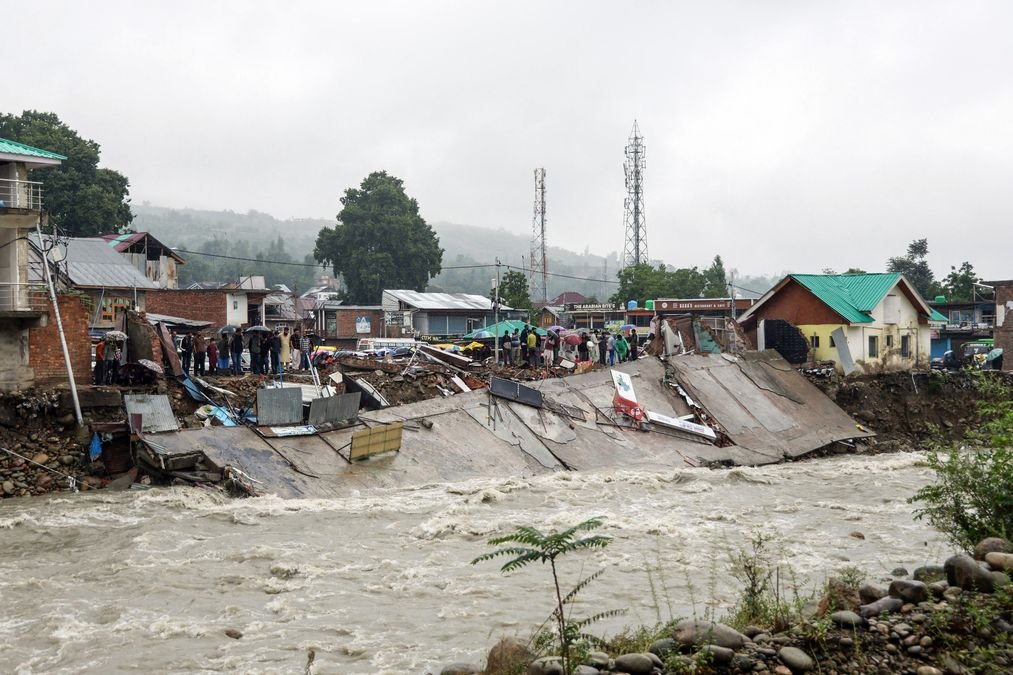
Srinagar, Aug 08: Kashmir is steadily losing the natural ecosystems that once protected it from devastating floods, leaving the Valley increasingly exposed to climate-induced disasters, environmental experts warned on Saturday, calling for an urgent shift from engineering-led flood control to ecological restoration.
Speaking at a panel discussion on Jammu and Kashmir’s environmental crisis hosted by Rising Kashmir, the experts said wetlands, floodplains, forests and spill channels had historically acted as Kashmir’s natural flood defence system by absorbing excess rainwater, regulating river flows and reducing the impact of extreme weather events.
However, decades of encroachments, shrinking wetlands, unchecked urbanisation, pollution and indiscriminate construction have severely weakened these natural safeguards at a time when climate change is making cloudbursts, intense rainfall and flash floods increasingly frequent across the Himalayas.
The panellists cautioned that while climate change has intensified extreme weather, the scale of destruction witnessed during recent floods is largely the consequence of human-induced ecological degradation.
Salman Sagar, senior National Conference leader and the Member of the Government Committee on Environment Protection, said the discourse on flood mitigation in Kashmir has remained narrowly focused on dredging the River Jhelum, while the Valley’s natural flood defence network has continued to deteriorate.
“Dredging certainly has a role, but it is not a permanent solution. Kashmir once had a complete natural flood management system comprising wetlands, floodplains and spill channels. Unfortunately, we have weakened that system ourselves,” he said.
Sagar, an MLA, Hazratbal constituency, said wetlands function like giant natural reservoirs, storing excess water during heavy rainfall and gradually releasing it into rivers and groundwater systems.
“Every wetland that disappears reduces Kashmir’s capacity to absorb floodwater. When these natural buffers are lost, rivers are forced to carry water they were never designed to handle, resulting in widespread flooding,” he said.
The MLA stressed that restoring wetlands, reviving spill channels and protecting floodplains should become as important as river dredging in future flood management policies.
Senior environmentalist Dr Tanveer Ahmad Khan said the deteriorating condition of the River Jhelum symbolises the Valley’s wider environmental decline.
“There was a time when people drank water directly from the Jhelum. It sustained our lives, agriculture and culture. Today, pollution, encroachments and neglect have transformed one of Kashmir’s greatest natural assets into one of its biggest environmental concerns,” he said.
Recalling the lessons of the 2014 floods, Dr Tanveer said nature has repeatedly warned Kashmir against ignoring ecological limits.
“When you play with nature, nature plays back. We have narrowed rivers, occupied floodplains, degraded wetlands and reduced green cover. The consequences are becoming visible with every passing year,” he said.
He said environmental conservation should no longer be viewed as an obstacle to development but as the foundation of sustainable development itself.
Climate expert and Kashmir’s “Tree Man”, Dr Touseef Ahmad Bhat, said changing weather patterns across the Himalayas indicate that cloudbursts and other extreme rainfall events are likely to become more frequent.
“Climate change is no longer a distant threat. It is happening now. Rising temperatures are altering atmospheric behaviour, increasing the probability of high-intensity rainfall events in regions that rarely experienced them in the past,” he said.
Dr Bhat warned that ecological destruction is amplifying the effects of climate change.
“When forests are degraded, wetlands disappear, and mountains are disturbed through unplanned construction, even moderate rainfall can trigger disasters. Climate change and ecological degradation together create a dangerous combination,” he said.
He also called for a carrying-capacity-based tourism policy for ecologically sensitive destinations across Kashmir.
“Every destination has an ecological limit. We cannot promote unlimited tourism in fragile mountain ecosystems. Sustainable tourism requires balancing economic benefits with environmental protection,” he said.
Afreen Khurshid, a PhD researcher at the Department of Environmental Studies, University of Kashmir, said reversing environmental degradation would require active participation from governments, academic institutions, civil society and local communities.
“Environmental protection cannot succeed through government action alone. Every citizen has a responsibility to protect rivers, forests and wetlands. Conservation must become a collective movement,” she said.
She said Kashmir could draw important lessons from Ladakh, where policy interventions, community participation and environmentally responsible tourism have been integrated into development planning.
The panel observed that Kashmir’s environmental challenges—including shrinking wetlands, deteriorating river systems, rapid urbanisation, increasing cloudbursts and biodiversity loss—are deeply interconnected and cannot be addressed through isolated measures.
Instead, they called for an integrated climate resilience strategy centred on restoring wetlands, protecting forests, preserving floodplains, regulating construction in vulnerable areas, strengthening traditional water bodies and promoting scientific land-use planning.
The experts agreed that the Valley still has an opportunity to rebuild its natural flood defences, but warned that delaying ecological restoration would expose future generations to more destructive floods, worsening water insecurity, declining biodiversity and mounting economic losses.
“The safest flood barrier Kashmir ever had was nature itself,” the panellists said. “If we fail to restore that natural shield, no amount of engineering alone will protect the Valley from the climate challenges that lie ahead.”
