


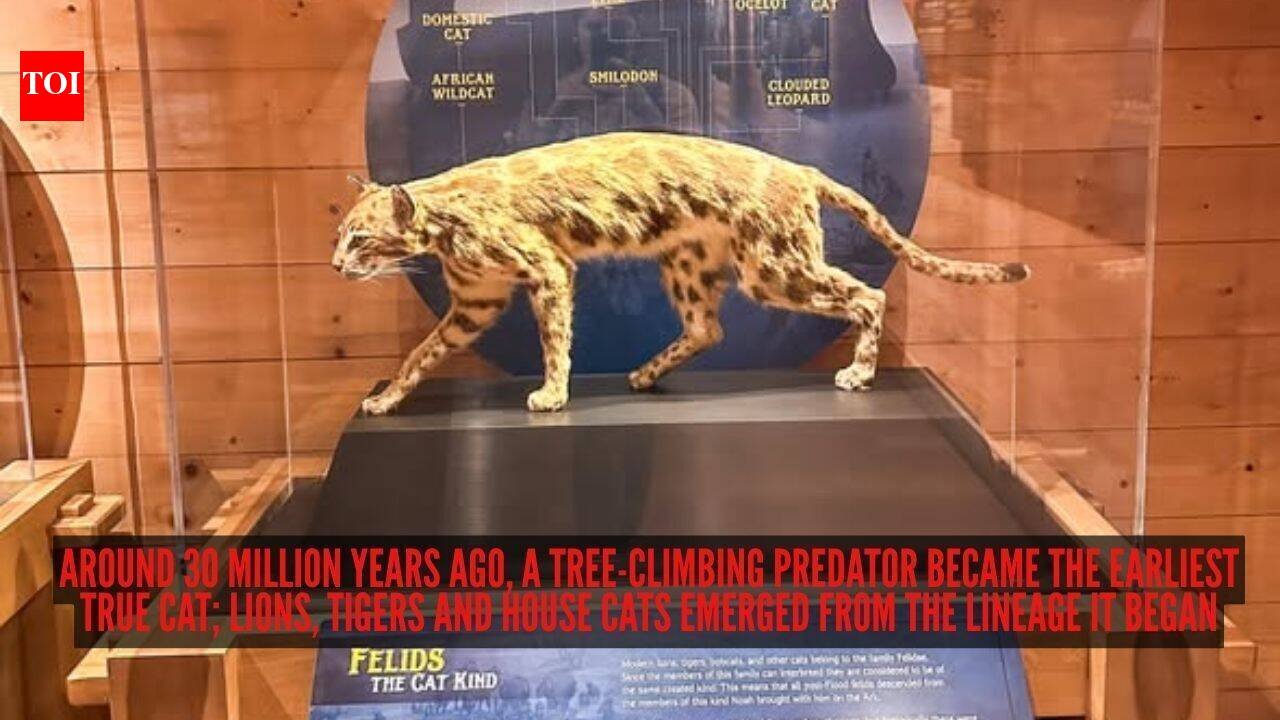
The cat family has developed into one of the most successful predator groups in the world, varying in size from small domestic cats to powerful lions and mysterious snow leopards. However, their evolution started long before the emergence of mankind on planet Earth. About 30 million years ago, during the Oligocene epoch, a quick, efficient predator, Proailurus lived in the Eurasian forests. Even though it was quite small by the standards of current big cats; scientists widely regard it as the earliest known true felid and an early ancestor of the lineage that eventually gave rise to modern cats.The meaning of Proailurus translates to “before cat,” referring to the fact that this animal is the first representative of the family Felidae evolutionarily.
A small predator that climbed trees
Image Credit: Facebook/ @Ark Encounter
Proailurus was far smaller than a lion or tiger, weighing around 7 to 10 kilograms, according to Discover Wildlife, about the size of a big house cat or a mid-sized dog. It had an elongated body, a long tail, sharp claws and strong canines, all of which made it a capable hunter despite its modest frame.According to researchers, Proailurus mostly lived in forests and spent a good deal of time in trees. It probably hunted small mammals, birds and other prey on the forest floor. Researchers believe it may also have climbed trees and possibly stored prey in branches, similar to the behaviour seen in modern leopards. Its agile frame, sharp vision and climbing skill would have let it move easily through thick woodland while staying clear of bigger predators.Proailurus fossils have turned up in what is now Spain and Mongolia, pointing to a wide distribution across Eurasia. This spread suggests early cats were already spreading into varied habitats millions of years before any modern feline existed.
The ancestor that shaped every modern cat
Skull of Proailurus lemanensis (Image Credit: Wikipedia)
However what is more important than Proailurus’ size or hunting habits is its significance in the history of feline evolution. It is widely regarded as the earliest known true felid and represents one of the earliest branches of the evolutionary lineage that eventually produced modern cat species.Throughout millions of years of evolution, the descendants of Proailurus formed various lines based on different environments and conditions, adapting to climatic changes, habitats and prey. While some of them evolved to become large roaring cats such as lions, tigers, jaguars, or leopards, others evolved into smaller cats including wildcats, lynx, and finally into a domesticated cat.The process was quite lengthy and was caused by natural selection. Changes in the climate resulted in the formation of new landscapes and development of different ecosystems. In turn, the cat species began developing specific features related to hunting, climbing trees, running or other physical characteristics. However, all cats continue possessing the traits of their oldest relatives such as retractable claws, binocular vision and hunting skills.
A lasting legacy in today’s felines
Proailurus vanished millions of years ago, but its influence lives on in every cat alive today. From a tiger creeping through undergrowth, to a leopard lounging on a branch, to a house cat leaping at a toy, countless feline traits and behaviours trace back to adaptations that first appeared in these ancient predators.Proailurus also helps scientists learn about how mammals adjust to changes in their environments over millions of years. The fossil records help us understand how species change and survive under various environmental conditions.What began as a small, tree-climbing hunter roughly 30 million years ago gave rise to one of nature’s most successful carnivore families. Every cat today, from the mightiest wild predator to the house cat asleep on the couch shares a distant evolutionary connection to the ancient feline lineage represented by Proailurus.
