


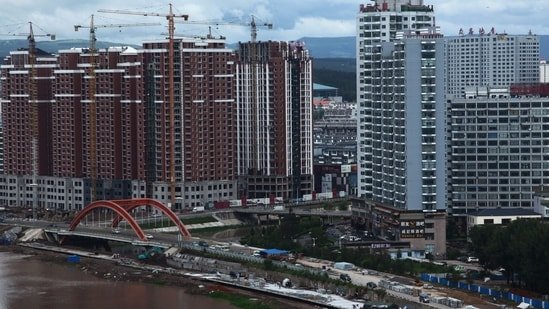
For nearly two decades, China’s property market was the engine of its economic growth and the cornerstone of household wealth. Homes were bought not just as places to live but also as investments, with real estate accounting for an estimated 70% of household assets. Then, a mix of debt-laden developers, unfinished housing projects, falling home prices, slowing population growth, weakening consumer confidence and an economic slowdown triggered a prolonged property crisis, wiping out trillions of dollars in wealth and shattering homebuyers’ faith in what was once considered the country’s safest investment.

This has sparked a crucial question for India. Could the country face a similar reckoning, especially in investor-heavy markets, where luxury launches and speculative buying have surged in recent years? Or do India’s younger demographics, strong end-user demand, and tighter regulatory framework provide a buffer against the prolonged downturn witnessed in China?
As India’s housing market continues to grow, understanding what went wrong in China offers valuable lessons for policymakers, developers, investors and homebuyers alike. Here’s a look at what triggered China’s property collapse, how India’s market differs, and the key warning signs that should not be ignored.
China’s housing market in freefall
Recent data underscores the depth of China’s real estate crisis. According to data from the China Index Academy, secondary home prices across 100 major cities fell 0.42% month-on-month in June 2026, with prices declining in 88 cities. New-home sales by floor area dropped 10.8% year-on-year in the first five months of 2026, while property investment, new construction starts and project completions all continued to contract.
Fitch Ratings expects China’s new-home sales to decline by 11-13% in 2026, warning that the recovery remains fragile. Demand is largely concentrated in a handful of top-tier cities, while lower-tier markets continue to struggle with high inventories, weak demand and falling prices.
What triggered China’s housing market crisis?
1. Years of debt-fuelled expansion
According to media reports, for nearly two decades, major developers such as Evergrande and Country Garden borrowed aggressively to acquire land and launch projects. Apartments were often sold before construction was completed, with proceeds used to fund older developments. When sales slowed, the model collapsed under its own weight.
2. Government’s debt crackdown
In 2020, Beijing introduced the ‘Three Red Lines’ policy to curb excessive borrowing by developers. The tighter financing environment triggered liquidity shortages, project delays and debt defaults, culminating in Evergrande’s collapse and a sharp loss of buyer confidence.
For perspective, Chinese president Xi Jinping first declared that ‘houses are for living in, not for speculation’ at the Central Economic Work Conference in late 2016. He reiterated the message at the 19th Communist Party Congress in 2017, making it the cornerstone of China’s housing policy.
The slogan reflected Beijing’s attempt to rein in speculative home buying, curb runaway property prices, and reduce developers’ reliance on debt-fuelled expansion. The broader objective was to reposition housing as a basic necessity rather than a vehicle for wealth creation and financial speculation.
The policy laid the groundwork for stricter regulation of the property sector, culminating in the introduction of the ‘three red lines’ policy in 2020. The framework imposed borrowing limits on highly leveraged developers, triggering a liquidity crunch for several major firms, including Evergrande and Country Garden. Experts say that while it intended to reduce financial risks, the crackdown exposed years of excessive borrowing and became a key catalyst for China’s prolonged property downturn.
According to Santhosh Kumar, vice president, Anarock Group, “the trouble started when the ‘three red lines’ policy of 2020 stopped giving cheap loans to developers who had been borrowing for 20 years, based on future pre-sales instead of finished inventory. The problems that led to Evergrande’s downfall were bad management, careless growth, and a pre-sale model that forced homebuyers to become investors. Not the squeeze itself but doing it so quickly after ignoring it for years.”
3. Unfinished housing projects
Millions of homebuyers who had paid for under-construction apartments were left waiting for possession. Mortgage boycotts and stalled projects eroded trust in the pre-sale model, discouraging fresh purchases.
4. Oversupply of homes
Developers built far more homes than the underlying demand, particularly in smaller cities. Local governments, heavily dependent on land-sale revenues, encouraged rapid construction, leaving behind large inventories of unsold homes, according to media reports.
5. Demographic slowdown
China’s population has been shrinking since 2022. Slower urbanisation, lower birth rates and an ageing population have weakened long-term housing demand, ending the demographic tailwinds that fuelled the property boom. The Asia Times reported this week that China’s population entered negative growth in 2022 and has continued to shrink. Experience elsewhere shows population decline is very hard to reverse, and China is likely to remain in negative growth for the foreseeable future.
“The era of rapid urbanisation that once drove explosive housing demand is largely over. Millions of people flocking to cities in the past decades fueled a surge in home prices, but that wave has run its course. Overall, housing supply is no longer scarce. After years of construction, China has enough homes overall, except for a tight supply in major cities and prime areas,” it noted.
6. Falling prices and weaker confidence
As prices continued to decline, buyers delayed purchases in anticipation of even lower prices, creating a self-reinforcing cycle of falling sales and declining values. According to media reports, buyers are waiting for prices to fall further. Many prospective homebuyers are delaying purchases in anticipation of lower prices, further depressing sales and prolonging the downturn. For years, Chinese households that invested nearly 70% of their wealth in real estate have suddenly lost confidence, media reports said.
Experts say it’s a mixed bag. “Unfinished projects probably did the most sentimental damage because no one wants to keep making payments on a shell. There was less of a wealth effect because people put much of their savings into real estate, and prices began to drop. As more people moved to cities and older people became more common, the idea that prices would keep rising stopped holding true. When trust in the completion broke, price drops sped up the exit,” explains Santhosh Kumar.
7. Slowing economy
The broader economic slowdown has further weakened housing demand. Since real estate and related industries account for roughly a quarter of China’s economy, the downturn has also hit construction, banking, local government finances and household wealth. Developers continue to struggle. Although authorities have eased financing rules and offered policy support, many developers remain burdened with debt, while excess housing inventory continues to weigh on prices. Media reports quoted analysts as saying that the market still faces structural challenges rather than a temporary slowdown.
The crisis has spread beyond developers. According to a Reuters report, one of the latest developments is that property management companies are also coming under pressure as homeowners stop paying maintenance fees, especially in partially vacant housing projects. Some management firms have begun exiting residential communities because fee collections have become unsustainable.
What is China doing to revive the market?
Beijing has rolled out a series of support measures, including lower mortgage rates, reduced down-payment requirements, financing support for developers to complete stalled projects, easing home-buying restrictions and programmes to help local governments purchase unsold homes, as per media reports.
India vs China real estate markets: What’s different?
According to Santhosh Kumar, vice chairman, Anarock Group, the biggest difference lies in the structure of the two markets. “In India, developers largely rely on funding from regulated banks and NBFCs, while RERA mandates escrow accounts that ensure customer advances are used for project construction. In China, developers became heavily dependent on the pre-sales model and accumulated enormous debt outside such safeguards. Speculative ownership of multiple homes was also far more widespread there, whereas India’s housing demand continues to be driven primarily by end-users and newly formed households,” he says.
Also Read: Can Indian real estate market face a crisis like China’s Evergrande?
As a result, Kumar believes a systemic housing crash similar to China’s is unlikely, although pockets of overheating should be closely monitored.
Is Gurugram’s luxury boom a warning sign? Cities such as Gurugram and Hyderabad have witnessed a sharp rise in investor participation, particularly in the luxury and ultra-luxury housing segments. Does that increase the risk that speculation will outweigh genuine demand?
Kumar believes the current cycle does not yet resemble a bubble.
“Investors are actively ₹10 crore”>buying homes priced above ₹10 crore, and Gurugram recorded a record number of luxury home sales in 2025. However, what we are seeing today is more of a consolidation than a speculative bubble. Inventory remains relatively low in key corridors, while strong employment generation by Global Capability Centres (GCCs) continues to support demand. A sharp correction appears unlikely, although growth could moderate in pockets where leverage becomes excessive,” he says.
Is rising unsold inventory a concern?
India’s unsold housing inventory has crossed five lakh units in top cities, raising concerns that supply may be outpacing demand.
Kumar says the headline number needs to be viewed in context.
“Unsold inventory has certainly increased, particularly in the ₹2-5 crore price segment. However, inventory alone does not indicate a crisis. The picture becomes more nuanced when sales begin to moderate even as developers continue to launch new projects, as is currently visible in markets such as Bengaluru. That said, the situation is nowhere close to China’s ‘ghost cities’, where speculative construction far exceeded actual demand.”
Demographic dividend: A safety net, not a guarantee
India’s young population is widely seen as one of the country’s biggest strengths. But can demographics alone prevent a housing crisis?
“It significantly reduces the risk, but it doesn’t eliminate it,” Kumar says. “A younger population moving to cities creates sustained housing demand, something China no longer enjoys because of its ageing and shrinking population. However, demographics cannot compensate for poor financial discipline. Excessive leverage or irresponsible lending could still create stress in specific markets. Demographics provide a safety net, not a fail-safe,” he said.
Lessons from China’s property crisis
Experts say China’s experience offers important lessons for policymakers, developers and homebuyers.
For policymakers, maintaining strict enforcement of RERA’s escrow provisions is critical to ensure that homebuyers’ funds are not diverted, as happened in China. Developers should avoid launching projects solely on the back of investor demand, particularly in fast-growing corridors such as Dwarka Expressway, and instead align supply with genuine end-user demand.
Also Read: Chinese man’s ‘ghost’ flat on the 34th floor offers a lesson for Indian homebuyers
For homebuyers, due diligence remains essential. Buyers should prioritise developers with a strong track record of timely project delivery rather than relying on marketing promises.
“The current boom in Gurugram is fundamentally different from the ghost developments seen in parts of China because it is backed by greater transparency, tighter regulation and stronger financial discipline,” Kumar adds.
