


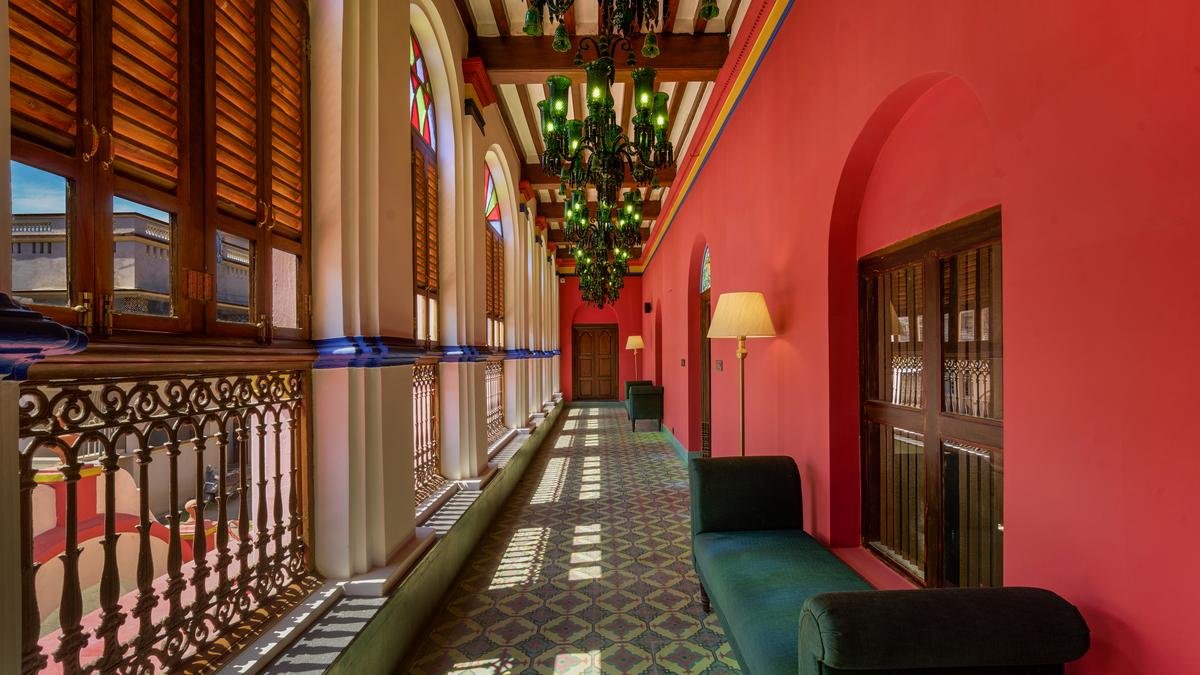
Chettinad is undergoing a revival. Its mansions are paying the price.
As travellers, architects and designers discover the region’s unique aesthetic via festivals and curated holidays, luxury homes and hotels across the country are increasingly being outfitted with Burmese teak doors, granite pillars, vintage tiles and even carved wooden roofs retrieved from century-old mansions. “Entire houses are being cannibalised,” says Chennai-based architect Sujatha Shankar. “Wares from these homes fuel a thriving antique market, drawing buyers in India and abroad.”
Chidambara Vilas
Comprising 75 villages (Karaikudi being the largest town and commercial hub), spread over about 600 square miles, the region is home to the Nattukottai Chettiars, who built houses here between the end of the 18th century and the mid-20th century. The successful mercantile community travelled across South and Southeast Asia, and poured the money they made into lavish mansions, spanning 20,000 sq.ft. to 40,000 sq.ft.
At its peak, Chettinad had about 15,000 mansions. Today, fewer than 10,000 remain, of which only about 10% are maintained or occupied. Photographer and author Amar Ramesh, who has been documenting the mansions for the past decade, and brought out Mogappu (2023), a book documenting their 108 grand entrances, estimates that the number of remaining homes is closer to 7,000.
Amar Ramesh
| Photo Credit:
Courtesy Amar Ramesh
“There are two types of destruction,” he says. “Some houses are just falling apart because there is no maintenance. One of my favourite mogappus, a wooden colonial-style verandah, just collapsed recently. Then there are those being torn down, though that is not recent. A lot of houses were wiped out between 1998 and 2010.”
The wooden colonial-style mogappu
| Photo Credit:
Courtesy Amar Ramesh
Business of dismantling
Higher prices, however, are now accelerating the decline. At the Karaikudi Antique Market, Raghavendra, whose father started dealing in Chettinad’s artefacts 40 years ago, says one or two mansions come down every month, after which the pillars and wood are shipped across the world. He adds that buyers now come from France, Sweden, the Czech Republic, and England.
Karaikudi Antique Market
| Photo Credit:
Shonali Muthalaly
Lokesh Kumar S. of Chennai-based Anteak Woods says a door recently sold for ₹1 crore. “When it comes to antiques, the price depends on how much the buyer wants the piece,” he says, adding that social media and WhatsApp now help Karaikudi’s carpenters, carvers and locals access buyers globally.
According to sources, as the community now understands the value of these homes, one member of the family tends to buy out the rest (each house is often owned by multiple cousins, so it can have 40 to 50 claimants). They then sell different parts to dealers, which is more profitable, especially because there is growing demand from buyers abroad. The rosewood and teakwood are repurposed for furniture, and the usually untouched dowries of enamel ware, brassware and glasses are sold separately.
On Instagram, for instance, one post advertises 12 stone pillars on sale for ₹15,000 each, plus loading and shipping charges. Another dealer says he buys the pillars for ₹20 lakh-₹25 lakh and then sells them for ₹1 lakh profit.
There can also be surprises: Chettiars traditionally placed a navratna of nine types of grain, gems or diamonds under the door, so now when a house is razed, the door frame is removed first. There are also local legends of lucky buyers, like the man who found a box of diamonds in a mansion he bought, and went on to use the money to open a successful steel bureau company.
Even a few years ago, small houses used to go for ₹75 lakh to ₹3 crore, according to sources at the Karaikudi Antique Market. Today, Kathiravan, manager at the Chettinad heritage hotel, The Lotus Palace by The Park — who has been tracking land prices — says it costs ₹7 crore-₹10 crore to buy a mansion, depending on its location and size. However, he adds that the community prefers not to sell to outsiders, which could explain why public sale listings are hard to find.
Restoration can cost about ₹15 crore, says architect Shankar, adding that a single room can cost a couple of crores. “Some people want to do only the front,” she says. “But more families are updating now because the next generation may not be equipped to restore these homes, and craftsmen are fewer.”
Architect Sujatha Shankar
Can hotels save Chettinad?
Restoration has been magnified by the push to save Chettinad, spearheaded by the Chettiar community, historians, and a small but committed group of hoteliers and architects, driving repair and adaptive reuse. When The Bangala was opened in 1999 by Meenakshi Meyyappan — who is credited with putting Chettinad on the tourist map — it drew attention to the Chettiar’s banana leaf lunches and warm hospitality.
Meenakshi Meyyappan
The Bangala
The Lotus Palace opened last year in Kanadukathan, in a 230-year-old mansion that spans more than 16,500 sq.ft. Renovation took four-and-a-half years because the group focused on using original material and local labour. It has just 15 rooms and suites.
The Lotus Palace
Rising interest
Driven in part by social media and festivals, hotels have seen an increase in guests. Senthil Kumar Bheeman says occupancy at Chidambara Vilas, which has 25 rooms, was about 40% before the pandemic. It is now around 65% on average, with most guests coming during the cooler months of October to March, when the occupancy rises to 85%. “Chettinad is also becoming a popular wedding destination for niche, intimate functions,” he adds.
At Chettinad Palace, built between 1902 and 1912, proprietor A. Chandramoli, who is in his 90s, explains they rent out just eight bedrooms, despite having 70-plus rooms spread over 44,000 sq.ft. Since the mansions were built for community living, they have very few bedrooms. Most spaces are either huge ones for gatherings, or tiny windowless areas for storage. “The cost to convert them into hotel rooms is prohibitive, but if we don’t renovate, the decay will accelerate,” he says, stating that there are three main problems all the old houses are facing: water leakage, termites and plants growing through the walls.
Inside Athangudi Palace
Fortunately, hoteliers such as Priya Paul, chairperson of Apeejay Surrendra Park Hotels, who opened The Vaadhyar’s House restaurant after redoing a dilapidated mansion in 2018, and then The Lotus Palace opposite it, are undeterred. “The value of such a project lies in its positioning rather than scale,” she says, adding that they attract “guests who are looking for more than just a hotel room”.
Priya Paul
| Photo Credit:
Nick Harvey
Locals are now enthusiastic about tying up with hotels, often with an agreement in place so they can continue to have their weddings and family functions there. Tourism also brings fresh opportunities: though hotel rooms are still limited, there has been a rise in mansions being opened up. Visitors can explore CVCT House and its dramatic 240 wooden mandapams carved with 240 yaalis, for just ₹50. Homes are also opened up to film crews, with prices ranging from ₹1,000 for a one-hour photo shoot to about ₹25,000 a day for video. Movies and shows shot here draw more visitors to the region.
In Kadiyapatti, around 35 minutes from Karaikudi, Sangam Hotels runs the more-than-a-century-old Chidambara Vilas, a luxurious mansion that sprawls over 40,000 feet. Over chilled glasses of panagam, resort manager Senthil Kumar Bheeman says, “The foundation is almost 10 feet, and they used sembari stone from Palathur, which stays dry. An earthquake will not shake these houses.”
Chidambara Vilas
However, renovation took three years because the house had been closed for 47 years, during which there was continuous water seepage. A lot of the skills used to make these homes have died out, but they did manage to redo the silky smooth walls with a traditional blend of limestone, palm sugar and egg whites. This mansion, which famously had electricity in 1926 when the owner brought in dynamo generators from Germany, is one of 65 still standing in the village.
Discussing how construction was a labour of love, Bheeman points to the 200 kg carved teak door, with a nine-step locking system from Dindigul, and says craftsmen from Tirunelveli stayed in the house and worked from 1897 to 1904 to carve it. “They would stay and work for seven years in one house, then move to the next. There is no one today who can do this kind of carving.”
Bheeman opening the teak door with a nine-step locking system
The 200-kg carved teak door at Chidambara Vilas
Festivals in focus
The Chettinad Culture and Heritage Festival, spearheaded by Meenakshi Meyyappan and The Bangala, now in its sixth edition, draws national and international attention. It sells out quickly every year. Priced between ₹1.5 lakh and ₹2 lakh this year, it will be held from September 18 to 21, and will showcase the region via concerts, talks and tours. The Park also runs two annual festivals: Kalai, focused on architecture, and Suvai, an immersive culinary holiday.
Scenes from Kalai
Since there are a limited number of rooms available, these festivals are necessarily small, with between 30 and 150 people. But what they lack in size they make up for in influence, as the six major properties in the region join forces, drawing a focused guest list. “The Chettinad festival was not meant to sell a hotel,” says Meyyappan, explaining why they work as a group. “It was meant to sell Chettinad as a destination.”
What cannot be rebuilt
Ramesh is currently photographing the graceful murals painted on walls and pillars that cannot be saved when a house is brought down, for a talk at the Nagarathar Sangam North America in Atlanta, to an audience of Chettiars. “I want to ask them to document their mansions for posterity,” he says. He rescued a 120-year-old Burma teak roof from a fallen mansion he was photographing four years ago, and moved it to his farmhouse in Cheyyur. “It’s four times more expensive now,” he says.
120-year-old Burma teak roof
| Photo Credit:
Courtesy Amar Ramesh
Though architects are creating Chettinad-inspired homes across the country, incorporating the central courtyards, terracotta roofs, Athangudi tile floors and wooden pillars, it is impossible to recreate one of these mansions today, as architect Sasikala Ananth points out, because of the scale and techniques used. “It’s a modular design, and measurements are critical for the visual order,” she says. “The value of the model is based on the nakshatra [birth star] of the owners, and it is a formula in six steps. When you walk in, you feel that energy. It is not just the embellishments that everyone is responding to. It is also the rhythm.”
Holding on
The Athangudi tiles, however, can be easily incorporated into apartments, restaurants and hotels, and the demand has encouraged a rise in skilled workers. S. Palaniappan, production manager at Chettinad Tiles, estimates that there are about 500 factories across Karaikudi today. At his factory, workers make about 600 tiles a day, which are shipped globally, he says, pointing to boxes packed to be sent to Singapore and Malaysia.
Athangudi tile making
Murugappan Shanmugam of the 200-year-old S.M.R House in Konapet explains why there are families that will keep holding on to their homes, despite the fact that maintaining them can cost between ₹1 lakh and ₹5 lakh a month. “We do it for sentimental reasons, as well as for heritage value,” he says. “I spent summer holidays there with my grandparents, and saw my sisters’ and cousins’ weddings in that house. It is filled with memories, everything from playing in the courtyard and sleeping under the open sky, to attending village and temple festivals, and watching Tamil movies in ‘tent kottai’ aka touring talkies.”
In Kadiapatti, an elderly Chettiar lady sitting in her darkened, silent mansion echoes this. “I came here when I was 25, and we were four families living together. Now, I sleep alone in this house, and I am not afraid. Our ancestors watch over me. We are determined to keep it. You can never buy something like this again.”
