


LUCKNOW It looked like just another bustling corporate office inside the upscale Summit Building in Lucknow’s posh Vibhuti Khand area. But behind the 11th-floor glass doors, a highly sophisticated cybercrime syndicate was operating a multi-layered, international fraud machine in plain sight until a midnight raid by the Lucknow Commissionerate Police brought it crashing down late on Wednesday.

Following the crackdown, authorities sent 119 individuals to jail on Thursday, hours after they were detained during the raid. The massive international call centre racket preyed exclusively on US citizens, weaponizing Internet calling platforms, intense psychological pressure and fake US government identities to extort savings from unsuspecting victims.
An FIR was registered at the Cyber Crime police station under Sections 3(5), 61(2), 318(4), 319(2), 336(3), 337, 338 and 340(2) of the BNS, along with Sections 66C and 66D of the Information Technology Act and Section 42 of the Telecommunications Act, 2023.
The callers allegedly posed as customer support executives of e-commerce platforms and convinced victims to install applications, including the ‘Dollar App’, or share sensitive banking details, following which money was siphoned off, police said.
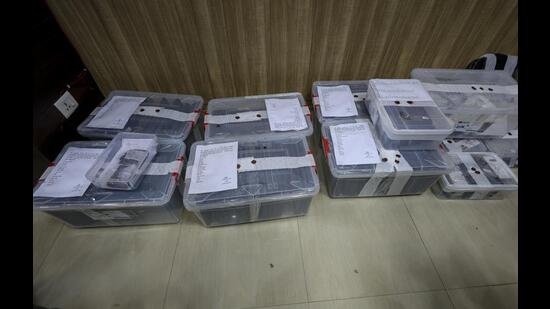
Police recovered 103 laptops, 177 mobile phones, VoIP-based calling systems, Eyebeam dialers, digital storage devices, forged documents and other electronic evidence used in the operation.
Holding a presser at the Police Lines police commissioner Amrendra K Sengar revealed that the operation had evolved into a full-fledged corporate structure where employees were assigned specific responsibilities, received monthly salaries of ₹30,000 to ₹40,000, worked in specialised departments and followed pre-defined scripts and standard operating procedures designed to maximise successful fraud.
Sengar told HT that even though the entire fraud is being ascertained, the call centre was making transactions of ₹30-40 lakh a day, translating into around ₹12 crore a month and nearly ₹150 crore a year.
Investigators said the call centre was not an improvised fraud operation but a structured enterprise with a hierarchy resembling that of a multinational company.
Employees were recruited primarily for their communication skills and proficiency in English. Most were young graduates drawn from several states, including Uttar Pradesh, Assam, Meghalaya, Manipur, Nagaland, West Bengal, Gujarat, Maharashtra, Rajasthan, Bihar, Jharkhand and Uttarakhand. Many lived in rented high-rise apartments across Gomti Nagar Extension, Sushant Golf city and nearby upscale localities.
Police believe many recruits were assigned specialised roles instead of handling the entire fraud cycle, making the organisation highly compartmentalised and efficient.
Investigators said the syndicate divided the fraud into four dedicated teams, each responsible for a specific stage of victim manipulation.
The first stage, known as the ‘Baiting Team’, generated initial contact by sending fraudulent text messages on phones claiming that victims’ Amazon, Apple, Microsoft, PayPal, Netflix, FB or Samsung accounts had been used for serious crimes, including child exploitation, narcotics trafficking or financing terrorism. Victims were urged to call a toll-free number immediately to avoid legal consequences, said police.
Once victims made contact, then came the ‘Dialer Team’. This department’s role was to establish trust, verify basic information and convince victims that multiple bank accounts linked to their identities had been used for criminal activities.
Calls were then transferred to the ‘Banker Team’, which extracted sensitive financial information. Victims were falsely informed that their social security number (SSN) and bank accounts would be frozen during investigation and were persuaded to “secure” their savings by converting funds into gift cards, cryptocurrency or other payment instruments.
The final stage involved the ‘Closer Team’, regarded as the most experienced members of the syndicate. These teams would impersonate senior officials of American agencies, including the Federal Trade Commission (FTC), Federal Bureau of Investigation (FBI), US Marshals Service, United States Treasury Department and United States District Court.
Investigators said these callers created intense psychological pressure by threatening arrests, prosecution, seizure of assets and criminal proceedings unless victims complied immediately and the gang would ask the victim to transfer money in the form of gift cards, digital vouchers and cryptocurrency instead of bank transfers.
“The objective of doing so was to conceal the actual source of funds and the ultimate beneficiary, as well as to complicate the financial trail for investigative agencies. Preliminary investigations indicate that the illicit funds were transferred via various digital channels for subsequent use,” said Sengar.
Police said the organisation relied heavily on internet-based communication technology to conceal its identity and location. “Using VoIP calling systems, Eyebeam Dialers (banned in India) and internet telephony software, callers projected American numbers while posing as customer support executives of globally recognised companies,” said JCP (law & order) Babloo Kumar.
Overseeing the entire case, DCP (crime) Anil Kr Yadav said: “Victims were falsely informed that their digital identities had been compromised or that illegal financial transactions had been detected in their names. To reinforce the deception, the syndicate emailed professionally prepared forged documents bearing the names of US government agencies. These included identity theft reports, FTC letters, investigation reports and non-disclosure agreements (NDAs), designed to resemble authentic official correspondence and convince victims that federal investigations were underway.”
Police said the fraudsters used several methods to collect money while making transactions difficult to trace. Victims were instructed to purchase Amazon, Walmart and other gift cards and disclose redemption codes over the phone to the so-called “investigating officer” of the closer team. “Others were persuaded to convert money into cryptocurrency, which was then transferred into wallets controlled by the syndicate. In certain cases, victims were allegedly directed to send parcels containing cash or gold to addresses specified by the fraudsters within the US,” said additional DCP (crime) Kiran Yadav who led the raid on Wednesday.
