


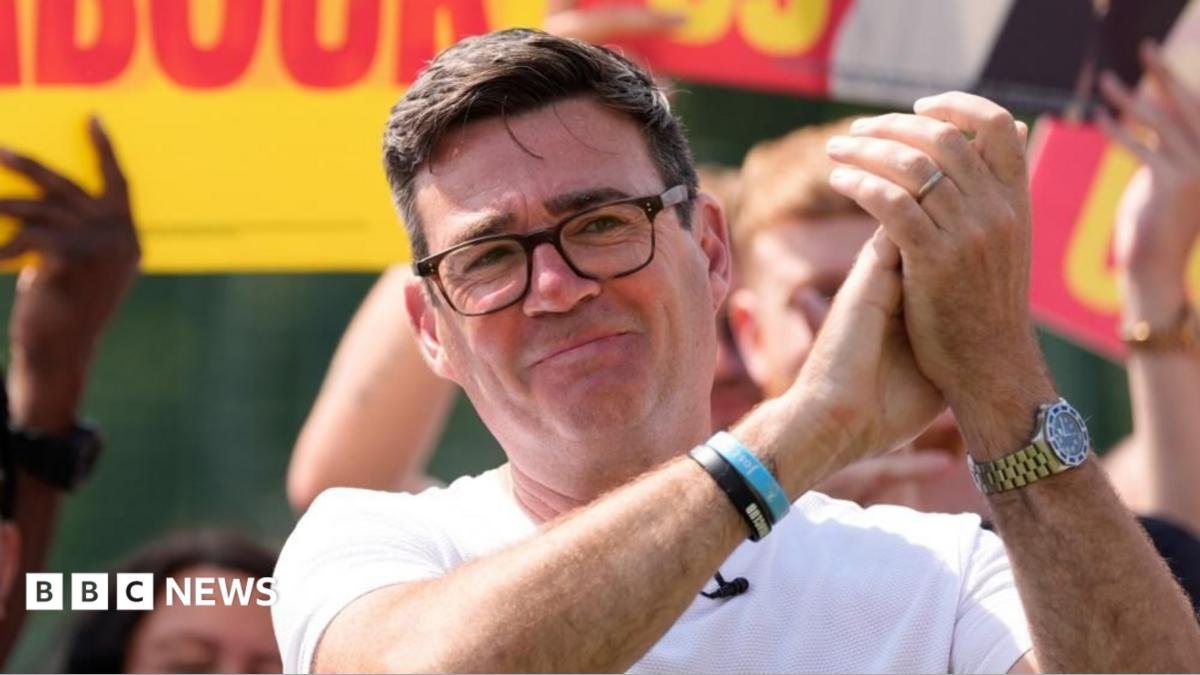
Andy Burnham will need a “Moscow test” for his policies if he becomes prime minister, the former Chief of the Defence Staff Admiral Sir Tony Radakin has said.
Burnham, the favourite to succeed Sir Keir Starmer as prime minister, has previously said that new legislation must pass a “Makerfield test”, the constituency he was elected to this month.
Speaking to the BBC’s Sunday with Laura Kuenssberg programme, the ex-military chief said the UK’s next leader would need to operate “almost like a wartime prime minister” in light of global threats.
Sir Tony’s intervention came as the government prepared to publish its long-awaited defence spending plan.
He said that whoever becomes prime minister must fulfil the pledge to increase defence spending to 3.5% of GDP by 2035, describing military capabilities as “too bare”.
Negotiations in Whitehall have continued this week over how the Defence Investment Plan (DIP) will be funded, while the government has committed to releasing it before the Nato summit in Turkey on 7 July.
Defence Secretary John Healey and Armed Forces Minister Al Carns – who has not ruled out challenging Burnham to be Labour leader and prime minister – both resigned from the government earlier this month over what they said was insufficient investment for the plan.
Speaking to the BBC, Sir Tony said: “As well as having the Makerfield test, I would say it’s the Moscow test.
“What do we like to Moscow? Do we look like a strong member of the Nato alliance? Do we look like a strong nuclear power? Do we look like a strong ally of America?
“Because those are the elements that keep us safe.”
Asked what his message to Burnham would be should be become prime minister, Sir Tony said: “It is keep our country safe, acknowledge that you have this extraordinary responsibility – so you’re almost like a wartime prime minister at the moment.
“And that means you need to invest in what really keeps us safe.”
Sir Tony said the UK’s level of defence spending at present risked falling “short on those commitments, and then that creates a whole load of hurt with our Nato allies and especially our relationship with America”.
Speaking about military capabilities, he said: “We’ve been very clear in saying that we need to strengthen our armed forces. It means additional money for day to day operations.
“That is stores. That is maintenance. That’s how you get those ships out. That’s how your aircraft are available for operations. That’s how your tanks and armored fighting vehicles are available.
“All of that at the moment is too bare.”
Under Sir Keir’s leadership, defence spending has increased and the government has pledged, along with most other Nato allies, to increasing spending up to an eventual ambition of 3.5% of GDP by 2035.
But in his resignation statement, Healey said the planned increase set out in the draft DIP fell well short of what was required, and claimed it would in fact lead to operational cutbacks.
There have been reports the Ministry of Defence has asked for an extra £28bn between now and the end of the decade, but had only been offered an additional £10bn.
All government departments have been asked to cut budgets in order to fund the increase.
Healey’s successor Dan Jarvis told BBC South that Burnham “understands the nature and complexity of the world we’re operating in, and national security will be, I know, the first priority of any Labour prime minister”.
He continued: “I am very confident though there will be a transition in prime minister, the basic policies will remain the same, which is ensuring everything we possibly can to keep the country safe…”.
Jarvis also repeated the government’s commitment to publishing the DIP before the Nato summit in July.
Watch Sunday with Laura Kuenssberg at 09:00 BST on Sunday on BBC One and iPlayer.
