


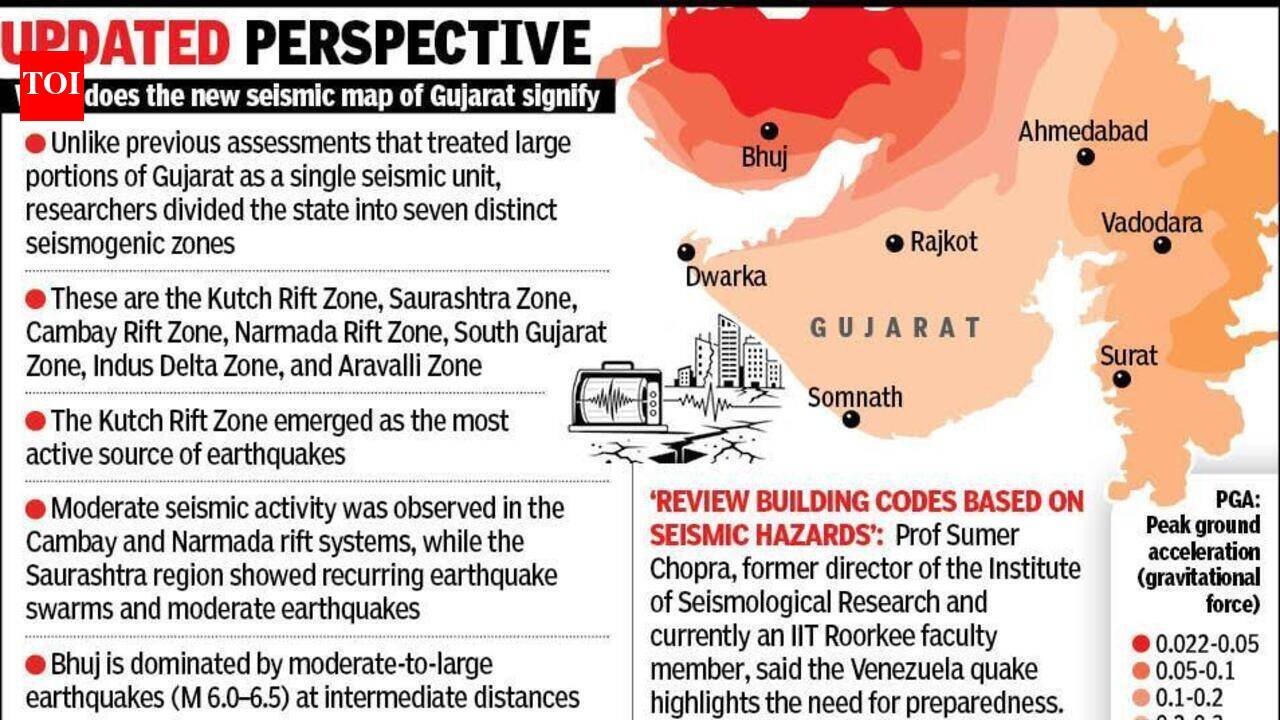
Ahmedabad: The devastating earthquake in Venezuela on Thursday hit close to home for Gujaratis who suffered the impact of a major quake in 2001. While the state sits in an earthquake-prone region with major historic earthquakes, a recent study updated the seismic hazard assessment for different regions. While Kutch remains the most earthquake-prone zone, urban centres such as Ahmedabad and Rajkot are also at risk for different reasons, the researchers indicated.The authors also shared lessons from the Venezuela earthquake and advocated seismic audits based on building codes and regular training for faster evacuation.The study, ‘Comprehensive surface level seismic hazard assessment for the state of Gujarat, India: Implications for resilient infrastructure and communities’, was recently published in the Geosciences Journal by Springer.The authors are Madan Mohan Rout, Vijay Singh Chufal, Sambit Prasanjit Naik, Sumer Chopra, B Sairam, and Uday Bhan from ISR Gandhinagar, University of Petroleum and Energy Studies, Dehradun, and University of Technology and Management.The authors explained that the study’s primary focus was probabilistic seismic hazard assessment (PSHA). Drawing on records of all 1,288 earthquakes from the past 350 years, the authors calculated a 2% and a 10% probability of ground shaking reaching certain levels — measured as peak ground acceleration (PGA), a standard gauge of how violently the ground moves.For example, if the epicentre of a strong earthquake is in Kutch, the PGA for the district would be 0.51 g (gravitational acceleration of Earth) at the bedrock level and up to 0.57 g at the ground surface in parts of Kutch.To put the figure in perspective, the 2001 earthquake had a PGA of 0.3 to 0.6 for different parts of the district, indicating widespread devastation. Any value above 0.1 can affect built infrastructure, the experts said.Compared to a conventional map that relies on the seismic scale, the PSHA focuses on potential ground shaking. The authors said that for a region like Gujarat, which is ‘among the most earthquake-prone intraplate regions in the world,’ the data helps review building codes and disaster response.The state has been hit by two earthquakes exceeding magnitude 7.7 in less than two centuries, both with the epicentre in Kutch.“Ahmedabad, the state’s biggest city that saw a lot of devastation and loss of lives in 2001, records a projected PGA of 0.05 g to 0.08 g,” a researcher said. “State capital Gandhinagar also has similar values. However, lower values do not automatically reduce the risk. Urban areas situated on softer sedimentary deposits may be at higher risk than suggested by the predictions from bedrock alone.”The study also suggests that broad seismic zoning maps currently used for building design may not adequately capture local variations in hazard.While national building codes classify large areas under common seismic zones, the new assessment demonstrates substantial differences in risk even within the same administrative region. Thus, a re-look at industrial clusters is required, the experts said.Component II‘Review building codes based on seismic hazards’Ahmedabad: Prof Sumer Chopra, former director of the Institute of Seismological Research and currently an IIT Roorkee faculty member, said the Venezuela quake highlights the need for preparedness. “Critical Ahmedabad structures should adhere to building codes based on the seismic hazards,” Chopra said.===Box==Checks in place, say AMC officialsAhmedabad: A senior AMC official said, “Since the 2001 earthquake, every new building has had to be designed by an authorised structural engineer to meet earthquake-resistant standards.”The official said, “Older buildings need structural assessments, maintenance, and repairs, especially before the monsoon.”Component IIIUpdated perspectiveWhat does the new seismic map of Gujarat signify– Unlike previous assessments that treated large portions of Gujarat as a single seismic unit, researchers divided the state into seven distinct seismogenic zones– These are the Kachchh Rift Zone, Saurashtra Zone, Cambay Rift Zone, Narmada Rift Zone, South Gujarat Zone, Indus Delta Zone, and Aravalli Zone– The Kachchh Rift Zone emerged as the most active source of earthquakes– Moderate seismic activity was observed in the Cambay and Narmada rift systems, while the Saurashtra region showed recurring earthquake swarms and moderate earthquakes– Bhuj is dominated by moderate-to-large earthquakes (M 6.0–6.5) at intermediate distances– Seismic hazard in Rajkot is primarily governed by far-field large events associated with regional Kachchh–Saurashtra tectonic sources– In contrast, Ahmedabad is controlled by near-field moderate earthquakes linked to local and Cambay Rift-related faults, making it more sensitive to site and soil effects– These insights will be useful in designing structures
