


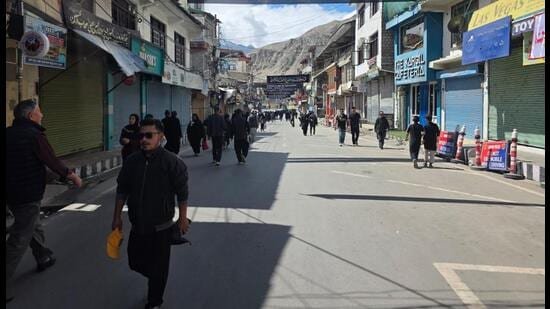
A shutdown disrupted normal life across the Union Territory of Ladakh on Tuesday as scores of protesters held a rally at the Polo Ground in Leh. Driven by a joint call from the Leh Apex Body (LAB) and the Kargil Democratic Alliance (KDA), the protest aimed to register public anger against the central government’s alleged failure to honour understandings reached during high-level talks on May 22.
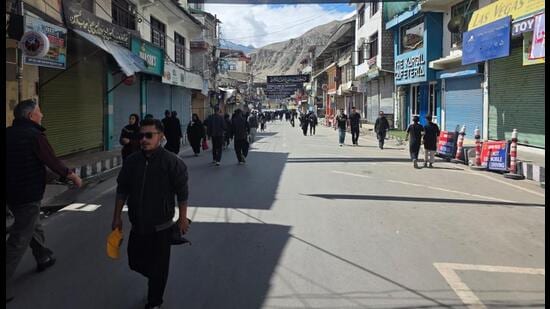
Shops, businesses, and private institutions remained closed across both the Leh and Kargil districts, with the strike extending into rural pockets like Zanskar. “There is some impact of the bandh in Zanskar. The shops are closed for half day,” said superintendent of police, Zanskar, Rigzin Sangdup.
Public and private transport services were largely exempted to accommodate the ongoing tourism season, keeping traffic movement normal. The police authorities said the situation remained peaceful. Leh superintendent of police Shree Ram said that the situation was calm. “There is a gathering of people for which permission was given at Polo Ground. Everything is fine,” he said.
A police officer in Kargil said while shops were closed, traffic plied as usual and the situation was peaceful.
Omissions trigger protest
The latest trigger in the five-year-old agitation stems from the May 22 meeting between Ladakh representatives and a sub-committee of the Union home ministry. According to LAB and KDA leaders, that meeting yielded concrete agreements on restoring democracy to the region. This included granting constitutional safeguards on the lines of Nagaland, Sikkim, and Mizoram through a proposed Article 371K, alongside bringing the local bureaucracy—including the chief secretary—under the authority of an executive led by the people of Ladakh.
However, Ladakhi leaders allege these crucial agreements were entirely omitted or distorted in the official minutes of the meeting issued by the Centre. “In the meeting with the sub committee of home ministry, some decisions were made but those decisions were not reflected in the proper manner in the minutes, we refused to sign the document and sought its rectification which never came,” said LAB co-chairman Chering Dorjay Larkuk.
Larkuk accused the government of using stalling tactics to buy time, warning: “It should not be one step forward and two steps backward. These tactics of the government reflect that their intentions are not right. This appears to be an attempt to buy time by involving us in talks. We have decided that we will not remain silent. They might be thinking that they will not raise their voice on the scheduled visit of the Dalai Lama to Ladakh.”
The Dalai Lama is expected to be in Leh early next month.
He said that LAB and KDA representatives then held a meeting on June 19 and decided to protest the omissions by the government.
The groups are demanding an immediate rectification of the minutes to accurately reflect agreements regarding control over employees, Article 371 safeguards, and the top bureaucrat’s performance appraisal issue. “These things are crucial for us and we think that the government should remain committed to the decisions taken in that meeting,” Larkuk added.
‘Unilateral governance’
Public anger has been further fuelled by the lieutenant governor-led administration, which the LAB and KDA accuse of taking major policy decisions “behind closed doors” without local consultation. Protesters are demanding an immediate rollback of newly introduced reforms concerning land conversion laws, the liquor policy, power, transport, and tourism, arguing these measures directly undermine the aspirations of the local population.
Ladakh has seen political unrest since 2019 when the Centre abrogated Article 370, stripping the erstwhile state of Jammu and Kashmir of its special status and splitting it into two Union Territories. Unlike Jammu and Kashmir, Ladakh was carved out without a legislative assembly, leaving it entirely under bureaucratic control.
Tensions in the region peaked previously following a chaotic period that saw curfew impositions and the near six-month incarceration of climate activist Sonam Wangchuk under the National Security Act (NSA), before his release on March 14.
Calls to Shurbir Singh, divisional commissioner of Ladakh, and Baseer Ul Haq Choudhary, administrative secretary information and public relations, for a reaction to the developments didn’t yield any response.
Box
Day’s developments, demands
*Businesses and shops across Leh, Kargil, and Zanskar closed, though transport was kept operational for the tourist season.
*Strike after the home ministry allegedly omitted key May 22 agreements—including state-like safeguards under Article 371 and democratic control over top bureaucrats—from official meeting minutes.
*Protesters demand withdrawal of recent unilateral laws on land conversion, tourism, and liquor passed by the unelected UT administration.
*Joint agitation by LAB and KDA continues to push for full statehood and constitutional protections under the Sixth Schedule.
