


What came first, the coconut grove or En Vilasam? According to its architect, Raj Andagere, the story of this gem-like private villa on the Alamparai coast, began with a sun-dappled gathering of coconut trees. They stood like silent sentinels, on a bed of buffalo grass. When Gomathi Subramanian, an antiques collector from Chennai, chanced upon them, her mind was set. She was eager to get out of the city and this very spot in the little fishing hamlet in Kadapakkam, between Mamallapuram and Puducherry, was the answer.
An aerial view of Alamparai Fort
With her Chettinad roots, armed with a book on the mansions in Karaikudi by renowned architectural historian and author George Michell, and rooms filled with antiques collected over the years, she knew what she wanted. It was then up to Auroville-based Andagere to find a balance between nostalgia and a unique contemporary language. “It was clear to me, what she wanted to build. We wanted to retain the spirit of those mansions and yet evolve,” says the architect who with his brother Ajith specialises in vernacular, craft-based, and eco-friendly design. “We knew that the house had to revolve around those trees and the waterbody,” he explains.
“En Vilasam is a reflection of Gomathi’s mind, her taste, and the way she saw the world. It stands as both her legacy and a quiet continuation of her artistic mind. This was a home she built to share and be appreciated and I wish to do the same.”Anjan RangarajOwner, En Vilasam
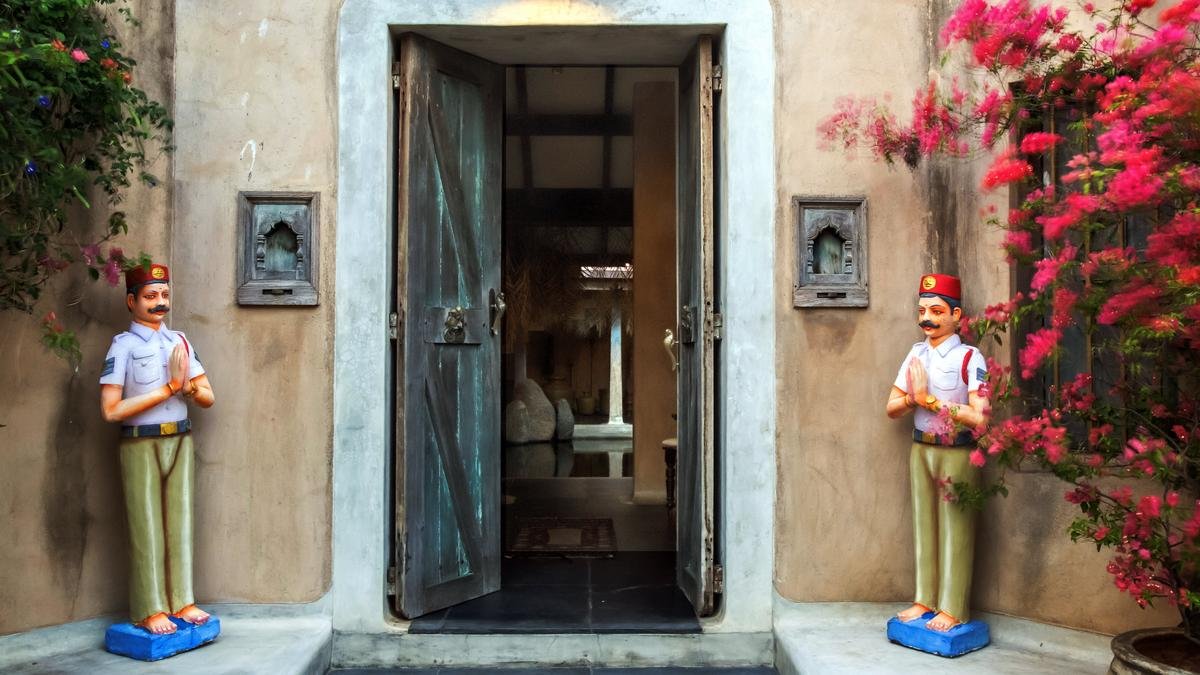
What he created in 2018-19 blended with the landscape, had “good bones” as Andagere puts it, and its owner’s personality. Take the entry point, with its deliberately high walls, flanked by two policemen statues. “We purposely used narrow doors so you only see the reflection of the water,” says Raj.
The narrow doors let you only see the reflection of the water
Once you enter, a sequence of openings reveal little bits of this Tamil home: sunlight glancing off the surface of a koi pond in place of a courtyard, ancient granite columns, old family photos, hand-plastered ochre walls. “Humans are curious creatures,” he points out, and the idea was to encourage visitors to discover something new along the way, from a bridal wooden chest to a brass wash basin, to an open shower. Everything from the louvered French accordion doors to the rotating book shelf in one of the bedrooms to the Tanjore art is an invitation to slow down, to inspect, to take home an idea.
Louvered French accordion doors and a rotating book shelf
Booking a sensory experience
About three years ago, when Chennai-based villa rental company, LuxUnlock, met with En Vilasam’s current owner, Anjan Rangaraj and added this property to their portfolio, more people were able to soak up this experience. “Every detail carries a part of Gomathi, which makes it deeply personal to me. This was a home she built to share and be appreciated and I wish to do the same,” says Bengaluru-based Rangaraj, who inherited the villa when Subramanian passed away. It has become a retreat for design-forward couples and families who want a different kind of luxury: one that factors the landscape and community around the home.
“The fishing village still has a wonderfully unselfconscious rhythm to it. Early mornings around the backwaters are particularly beautiful — fishermen heading out, birds over the estuary, the light changing over the ruins of Alamparai Fort,” says Ashish Gupta, founder, LuxUnlock. Of over 40 properties that his company operates in South India, he says that to him, En Vilasam feels the most emotionally layered. “What I love about it is that it doesn’t try to be conventionally luxurious. It is earthy, eccentric in parts, deeply Tamil in its references, and very atmospheric,” adds Gupta, rattling off the many types of sea shells to be found along the coast.
The garden
“What I love about it is that it doesn’t try to be conventionally luxurious. It is earthy, eccentric in parts, deeply Tamil in its references, and very atmospheric. The house opens itself slowly — through antique objects, changing light, the sound of water around the koi pond, glimpses of palms and sea beyond. The setting also adds so much character. You are in a quiet fishing village beside the ruins of Alamparai Fort, and life still moves at an older coastal rhythm there. Guests often arrive expecting a beach villa, but leave talking about the feeling of the place instead.”Ashish GuptaFounder, LuxUnlock
Ashish and Rucha Gupta
The magic of lime plaster
Incidentally, the scholar Michell was Andagere’s professor when he was studying architecture in Melbourne. Andagere talks about plastering with lime and sand, and using pigments such as brick powder. “The lime, as I am still discovering, grows harder as it grows older. It stays alive. It changes with the seasons, getting darker with the rains and lighter in summer,” he says. Our love for such materials is in our DNA, he chuckles, referring to how we gingerly step into fancy Louis Vuitton or Bulgari showrooms, while an old Indian house made of humble materials “feels like an embrace”.
What was the biggest challenge at En Vilasam? “Setting up nine roofs, given the rectangular-shaped site and the courtyard and corridors,” says Andagere, recalling how coconut rafters sourced from Karnataka were used throughout the house to bring down the expenses. “Gomathi had many stacks of those louvered doors. The stone columns had spots of paint and we chose not to clean them up. It was a bit of a puzzle, putting this place together with her antiques and our design,” he continues.
Louvered doors at En Vilasam
Personal and free-spirited
Each of the three bedrooms in this villa has a distinct character and opens out into the verandah, while the bathrooms are hand-plastered an emerald green and lapis lazuli. “Most guests say the home feels ‘unexpected’. They don’t quite know where to place it initially, because it doesn’t follow a predictable luxury-villa aesthetic.
“We were travelling as a group of six friends. En Vilasam is an intimate retreat with the feeling of a home. What we loved most was the charm of the property — the lovely details tucked around the house, and the seamless indoor-outdoor spaces that invited us to slow down, gather, and enjoy the rain. There’s a warmth and thoughtfulness to the place that makes it feel deeply personal.”Solachi RamanathanPrincipal architect, Urban Workshop
There are strong Tamil coastal influences, Chettinad references and antique elements, but everything has been interpreted in a very personal and free-spirited way,” explains LuxUnlock’s Gupta. You can stop by an open shower at the entrance to wash away the sand from the silky smooth beach nearby or settle down with a book in the garden lounge. A bamboo reed roof and a table built from reclaimed catamaran logs and old railway benches is the ideal setting to plan the day’s activities – perhaps a visit to the crumbling 18th century fort of Alamparai or a local fish meal at a small restaurant nearby?
“The open-to-sky bathrooms, hand-plastered walls, old doors, bold colours and collected artefacts make it feel more like someone’s artistic home than a designed hospitality space,” continues Gupta.
“I think people also respond instinctively to the sensory quality of the house. The sea breeze moves through the corridors, there’s water reflecting light into the rooms, and the textures are all very tactile — stone, lime plaster, old wood, brass. It feels lived-in rather than styled,” he concludes.
Details: luxunlock.com
Published – April 25, 2026 10:28 am IST
