


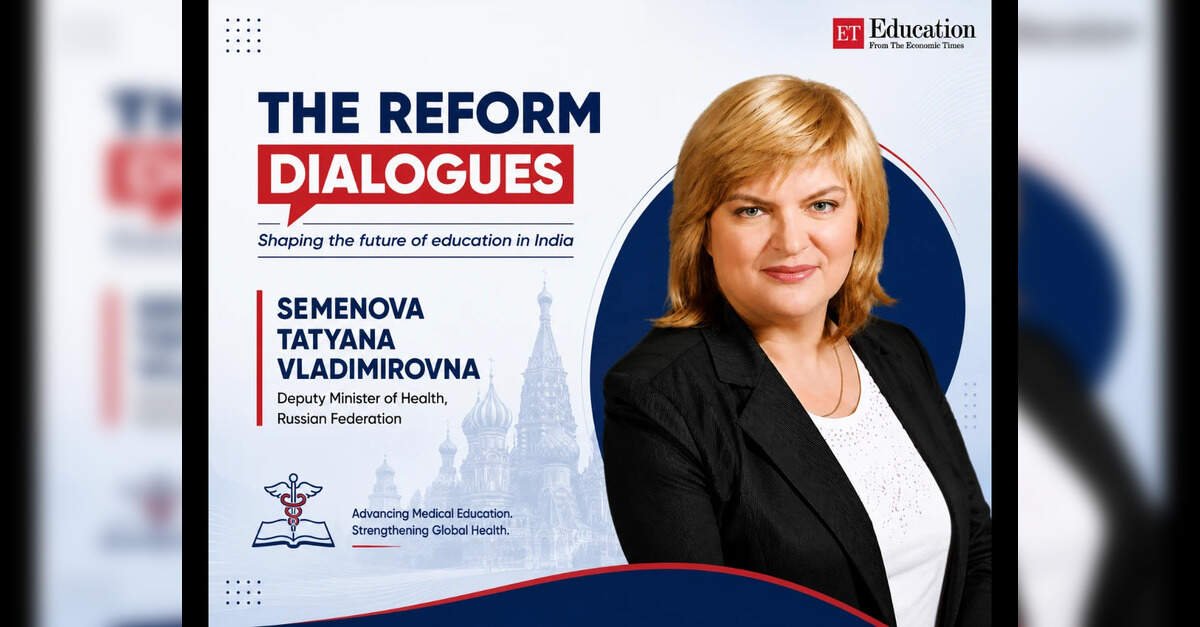
As India strengthens oversight of foreign medical education through stricter regulatory requirements, overseas destinations popular among Indian MBBS aspirants are adapting to a changing landscape. Russia, one of the leading destinations for Indian students pursuing medical education abroad, says its existing academic framework already aligns with most of India’s 2021 Foreign Medical Graduate regulations.
In this edition of Reform Dialogue, Semenova Tatyana Vladimirovna, Deputy Minister of Health of the Russian Federation, discusses Russia’s engagement with Indian regulators, curriculum alignment with India’s medical education norms, the growing use of artificial intelligence and simulation-based learning in medical training, and the future of India-Russia cooperation in healthcare education. Edited excerpts:
Q. India has tightened regulations around foreign medical education. How are Russian medical universities adapting to these new standards?
Deputy Health Minister Semenova: The regulations adopted by India in 2021 have been studied very carefully by the Russian Federation. We have maintained continuous engagement with India’s Ministry of Health and Family Welfare and the National Medical Commission to understand the requirements and ensure compliance.
In December, the Health Ministers of both countries met to discuss these issues, and we have remained in regular contact since then. Our objective is to ensure that students are not adversely affected by regulatory changes while maintaining high academic standards.
We continue to work with Indian authorities and relevant stakeholders to finalise approaches for implementing these requirements across Russian medical universities.
Q. Have Russian universities redesigned their curricula to align with India’s 2021 regulations?
Deputy Health Minister Semenova: The regulations introduced by India did not require major changes to our curriculum. Russian medical education already follows internationally recognised standards and includes the competencies outlined in the Indian framework.
We reviewed and harmonised the list of disciplines and internship-related requirements referenced in the regulations. While Russia does not traditionally have a separate one-year internship structure, the required training hours and competencies are already embedded within our existing programmes. As a result, no significant curriculum redesign was necessary because our programmes already provide the academic and clinical foundations expected under the new requirements.
Q. How are Russian medical universities integrating artificial intelligence, simulation-based learning and digital healthcare technologies into medical education?
Deputy Health Minister Semenova: New technologies, including artificial intelligence, are being used across our medical education system for all students. Russia has invested significantly in simulation-based education, and today domestic manufacturers provide a wide range of solutions ranging from dental training systems and physical examination simulators to advanced robotic platforms.
Every medical university has dedicated simulation centres that enable students to gain practical experience in controlled environments before entering clinical settings. These technologies are integrated into the educational process because they reflect the realities of modern healthcare delivery. Our universities are equipping students with the skills required to work in increasingly technology-driven healthcare systems.
Q. Thousands of Indian students pursue MBBS degrees in Russia every year. How important are Indian students to Russia’s medical education ecosystem?
Deputy Health Minister Semenova: Russia has traditionally been among the leading destinations for international education. We believe education serves as a bridge between nations and helps strengthen cooperation at both institutional and societal levels.
Today, Russian universities host students from more than 150 countries, with Indian students representing one of the most significant groups in medical education. Russian medical universities provide students with exposure to a healthcare system that is designed to offer comprehensive care across diverse geographical regions and healthcare settings. We believe this experience is valuable for students and contributes positively to broader India-Russia educational cooperation.
Q. What are the key areas of India-Russia cooperation in medical education, and what should prospective Indian students know about ongoing regulatory discussions?
Deputy Health Minister Semenova: India and Russia are working closely to address administrative and regulatory issues arising from the implementation of India’s foreign medical education requirements. One area under discussion relates to professional practice and language requirements. Students studying in English may face practical challenges when interacting with Russian-speaking patients, creating certain administrative complexities that require mutually acceptable solutions.
Important progress was made during the ministerial-level discussions held last year, and consultations continue between relevant institutions in both countries.
Our objective is to ensure that students receive quality medical education while meeting the regulatory expectations of both nations. We remain committed to working with Indian authorities to create a framework that supports students and strengthens educational cooperation between our countries.
