


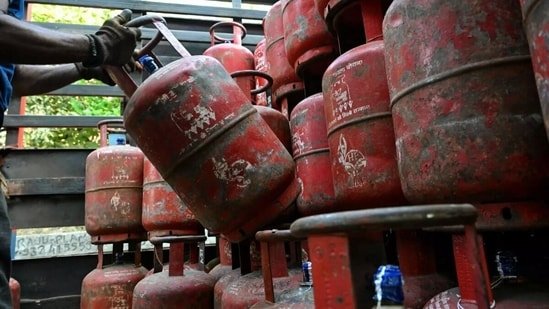
After the price of domestic LPG increased by ₹29 per cylinder, the ministry of Petroleum and Natural Gas on Sunday said that Indian households continue to pay significantly less for cooking gas than consumers in neighbouring countries and several advanced economies.

The ministry also said a beneficiary of the Pradhan Mantri Ujjwala Yojana (PMUY) effectively pays ₹642 for a 14.2 kg LPG cylinder, while the general consumer in Delhi pays ₹942. The actual cost of supplying the same cylinder has now crossed ₹1,600.
The government has increased the price of domestic LPG cylinders by ₹29 from Sunday, citing the sharp rise in international costs triggered by the West Asia crisis, according to news agency ANI.
International prices influence India’s LPG costs
According to the ministry, petroleum product prices in India are linked to corresponding international market prices. However, the government continues to moderate the effective price paid by households for domestic LPG.
Any household can purchase cylinders at ₹942. PMUY beneficiaries additionally receive a direct benefit transfer of ₹300 per cylinder on the first four refills every year, which is broadly the average annual consumption of a typical Ujjwala household. As a result, they effectively pay ₹642 for those refills, and this support remains unchanged.
The ministry said that even households not covered under PMUY are paying around ₹700 less than the market-linked cost of a cylinder. Retail prices may vary slightly across locations because of distribution costs.
Government says it is absorbing much of the burden
Explaining the pricing mechanism, the ministry said, “What the household does not bear the brunt of is the several hundred rupees a cylinder which the Government is bearing. Through a period of sharp international cost increases, that burden has been absorbed upstream rather than passed to the consumer.”
Why costs have risen
The ministry noted that India imports around 60 per cent of its LPG requirement and that the landed cost is linked to the Saudi Contract Price (CP), which is determined monthly by Saudi Aramco.
Also read | Delhi’s commercial kitchens feel the heat as LPG prices rise, here’s how eateries are adapting
Before the disruption in West Asia, the Saudi CP for LPG stood at about USD 543 a tonne in February. Following the closure of the Strait of Hormuz in late February, the April contract price rose to USD 775 a tonne, with propane at USD 750 and butane at USD 800. It has since increased further to USD 790 a tonne in June.
As a result, the blended LPG benchmark has risen by around 46 per cent since February, pushing up the cost of imported LPG.
The ministry said that based on the June contract price, the cost of supplying a 14.2 kg cylinder on an import-linked basis has risen to over ₹1,600. The under-recovery being absorbed on each domestic cylinder is now about ₹700.
Commercial cylinders reflect international prices
Unlike domestic cooking gas, the price of commercial LPG cylinders used by hotels and businesses is revised automatically every month because it directly reflects international benchmarks.
The ministry said that a 19 kg commercial cylinder in Delhi is currently priced at ₹3,113.50, or about ₹164 per kg, after five increases during the West Asia crisis. By comparison, a domestic household pays about ₹66 per kg after the latest revision.
It also noted that commercial gas carries higher taxes and larger margins, placing its price above the cost-reflective level for households.
Opposition on price hike
On Domestic cooking gas LPG prices rising by ₹29 per cylinder, Karnataka Minister Yathindra Siddaramaiah told news agency PTI, “When crude oil prices were lower, the government didn’t pass on the benefit to the common people. Now, when the international price has increased, it has been passed on to the people. This government has been very anti-people and is not looking in the interest of the people.”
“This is causing a huge problem because it’s making inflation skyrocket. It is an absolutely difficult time for the middle class. The government should have accepted it, explained it to the public, and taken them into confidence. Instead, they kept saying all the time that we are the Vishwaguru,”Congress MP Vivek Tankha was quoted as saying by PTI.
Measures taken to secure supply
According to the ministry, domestic LPG production was increased by more than 60 per cent, from about 32 TMT to around 52 TMT, to offset constrained imports.
It also said sourcing was expanded to suppliers across the world, including those that do not route through the Strait of Hormuz, such as the United States, Canada and Algeria. Available LPG supplies were prioritised for households and essential users like hospitals and educational institutions.
On the demand side, consumers were encouraged to shift to piped natural gas (PNG) where available. To prevent diversion of subsidised domestic LPG into the commercial market, OTP-based delivery verification was raised to about 90 per cent in coordination with state governments and industry associations.
The ministry urged people to use this precious resource carefully and adopt energy-efficient cooking practices.
(With ANI inputs)
