


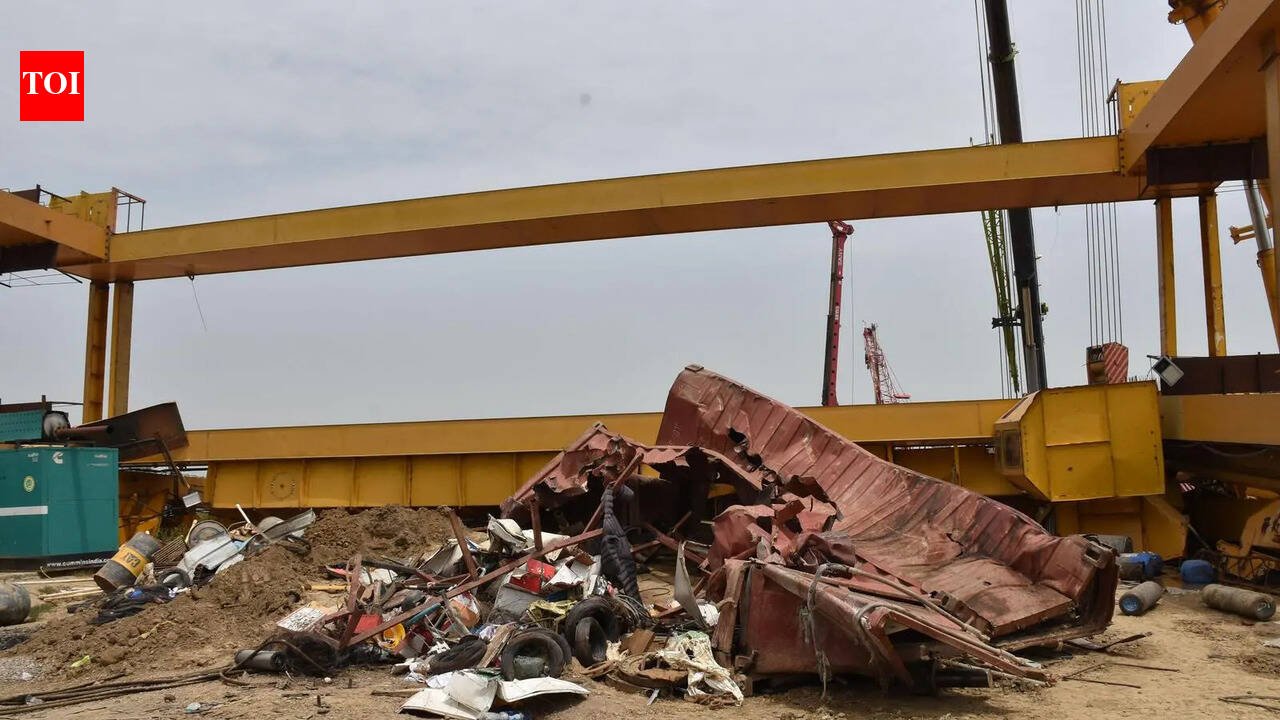
Gurgaon: The death of three workers after two double-girder gantry cranes collapsed at the casting yard of NHAI’s 31-km long connectivity project linking Noida International Airport with the Delhi-Faridabad-Ballabhgarh-Sohna stretch of Delhi-Mumbai Expressway has brought scrutiny on safety management at construction sites, especially during bad weather events.NHAI has constituted a two-member committee, comprising its officials, to investigate and the panel visited the site on Friday. On Thursday, at least two NHAI officials had told TOI that the incident did not happen due to safety lapses.“At this stage, it is difficult to speculate on the cause of the collapse. We have seen videos of the incident and, prima facie, strong winds and stormy weather appear to have contributed. The committee will examine all aspects before submitting its findings,” a senior NHAI official said.But experts cautioned against attributing the collapse to weather alone. Gurgaon-based mechanical engineer RK Agrawal said such failures typically involve multiple factors and are not down to a single event.“These are heavy-duty machines engineered with significant safety margins, including provisions for extreme weather. It would be premature to attribute the failure solely to strong winds,” he said.Agrawal flagged foundation instability, improper load balancing, wear and tear, inadequate maintenance, lubrication failures, alignment issues and overloading as possible contributing causes, and called for a forensic examination of equipment, maintenance records and site conditions.He added that moving parts require regular inspection. “Worn-out components, unusual vibrations or abnormal noises are indicators that machinery needs immediate attention. Unfortunately, such signs are sometimes ignored until a major failure occurs,” he said.The cranes, each weighing around 100 tonnes and used for girder-lifting operations, were not in operation at the time. Police said high wind pressure during Thursday’s dust storm may have affected their braking systems, causing the structures — which move along iron tracks — to topple. Around 11 km of the greenfield corridor is being developed as an elevated road.
