


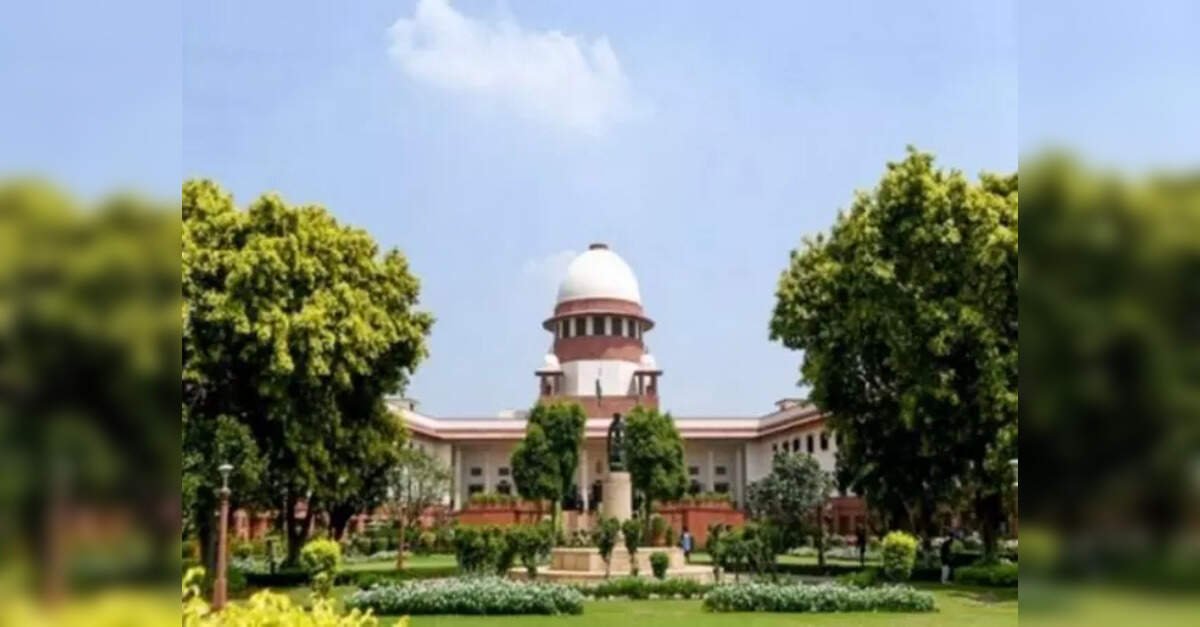
In a significant development in the Supreme Court’s ongoing crackdown on unauthorised constructions and land-use violations, the bench of Justice Ahsanuddin Amanullah and Justice R. Mahadevan has directed the Commissioner of the Greater Bengaluru Authority to submit a personal explanation after the Court noted, on the basis of an office report, that notice sent to the authority had allegedly been refused.
“We take note of the Office Report dated 19.05.2026 indicating that service is complete upon all respondents except the authority at Bengaluru, where notice was reportedly refused,” the bench noted.
“Since the same has been recorded in the Office Report, we direct the Commissioner, Greater Bengaluru Authority, to submit a personal explanation in that regard,” the bench added.
The order, passed in Loganathan v. The State of Tamil Nadu & Ors. escalated what began as a Tamil Nadu residential zoning dispute into a full-scale, nationwide audit of building law violations.
The case traces its origins to an unauthorized G+1 structure built without a sanctioned plan in Chennai. The Supreme Court, after dismissing the petitioner’s SLP on February 16, 2026, had directed the Greater Chennai Corporation to explain how such violations went unchecked. When the Court found the State of Tamil Nadu’s response unsatisfactory, it expanded the case on March 25, 2026, to examine illegal constructions on a pan-India basis, directing all State and UT capital municipal bodies to file affidavits.
The Court found the affidavit filed by Kakarla Usha, Additional Chief Secretary (ACS), Housing and Urban Development Department, Tamil Nadu to be “shocking” appearing more as a defence of the petitioner than an objective compliance report.
The Court noted that the unauthorised structure had remained intact even after the SLP was dismissed on February 16, 2026, at which point all interim protection had ceased. It held that the continued existence of the structure “prima facie suggests connivance” and directed the ACS, Tamil Nadu to be personally present at the next hearing with a show-cause response explaining why action should not be initiated against her.
Amicus Curiae Ajit Kumar Sinha told the Court on May 20 that affidavits had been received from only three States, and even those merely described survey results without detailing any remedial action taken.
He highlighted that in Delhi’s high-footfall commercial hubs including Lajpat Nagar and Sarojini Nagar, buildings sanctioned for two storeys have been constructed far beyond those limits, with foundations structurally incapable of bearing the additional load.
When the bench queried the Municipal Corporation of Delhi‘s senior counsel, the response that “multiple usages are permissible under the Master Plan” was rejected. The Court held that once a building plan is sanctioned for a specific use, any subsequent change of user “amounts to nothing short of a fraud on the system,” and that the MCD‘s stance “may even indicate tacit collusion and connivance with the violators for extraneous considerations”.
The Court directed all respondents to file fresh affidavits, personally affirmed by the head of the authority, detailing concrete action already taken on the ground. It clarified that “follow-up action” means immediate measures, including sealing, demolition, or other legally required steps.
The bench made clear that if any respondent, including those newly added, fails to file an affidavit by the next date, the head of that authority must be personally present in court with a show-cause response. Failure to appear without a satisfactory explanation may result in initiation of contempt proceedings.
The matter has been listed for further hearing on August 4, 2026.
