


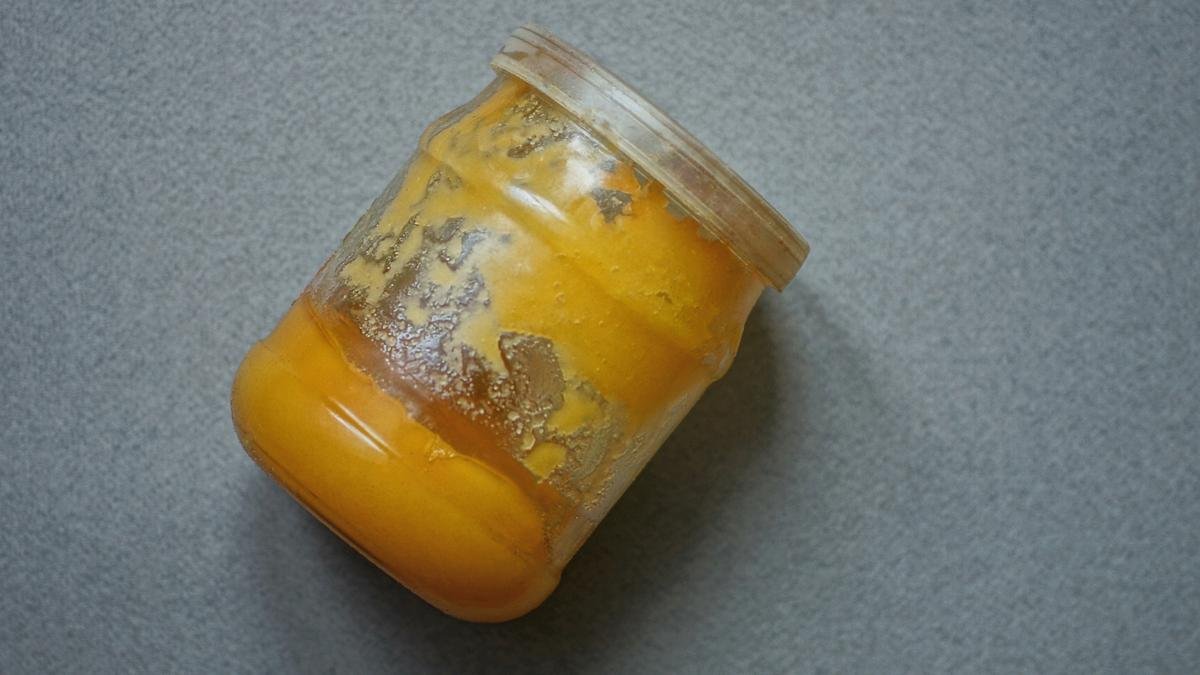
Image used for representational purposes only.
| Photo Credit: Getty Images/iStockphoto
Guwahati
The red-orange pigment from carrots can make fake ghee dodge a popular quality test to pass off as a premium product sourced from cows, a new study has found.
Researchers from the Indian Institute of Technology (Banaras Hindu University) in Varanasi, Uttar Pradesh, have demonstrated that non-dairy fats, such as palm oil and lard or rendered pig fat, can be engineered to mimic the Raman spectral signature of authentic cow ghee simply by adding a beta-carotene-rich carrot extract.
Cow ghee naturally contains beta-carotene, responsible for its yellowish colour. The researchers are Vineet Sharma, Ajay Kumar Bind, Shreyans K. Jain, and Venkatanarayan Ramanathan. Their study has been published in the latest issue of the Journal of Raman Spectroscopy.
The findings, although based on a small sample size, raise concerns about fraud in India’s premium dairy market. They also challenge the efficacy of Raman spectroscopy, a rapid testing technique widely used by food regulators and laboratories.
Named after Nobel laureate C.V. Raman, Raman spectroscopy is considered a powerful analytical quality test. It acts as a molecular fingerprint to verify the exact chemical composition, crystalline structure, and purity of a substance.
The IIT (BHU) team investigated whether the characteristic Raman signatures associated with cow ghee could be artificially recreated with other fats.
Previous studies have treated three Raman spectral peaks of beta-carotene — at 1,006, 1,157, and 1,520 cm−1 — as reliable markers for authenticating cow ghee. These peaks are often absent in non-dairy fats.
To test the robustness of these markers, the researchers fortified samples of lard and palm oil with carotenoids extracted from carrots. Both lard and palm oil displayed the same Raman peaks traditionally attributed to cow ghee.
The fortified fats also acquired the yellow-orange colour similar to cow ghee, making them resemble the dairy product in appearance and spectroscopic profile.
The team conducted another experiment using lard. A master mixture containing carotenoid extract was progressively diluted to determine the minimum concentration at which the characteristic Raman signals remained visible. They found that carotenoid markers could still be detected at concentrations as low as 0.22 milligrams per gram of lard, equivalent to 0.022% by weight.
Additional test
While Raman spectroscopy clearly detected the added carotenoids, a complementary analysis using Attenuated Total Reflectance Fourier Transform Infrared (ATR-FTIR) spectroscopy showed little change in the underlying lipid composition of the fats. The FTIR spectra remained dominated by the signatures of lard and palm oil, indicating that the resemblance to cow ghee arose primarily from the added pigments rather than any transformation of the fats.
The researchers said their study was designed as an “anti-fraud proof-of-concept” to highlight weaknesses in current screening processes and not to examine the adulteration of genuine ghee with other fats.
They said Raman spectroscopy was indispensable in detecting the beta-carotene peaks, but “compromise is inevitable” if it is solely relied upon for the authentication of cow ghee. “This vulnerability has severe ramifications in consumer protection and market integrity where cow ghee carries not only high economic value but also harbours immense sociocultural sensitivity,” they noted.
Published – May 31, 2026 08:00 pm IST
