


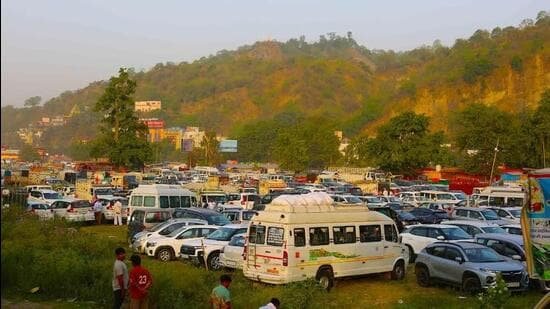
An unprecedented influx of tourists and pilgrims over the extended weekend put traffic management systems under severe pressure across Uttarakhand’s major destinations, with Mussoorie and Haridwar witnessing prolonged traffic jams and overcrowding, while Nainital made efforts to manage the rush through strict traffic regulations.

The surge in visitor numbers was driven by a combination of summer vacations, rising temperatures across north India, the ongoing Char Dham Yatra and the long weekend.
While the tourism boom provided a major boost to local businesses, it also exposed infrastructure limitations and raised concerns about the carrying capacity of popular destinations.
Mussoorie choked by traffic
The Queen of Hills witnessed one of its busiest weekends of the summers as thousands of tourists headed to Mussoorie to escape the scorching heat in the plains.
Traffic congestion began building up on Friday evening and intensified through Saturday, with major roads witnessing long queues of vehicles.
The Mussoorie-Dehradun Road, particularly the stretch between Kingcraig and Library Bazaar, remained clogged for hours, while bottlenecks were reported at JP Bend, Gandhi Chowk, Picture Palace and along the routes leading to Kempty Falls and Dhanaulti.
Tourists reported spending more than two hours covering short distances as traffic jams stretched for over two kilometres at several locations.
Long queues of vehicles were visible from Bhagat Singh Chowk to Kingcraig from early Saturday morning.
According to the officials, more than 3,000 vehicles entered Mussoorie daily since Friday, placing immense pressure on the town’s narrow roads and limited parking facilities.
Rahul Anand, sub-divisional magistrate (SDM), Mussoorie, said authorities implemented emergency traffic measures to prevent a complete breakdown of the transport network.
“The administration enforced a one-way traffic plan under which Mussoorie-bound vehicles were diverted through Kimadi, while Yamunotri-bound traffic was redirected via Vikas Nagar from Kuthal Gate. Large tourist vehicles and commercial tempo travellers were stopped at Kingcraig and tourists were shifted to authorised local shuttle services,” he said.
Authorities established dedicated shuttle drop-off points at Picture Palace and Library Bazaar and deployed additional police personnel and volunteers at key intersections.
By Saturday evening, heavy vehicles were stopped at Kuthal Gate and only tourists with confirmed hotel bookings were allowed entry.
Officials attributed part of the tourist surge to the recently operational Delhi-Dehradun Expressway, which has reduced travel time from Delhi to Dehradun to around three hours.
“The expressway made the journey very comfortable, but the last stretch to Mussoorie took nearly three hours because of traffic congestion,” said Mohamad Haris, a tourist from Noida.
The tourist influx also strained local infrastructure. Residents complained of increased pressure on drinking water supply, electricity services and parking facilities.
Environmental experts warned that Mussoorie may have exceeded its ecological and physical carrying capacity.
Environmental expert Vipin Kumar said a fresh carrying-capacity study is urgently needed.
“Improved accessibility through the Delhi-Dehradun Expressway is likely to further increase tourist numbers. The government should assess Mussoorie’s carrying capacity and consider regulating tourist inflow during peak seasons,” he said.
Despite the challenges, the tourism boom proved beneficial for local businesses.
Sanjay Agarwal, president of the Mussoorie Hotel Association, said hotel occupancy crossed 90% during the weekend. However, he stressed that inadequate parking remained the town’s biggest infrastructure challenge.
Haridwar struggles with pilgrim influx
Haridwar also witnessed an overwhelming rush of pilgrims and visitors due to the ongoing Char Dham Yatra, summer vacations and religious events associated with the auspicious Jyesth Purushottam month.
A journey from Haridwar railway station or bus stand to Har-ki-Pauri, a distance of around 2.5km that normally takes about 10 minutes, is now taking nearly half an hour on weekends.
Similarly, the 14-km stretch between Haridwar and Nepali Farm near Raiwala often takes more than an hour due to traffic congestion.
The scale of the rush was evident on May 24 during Somvati Amavasya when more than 24.52 lakh devotees arrived in Haridwar for a holy dip in the Ganga.
According to police estimates, nearly 8 to 10 lakh (800 thousand to 1 million)pilgrims and tourists are arriving in the city on regular weekends, while around 13 lakh (1.3 million) visitors arrived during Buddha Purnima earlier this month.
“A footfall of 24.52 lakh pilgrims was witnessed in Haridwar on a single day during Somvati Amavasya. As the Char Dham Yatra and summer tourist season are underway, traffic pressure rises considerably on weekends. Diversion plans, parking arrangements and traffic management measures have been put in place,” said Navneet Singh Bhullar, senior superintendent of police (SSP), Haridwar.
To review arrangements, district magistrate Mayur Dixit and SSP Navneet Singh Bhullar inspected Har-ki-Pauri and adjoining areas on Sunday.
Police identified several congestion hotspots, including Bahadarabad-Harilok tri-junction, Ranipur Jhal-Singhdwar, Shankaracharya Chowk, Chandighat intersection, Rodibelwala, Pantdweep parking area and the Bhimgoda cut on NH-58.
Additional police and traffic personnel have been deployed at these locations, while drone surveillance and live CCTV monitoring are being used to track traffic movement and crowd density.
State government is focusing on long-term solutions. Pradeep Batra, Uttarakhand transport minister, said a major ring road project, new flyovers on the Roorkee-Haridwar corridor, expansion of parking facilities and the near-completion of the four-laning of the Nagina-Haridwar highway are expected to significantly reduce traffic pressure in the coming years.
Nainital handles rush with strict traffic measures
Nainital witnessed a massive tourist influx but largely avoided major traffic jams due to strict traffic management measures implemented by the district administration and police.
Hotels, resorts and homestays across Nainital, Bhimtal, Mukteshwar and Ramnagar reported full occupancy as tourists escaped the intense heat prevailing across north India.
Officials estimated that more than 50,000 tourists visited Nainital district during the extended weekend.
More than 1,500 hotels, resorts and homestays in the district were fully booked. Popular attractions including Naini Lake, Mall Road, Snow View Point, Tiffin Top and Eco Cave Gardens witnessed heavy footfall throughout the weekend.
“It is extremely hot in the plains, which is why we have come to Nainital with our family. The weather here is very pleasant and we are finding immense relief,” said Sanjay Vashishth, a tourist from Kanpur.
Authorities imposed a temporary ban on the entry of two-wheelers into Nainital and Kainchi Dham and diverted tourist vehicles to designated parking facilities at Russi Bypass and Narayan Nagar.
Jagdish Chand, superintendent of police (Traffic), Nainital, said only vehicles with confirmed hotel bookings were allowed entry into the town, helping prevent congestion on key roads.
“In addition to traffic police personnel, staff from police stations and outposts have been deployed at strategic locations. Monitoring is also being carried out through district and city control rooms as well as drone surveillance,” he said.
Officials said the successful implementation of the traffic management plan ensured smooth vehicular movement despite one of the busiest weekends of the summer season.
