


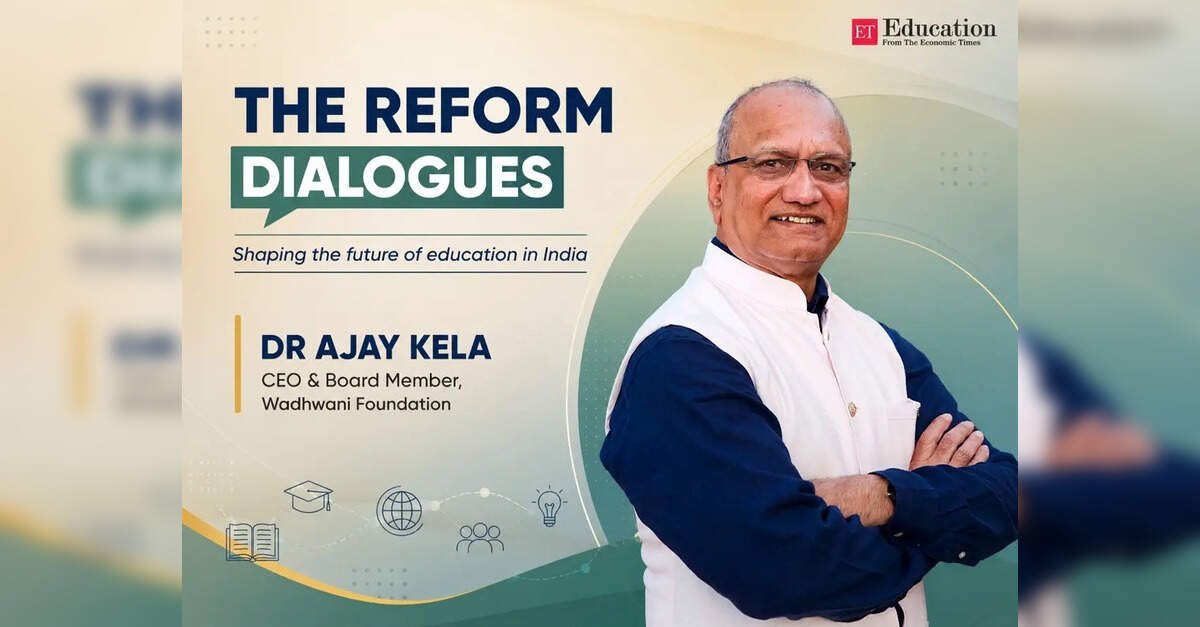
India’s universities need to move beyond publications and traditional degrees towards innovation, translational research, entrepreneurship, and continuous skilling, says Ajay Kela. In this conversation withETEducation, Dr Kela speaks about India’s research ecosystem, the academia-industry disconnect, employability in the AI era, and why the country must urgently build stronger lab-to-market pathways.
Q. India produces massive amounts of academic research every year, yet very little translates into globally scalable products or companies. Where do you think the system breaks down?
Dr Kela: The biggest gap has historically been in translation. Universities have been very good at generating research, publications, and patents, but publications alone do not change people’s lives. A lot of high-quality research remains inside laboratories because the ecosystem required to convert it into products or startups has not existed at scale. The incentives in academia have traditionally been aligned towards publishing papers rather than building products or companies. Faculty members and researchers are rewarded for publications and patents, not necessarily for commercialization or societal impact.About 10 years ago, we started working on this problem at IIT Bombay in biosciences and biotechnology. We selected projects where we felt there was strong translational potential. Out of around 120 projects that we funded over the years, nearly 20 translated into real-world solutions or startups. Many more are still in the pipeline. That demonstrated that India has enormous innovation potential if the right ecosystem exists around researchers.
Q. Was that success what eventually led to the creation of the Wadhwani Innovation Network and now the National Innovation Network (NIN)?
Dr Kela: Yes. After seeing the model work at IIT Bombay, we felt it needed to scale much more aggressively. Last year, we expanded through the Wadhwani Innovation Network across multiple institutions.
But then we realised something important. Even if you support 10 or 20 institutions, that alone is not enough for a country of India’s scale. We needed a much larger national ecosystem. That is where the Wadhwani Innovation Network comes in. The idea is to democratise innovation in India so that research translation is not restricted to only a few elite institutions.
We want India to become a global leader in innovation by creating pathways that help researchers move ideas from laboratories into products, startups, and societal solutions.
Q. Through WIN, what exactly is the gap you are trying to solve in the innovation cycle?
Dr Kela: There is already funding available for basic research through government agencies like DST and DBT. Venture capital also comes in when technologies are much closer to commercialization. But there is a massive gap in the middle stages, the translational phase.
A lot of research reaches a promising stage but then gets stuck because researchers do not have funding, infrastructure, mentorship, industry access, or entrepreneurial guidance to move further. We focus on supporting projects that are already showing promise and help them move towards proof-of-concept development, prototyping, validation, pilot deployments, industry partnerships, IP support, and eventually startups or commercialization.
But funding alone is not enough. Researchers also need access to labs, testing facilities, industry experts, and entrepreneurial training. A faculty member may be an outstanding scientist, but that does not automatically mean they understand how to build a company or take a product to market. That ecosystem support is equally important.
Q. So will this expansion move beyond IITs and elite institutions?
Dr Kela: It has to. If India wants to create a large-scale innovation ecosystem, it cannot remain limited to a handful of institutions. At the same time, translational research requires strong foundational research capability. So we cannot simply fund every institution. There has to be a pipeline of high-quality research already happening.
We have fairly stringent selection criteria before designating an institution as a Centre of Excellence. The institution must have strong research output, faculty capability, and commitment towards innovation. Our long-term goal is to build hundreds of Centres of Excellence across India in areas like AI, biotechnology, healthtech, quantum technologies, space technologies, critical minerals, and other strategic sectors.
Q. You also spoke about hub-and-spoke models in AI and research. How important will collaboration between institutions become going forward?
Dr Kela: Extremely important. No single institution can build the future alone. For example, one of the major areas we are investing in is AI. At IIT Kanpur, we are building a large ecosystem around AI with academic programmes, research centres, and translational capabilities.
Part of the responsibility of these leading hubs is also to nurture and support other institutions. So stronger institutions help build capacity across the ecosystem. That kind of collaborative model will become critical if India wants to scale innovation nationally rather than concentrate it in a few campuses.
Q. Industry often says graduates are not employable, while academia says industry does not collaborate enough. Why does this disconnect persist?
Dr Kela: Historically, academia and industry have largely operated in silos. Academia focused on research, theory, and publications, while industry looked for deployable solutions and immediately usable talent. There was limited alignment between what universities produced and what industry actually needed.
But this is slowly changing. India’s startup ecosystem has had a very significant cultural impact on campuses. Researchers and faculty members are now seeing students become entrepreneurs and build companies. That entrepreneurial mindset is growing. Government initiatives around innovation, commercialization, and translational research are also creating momentum.
The encouraging part is that institutions are beginning to recognise that societal impact and commercialization matter alongside academic excellence.
Q. Many institutions are now discussing commercialization and industry-linked research much more openly than before. Do you see a mindset shift happening?
Dr Kela: Definitely. Earlier, commercialization was often viewed negatively within academic ecosystems. That mindset is changing rapidly.
Now institutions are beginning to understand that creating products, startups, and technologies which solve real-world problems is also a valuable academic outcome. Some institutions are already evolving their incentive systems. Commercialization and translational impact are increasingly becoming part of discussions around faculty growth and institutional success.
India’s startup ecosystem has accelerated this shift because it has shown that innovation can create both economic value and societal value.
Q. Are universities moving fast enough to prepare students for an AI-driven economy?
Dr Kela: Not fast enough. The pace of technological change today is extraordinary. Skills are evolving constantly, especially because of AI. Universities cannot continue operating with static curricula designed for a completely different era.
We are moving into a world of continuous learning. People will need to reinvent and upgrade themselves continuously throughout their careers. The future will increasingly revolve around competencies and skills rather than only traditional degrees. Employers are already placing greater emphasis on what people can actually do.
AI is also changing how learning itself happens. Personalised learning, AI tutors, adaptive skilling platforms, AI interview coaching, all of these are transforming education globally. Institutions will need to redesign learning around lifelong skilling and continuous adaptation.
Q. Do you think the traditional four-year degree model itself is under pressure?
Dr Kela: I think the model will evolve significantly over time. The reality is that industries today need continuously updated skills. Knowledge cycles are becoming shorter and shorter. We are already seeing employers value certifications, competencies, and demonstrable capabilities much more seriously. The future workforce will need constant upskilling and reskilling.
That does not mean universities disappear, but their role and delivery models will have to change substantially.
Q. If India wants to become a global innovation powerhouse by 2035, what higher education reforms cannot wait any longer?
Dr Kela: First, we need a much stronger innovation culture within universities. Faculty and researchers should be encouraged to think beyond publications towards products, startups, and societal impact.
Second, academia and industry need much deeper collaboration. Translational ecosystems cannot succeed in isolation.
Third, India must modernise academic programmes at scale so students are prepared for an economy driven by AI, entrepreneurship, emerging technologies, and continuous reinvention.
And finally, we need to dramatically expand translational research ecosystems across the country so that promising ideas do not remain trapped inside laboratories.
