


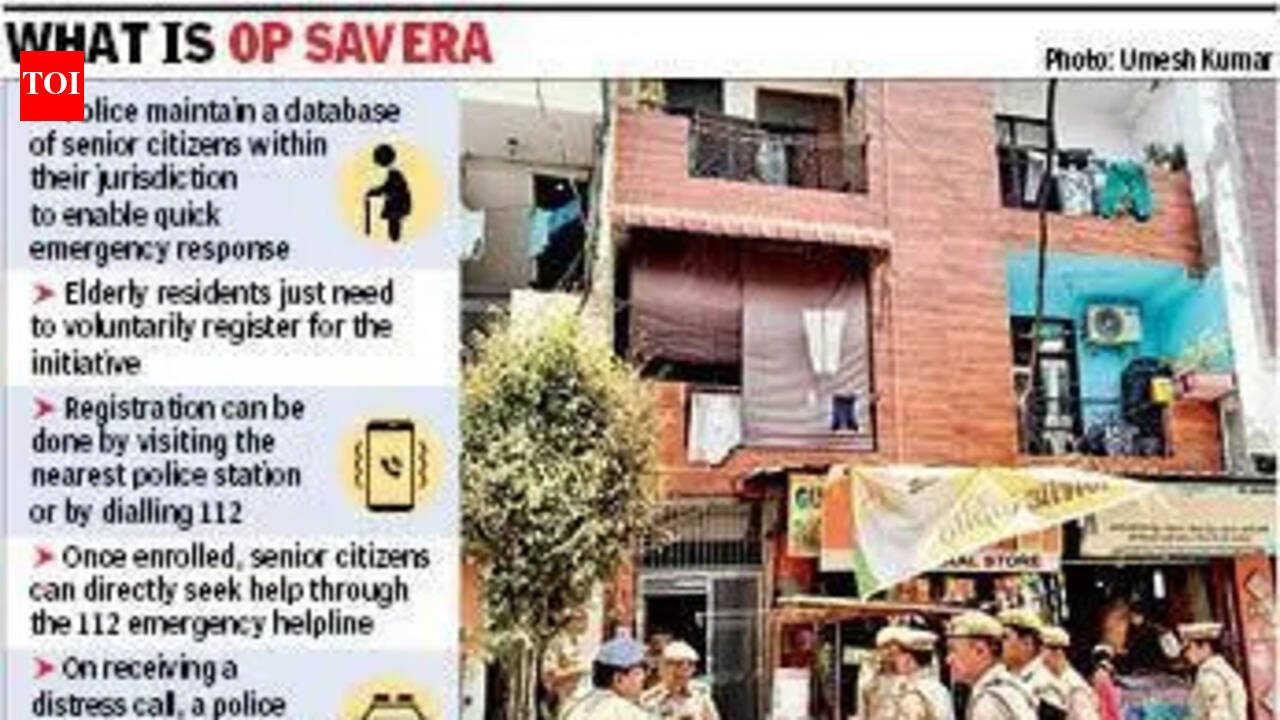
Ghaziabad: Operation Savera’s outreach workers regularly find elderly citizens living alone, cut off from family, enduring prolonged isolation, yet the programme, bound by its mandate, can only step in for welfare checks or when a health emergency strikes. The limitation came into focus this week after two elderly men, who had been living away from their families, were found dead in Shalimar Garden.With 2.6 lakh senior citizens registered across the district and around 7,000 police personnel involved in its implementation, the programme has a wide reach. But officials said it primarily focuses on emergency response and periodic outreach, and cannot fully address prolonged loneliness, isolation, or the absence of family support — conditions that its own workers routinely encounter in the homes they visit.Police said a local unit had visited the residence of Nem Singh (60) and Rakesh Sharma (75), who had been living alone and away from their families for years, on April 25 as part of routine checks under Operation Savera, just two days before their bodies were recovered.While officials ruled out foul play in both cases, ACP (Shalimar Garden) Atul Kumar Singh said the viscera of Rakesh Sharma were preserved after an autopsy failed to establish a clear cause of death. Nem Singh died of head injuries.While cops were unable to trace Sharma’s relatives, Nem Singh’s family was eventually traced to Delhi. “He has a 27-year-old son. His wife left him two years after their marriage, and for the last 14 years, he had no contact with his family. Nem Singh was driving Sharma’s auto and also served as his caretaker,” the ACP said.Officials said such cases are not uncommon. Beat constables assigned under the programme visit registered senior citizens once every three months, sharing emergency contact numbers and discussing basic safety measures. “But that is not enough among the elderly,” an official acknowledged.When a distress call is received or a resident is found unwell during a visit, police arrange admission to the nearest hospital. “It depends on their willingness and capacity to pay medical expenses. We do not have any financial power at our disposal,” said additional SP (protocol) Rajesh Kumar Pandey. Where patients are to be admitted to a govt hospital, the chief medical officer is informed, and police visits continue until the elderly person returns home.Pandey said families of many elderly residents had been contacted over the years — some living in other states, others abroad — but it was rare for them to return permanently or assume responsibility.“Unless there is a medical emergency, complaint, or immediate safety concern, the programme has limited scope for longer-term intervention,” Pandey said. “We are monitoring agents of the state, with no financial power and limited human resources. There is only so much at our disposal.”The CMO could not be reached for comment..
