


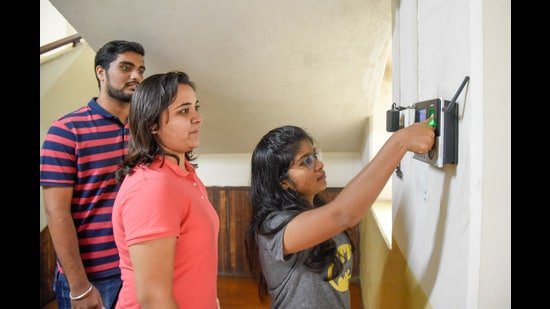
Amid growing concerns over the increasing dependence on “integrated” coaching-college arrangements for National Eligibility-cum-Entrance Test (NEET-UG) and Joint Entrance Examination (JEE) preparation, the Maharashtra government has said it is planning stricter monitoring of junior colleges through biometric attendance systems and closed-circuit television (CCTV) surveillance.

The move comes at a time when thousands of Class 11 and 12 students across Maharashtra remain formally enrolled in junior colleges but spend most of their academic year attending private coaching institutes. The issue has again come into focus following the ongoing NEET paper leak investigation, which has renewed scrutiny on the growing coaching-driven education ecosystem.
Lack of centralised mechanism
According to officials,75% attendance is mandatory in junior colleges. To check the same, biometric attendance was first introduced through the government resolution issued in 2018, primarily for science stream junior colleges, with the objective of ensuring regular student attendance and curbing the practice of students remaining absent from colleges while attending private coaching institutes. However, officials say it has been observed that the implementation of the biometric system was inconsistent across several institutions. Therefore, from the upcoming academic year, the school education department has decided to strictly reinforce compliance with biometric attendance provisions along with mandatory CCTV infrastructure to ensure greater transparency, accountability, and effective monitoring in colleges. Due to the absence of a centralised monitoring mechanism, authorities are also planning to conduct a review of compliance across institutions.
Education commissioner Sachindra Pratap Singh said the government is working towards improving transparency and accountability in junior colleges.
“The government is taking steps to strengthen monitoring systems related to attendance and academic functioning. Biometric attendance mechanisms and CCTV surveillance systems are being introduced in junior colleges to improve transparency and supervision,” he said.
The National Education Policy (NEP) has also acknowledged the growing coaching culture and its impact on mainstream schooling. However, with intense competition for limited seats in medical and engineering colleges, the integrated coaching-college model continues to attract thousands of students every year.
How integrated system works
Under the integrated system, students formally take admission in junior colleges while attending coaching classes for most of the day. Colleges and coaching institutes often coordinate schedules, examinations and attendance requirements to allow students to focus on entrance exam preparation.
For many aspirants, regular college attendance has become limited. Mayuri, a NEET aspirant from Beed currently studying in Pune, said she visited her college mainly during examinations. “After Class 10, I shifted to Pune for NEET preparation. My admission was in a college in Beed, but most of my time was spent in coaching classes, group discussions and solving practice papers,” she said.
Dhruv, a JEE and CET student from Chhatrapati Sambhajinagar, said several students in his batch followed a similar pattern. “My day starts at 6 am and continues till night because I attend separate coaching classes for different subjects. I had taken admission in a college where attendance was flexible. Almost everyone is focused mainly on entrance exams,” he said.
Students say the integrated model is now widely seen as a practical option for managing both board examinations and competitive exam preparation.
Apurva, an aspirant from Jalna, said, “I shifted to Chhatrapati Sambhajinagar for coaching while my college admission remained in Ambad. Since most of our focus was on entrance exam preparation, attending regular college lectures became difficult. We depended largely on crash courses for board exams.”
Broader gaps
Teachers and coaching faculty members acknowledge that the system has become a significant part of the competitive exam ecosystem.
Sudhakar Patil, a NEET faculty member in Pune, linked the trend to Maharashtra’s long-standing “Latur pattern”, which popularised exam-oriented preparation decades ago, said, “A large number of students preparing for NEET come from districts such as Beed, Chhatrapati Sambhajinagar, Nanded and Latur, where medical education is considered a secure career path. Over time, integrated colleges and coaching tie-ups have become common because students prioritise entrance examinations.”
Another coaching faculty member, Premraj Patil, said schedules are often coordinated between colleges and coaching centres. “Our coaching classes run for nearly seven hours daily. Many students are enrolled in colleges that coordinate schedules with coaching institutes so they can manage both academics and entrance preparation,” he said.
Education activists and student organisations, however, argue that the growing coaching-driven model has weakened the role of junior colleges.
MNS Vidyarthi Sena president Dhananjay Dalvi recently submitted a complaint to the deputy director of education, Pune division, seeking action against alleged dummy and integrated colleges operating in Pune and Pimpri-Chinchwad. The complaint referred to the Union government’s January 2024 guidelines for the regulation of coaching centres, which discourage dummy schools and colleges and prohibit coaching sessions during regular school or college hours.
According to the complaint, “Some institutions allegedly function mainly as attendance and examination centres while students spend most of their academic year in coaching institutes. It also sought an inquiry into attendance records, admissions and coordination between coaching centres and colleges.”
Education expert Harish Butle said the issue reflects broader gaps in the education system. “There is increasing dependence on coaching institutes because students and parents feel they are necessary for highly competitive examinations like NEET and JEE. The government needs to strengthen academic systems within colleges themselves so students do not feel compelled to rely entirely on private coaching,” he said.
He also pointed to concerns regarding attendance enforcement. “Attendance rules exist, but implementation needs closer monitoring. The government must ensure that academic requirements are followed properly while also improving the quality of education within junior colleges,” he said.
