


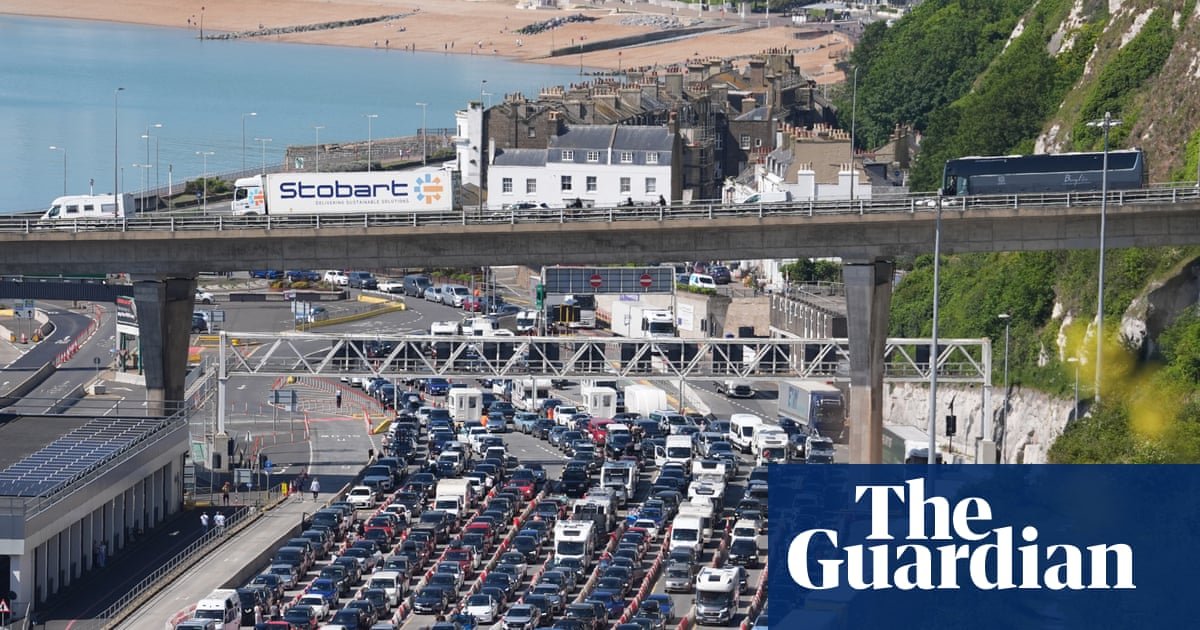
French police have temporarily suspended extra EU border checks at the port of Dover as thousands of holidaymakers faced long delays in the hot weather.
Wait times of more than two hours were reported at the terminal in Kent for the cross-Channel ferry to France. The delays come a month after the EU’s entry-exit system (EES), which replaces passport stamps with a digital registration, became fully operational.
The port of Dover said Saturday marked the “first peak period” since the new procedures were introduced.
Describing the situation as “challenging”, the port of Dover posted on X: “We are pleased that Police Aux Frontières (PAF) have responded positively by invoking the article 9 clause of the EES regulations.” This allows for checks to be temporarily relaxed.
“While conventional border checks will still be undertaken, this will now enable PAF to significantly reduce the border processing time,” the statement added.
“We will be working with PAF and all our partners to get customers into and through the port as swiftly as possible and keep the roads clear for our local community.”
Temperatures were expected to reach up to 29C in parts of England on Saturday. Images at Dover showed long queues of cars at the congested terminal, which is the departure point for ferries to Calais in northern France, a popular route for British tourists, especially at the start of the half-term school holidays.
The port said passengers who missed their ferry crossing as a result of waiting times would be able to travel on the next available crossing. It warned drivers to stay in their cars and treat its staff with “kindness and respect”, adding that “unacceptable behaviour towards staff will not be tolerated”.
EasyJet has called on EU countries – with a particular focus on Spain – to drop the new rules over fears that holidaymakers could lengthy delays, with the company’s chief executive, Kenton Jarvis, saying the additional checks would “put [holidaymakers] off” travelling.
The EES is used by EU countries – with the exception of Ireland and Cyprus – and other countries that are part of the Schengen free movement area, including Switzerland, Norway and Iceland.
Non-EU passengers and some transport providers have raised concerns about the new system, especially in Britain, which left the EU in 2020 under Brexit.
The system, which became fully operational in April, replaces passport stamps with a digital registration to make the EU’s borders more secure, more efficient and stronger against irregular migration, according to the European Commission.
Temperatures are forecast to rise throughout the bank holiday weekend, with record-breaking May temperatures as high as 33C (91F) expected in parts of the UK.
The Met Office has issued amber heat health alerts, which indicate a possible risk to life as well as potential damage to properties, significant travel delays and power cuts. They are in place for the East Midlands, West Midlands, the east of England, London and the south-east until 5pm on Wednesday.
The UK is forecast to have its hottest ever day in May over the long weekend, marginally exceeding the 32.8C recorded around parts of London, West Sussex and Kent more than 80 years ago, on 29 May 1944.
