


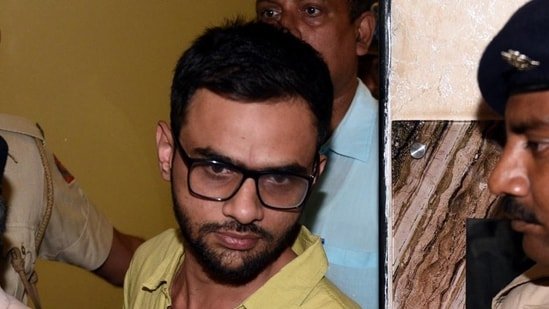
A Delhi court on Tuesday dismissed an interim bail plea moved by JNU student activist Umar Khalid, seeking to take care of his ailing mother and take part in post-death rituals of his uncle.

The order was passed by Additional Sessions Judge Sameer Bajpai of Delhi’s Karkardooma court.
Umar Khalid and others were booked under the Unlawful Activities (Prevention) Act (UAPA), an anti-terror law, and provisions of the Indian Penal Code (IPC) for allegedly being the “masterminds” of the 2020 riots that left 53 people dead and more than 700 injured in northeast Delhi.
The violence had erupted during widespread protests against the Citizenship (Amendment) Act (CAA) and the National Register of Citizens (NRC).
The fresh setback comes a day after a sliver of hope emerged for Umar Khalid as the Supreme Court criticised its January 5 judgment denying him bail and activist Sharjeel Imam in the alleged larger conspiracy case linked.
The top court bench emphatically held that “bail is the rule and jail is an exception” even in prosecutions under the Unlawful Activities (Prevention) Act (UAPA).
A bench of justices BV Nagarathna and Ujjal Bhuyan, while granting bail to Jammu and Kashmir resident Syed Iftikhar Andrabi in a narco-terror case investigated by the National Investigation Agency (NIA), expressed “serious reservations” about the reasoning adopted earlier this year by another two-judge bench comprising justices Aravind Kumar and NV Anjaria in the Delhi riots conspiracy case, as reported by HT earlier.
The court underlined that the January 5 verdict failed to correctly apply the binding principles laid down by a larger three-judge bench in Union of India Vs KA Najeeb (2021), which recognised that prolonged incarceration and delay in trial can override the statutory restrictions on bail under Section 43D(5) of the UAPA.
Reading out the operative portions of the judgment in open court, Justice Bhuyan observed: “Bail is not an empty statutory slogan. It is a constitutional principle flowing from Article 21, and the presumption of innocence is the cornerstone of any civilised society governed by the rule of law.”
The bench added: “Even under UAPA, bail is the rule and jail an exception. Bail can only be denied in a particular case depending on the facts of that particular case.”
