


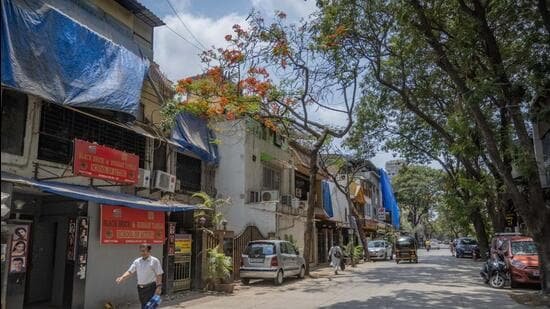
MUMBAI: Redevelopment plans in three prominent Mumbai localities have residents and MHADA on a collision course. Residents in all three localities say state-led urban renewal is taking away their autonomy over their own homes.

Last year, MNHADA notified Construction and Development Agency (C&DA) model, also known as ‘cluster redevelopment’, in Sardar Vallabhbhai Patel (SVP) Nagar in Andheri, Bandra Reclamation and Adarsh Nagar in Worli. However, in all three neighbourhoods, individual housing societies already have redevelopment plans underway, but MHADA is allegedly stalling them in some instances, aiming to bring as many societies as possible under its cluster model.
Under the C&DA model, MHADA, as the land-owning authority, appoints a private developer; residents are promised larger homes; MHADA receives a share of the redeveloped housing stock; and the developer retains a portion of the real estate to recover investments and generate profits.
Residents also say MHADA’s process is opaque, coercive and in some instances does not meet the mandatory consent requirements. Unfazed by their concerns – societies also accuse MHADA of refusing to hold discussions with them – the state agency is pushing ahead with the tendering process even as legal battles play out in the Bombay High Court.
MHADA argues that cluster redevelopment is the only way to modernise ageing housing layouts while simultaneously upgrading the infrastructure in these localities.
MHADA vice-president and CEO, Sanjeev Jaiswal, said redevelopment under conventional provisions of the development control regulations would not have been feasible in certain layouts.
“It wouldn’t have been possible for SVP Nagar’s revamp under DCPR 33(5). Normally, HIG residents are not entitled to the benefits given under DCPR 33(5). We got the project under DCPR 33(9) (cluster redevelopment) by having an incentive-based scheme and made the entire project feasible,” said Jaiswal.
For Adarsh Nagar and Bandra Reclamation, he said, “By consolidating large swathes of land into planned clusters, MHADA plans to create integrated living environments complete with enhanced infrastructure, open spaces and community amenities. Nearly 60–70% of future housing supply is expected to come from cluster redevelopment initiatives, with a significant portion earmarked for economically weaker sections and lower-income groups.”
The petitions on Adarsh Nagar and Bandra Reclamation is scheduled to come up for hearing again on June 9, when residents hope interim relief may be considered.
Each layout gets 3 bids
MHADA received three quotations on Monday for each of the three localities in response to its tender floated on April 8. Collectively, 206.49 acres is on the block.
These technical bids will be opened on Wednesday. After scrutinising the technical details, financial quotations will be opened at a later date.
In 2025, other large layouts brought under cluster redevelopment by MHADA were Abhyudaya Nagar at Kalachowki, Guru Teg Bahadur Nagar in Sion, Motilal Nagar in Goregaon west and Kamathipura in the island city.
SVP Nagar, Andheri West
SVP Nagar is home to 98 chawls bought by residents from MHADA four decades ago. Ever since MHADA announced its plans for SVP Nagar in October 2025, residents have been wondering how cluster redevelopment will mesh with the plans of housing societies that initiated projects with private developers after 2007.
“Redevelopment of ten chawls sold under the Economically Weaker Section is in varying stages. For the Low Income Group, although developers have been finalised, they cannot proceed because MHADA is not permitting it,” alleges Ratnakar Ahire, former office bearer of the Sardar Vallabhbhai Patel Nagar Rahiwashi Welfare Association.
Ahire says MHADA is blocking redevelopment plans of societies that qualify for the minimum 4,000-sq m plot requirement for cluster redevelopment as the agency wants to bring them under the C&DA model.
Another point of contention is the formula for additional carpet area proposed under the cluster scheme. Residents say the cluster policy benefits smaller tenements, while larger flat owners receive comparatively lower gains.
Homes measuring 234 sq ft, 278.46 sq ft and 363.60 sq ft would receive 686.52-sq ft apartments. While owners of the smallest units would get 194% larger apartments, residents of High Income Group flats measuring 1,318.25 sq ft would receive 2,288.19 sq ft homes — an increase of 74%.
“MHADA has not bothered to respond to our letters on the redevelopment issue,” Ahire said. The welfare association is using the legal route to challenge MHADA’s cluster scheme.
Bandra Reclamation, Bandra West
At Bandra Reclamation, there’s a wider range of challenges. Tensions escalated after MHADA floated redevelopment bids on April 8, prompting several housing societies to move the Bombay High Court.
At least four societies — Suman, Saptarshi, Sagar Kiran and Kamalpushpa — have alleged that the cluster scheme bypasses mandatory consent provisions. Advocate Nidhi Singh of IndiaLaw, representing three of the four societies. said two GRs issued last year brought the entire Bandra Reclamation layout under redevelopment without recognising the rights of societies. “The authorities have ignored ongoing conveyance disputes and prior judicial orders that recognised their entitlement to the land,” said Singh.
The dispute has also created uncertainty for many housing societies here. Of the 26 societies, 14 are at various stages of redevelopment through agreements with private developers. Others were in advanced negotiations when MHADA’s cluster proposal was announced.
Parijat Society argues that several of these societies are not MHADA buildings at all. “Land was allotted to the Maharashtra State Government Employees Cooperative Housing Society by the state government and not by MHADA, on a 99-year lease in the 1970s,” said a letter to the state urban development department.
While the case is ongoing, the Bombay High Court has taken note of the petitioners’ submissions that the societies possess leasehold rights, enabling them to independently redevelop their properties.
Adarsh Nagar, Worli
In Worli’s Adarsh Nagar, residents have mounted a similar legal challenge, describing MHADA’s actions as “arbitrary”, “unreasonable” and “contrary to law”.
The colony consists of 863 homes constructed in the 1960s and allotted to families under housing schemes of the time. In 1982, MHADA executed 99-year subleases in favour of the housing societies.
Residents argue that despite these lease agreements, the state government has effectively stripped societies of their right to independently determine the future of redevelopment.
“The mechanism introduced by the government for appointing a construction and development agency is contrary to the Maharashtra Cooperative Societies Act, MHADA Act and DCPR 2034, rendering it void ab initio,” said advocate Anshuman Jagtap, who is representing MIG Adarsh Nagar Cooperative Housing Society in Adarsh Nagar.
The petitioners have also challenged the removal of the mandatory 51% consent requirement required in redevelopment projects.
Following an urgent hearing earlier this month, the Bombay High Court allowed the tendering process to continue, subject to the final outcome of the petitions. MHADA has extended the deadline for the opening of bids to May 20.
