


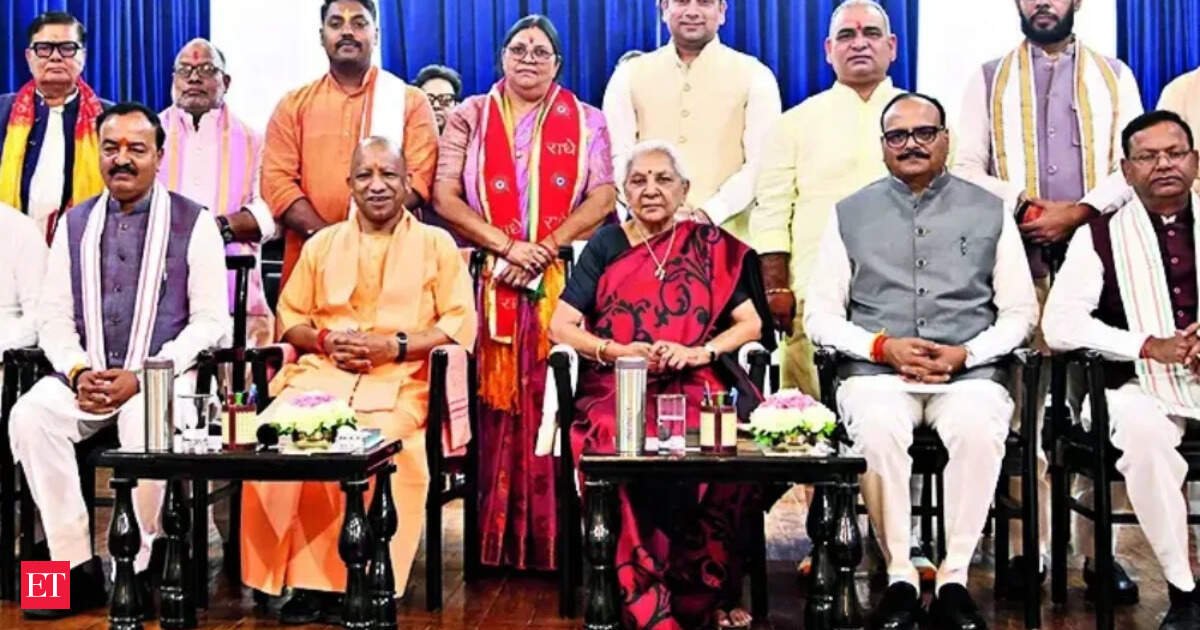
The arithmetic of the expansion tells the story.
Of the six new ministers inducted into the Adityanath 2.0 government, five come from backward or Dalit communities. Three are from Other Backward Classes — Bhupendra Chaudhary (Jat), Kailash Rajput (Lodh) and Hansraj Vishwakarma (Lohar) — while Krishna Paswan (Pasi) and Surendra Singh Daler (Valmiki) represent Dalit groups. The lone upper-caste face is Manoj Kumar Pandey, a Brahmin leader who crossed over politically from the Samajwadi Party camp ahead of the 2024 Lok Sabha elections.
Two ministers of state were also elevated with independent charge — Ajit Pal and Somendra Tomar — both non-Yadav OBC leaders.
The message is difficult to miss: the BJP is attempting to reinforce the broad social coalition that powered its rise in Uttar Pradesh, particularly among non-Yadav OBCs and non-Jatav Dalits, communities that have shown signs of drift after the Lok Sabha elections.
What the 2024 results tell us
In the 2024 parliamentary elections, the BJP-led NDA suffered a sharp setback in India’s most politically consequential state. The Samajwadi Party-Congress alliance won 43 of Uttar Pradesh’s 80 Lok Sabha seats, restricting the NDA to 36 — a dramatic fall from the BJP’s dominance in 2019.
More importantly, the defeat punctured the aura of invincibility that had surrounded the BJP in Uttar Pradesh for nearly a decade.
How UP looked after 2024 General Election results
The 2024 Lok Sabha results exposed just how uneven the BJP’s erosion was across Uttar Pradesh — and why the party is now recalibrating its social coalition ahead of 2027.
The sharpest setback came in Central Uttar Pradesh, where the Samajwadi Party emerged dominant with 11 of the region’s 24 seats, while the BJP was reduced to just eight. Congress, benefiting from the alliance arithmetic, added five more seats to the INDIA bloc tally. The region became the clearest example of how opposition consolidation and caste mobilisation combined to dent the BJP’s supremacy.
Bundelkhand, long considered a BJP-friendly belt, also witnessed a dramatic swing. The SP won three of the region’s four seats, leaving the BJP with just one. The reversal was significant because Bundelkhand had previously been seen as fertile ground for the BJP’s welfare-plus-Hindutva politics.
In North-East Uttar Pradesh, the BJP managed to hold a narrow edge, winning nine of the 17 seats against the SP’s eight. But even there, the numbers suggested a shrinking comfort zone for the saffron party in areas once considered secure under Yogi Adityanath’s influence.
Western Uttar Pradesh delivered another warning sign. The BJP retained nine seats, but the SP climbed to five while Congress opened its account with one. The gains reflected the continued impact of Jat-Muslim consolidation and opposition coordination in a politically volatile region that has historically shaped statewide narratives.
In Rohilkhand and South-East Uttar Pradesh too, the SP steadily expanded its footprint. In Rohilkhand, the SP won five seats against the BJP’s four, while in South-East Uttar Pradesh, the SP secured five of eight seats, more than double the BJP’s tally of two. Smaller parties and independents also managed breakthroughs in pockets, indicating fragmentation beneath the BJP’s once-dominant umbrella coalition.
Nothing symbolised that shock more than Ayodhya.
The loss of the Faizabad Lok Sabha seat, home to the Ram temple movement that has long been central to the BJP’s ideological project, carried enormous symbolic weight. The victor was SP leader Awadhesh Prasad, a Pasi Dalit leader whose win strengthened the opposition’s argument that caste consolidation could decisively alter the electoral battlefield.
For the Samajwadi Party, the result validated Akhilesh Yadav’s “PDA” formulation — Pichda, Dalit and Alpsankhyak — a deliberate attempt to stitch together backward castes, Dalits and minorities into a durable anti-BJP bloc.
The latest cabinet rejig
The BJP’s latest cabinet exercise appears designed to puncture that very narrative before it gains deeper political roots.
The induction of leaders from carefully selected caste groups reflects a strategy the BJP has perfected over the years: micro social engineering. Rather than depending solely on broad ideological messaging, the party is once again signalling representation to smaller caste clusters whose electoral behaviour can shape outcomes in tightly fought constituencies.
The inclusion of Hansraj Vishwakarma is especially more interesting.
The BJP’s Varanasi unit chief and a member of the Lohar community, Vishwakarma became the fourth minister from Prime Minister Narendra Modi’s parliamentary constituency. His elevation comes barely weeks after controversy over the alleged sexual assault and murder of a teenage girl from the Lohar community in neighbouring Ghazipur triggered outrage in the region. Within political circles, the appointment is already being interpreted as an attempt to reassure and consolidate the community.
Varanasi itself now appears heavily fortified in the BJP’s political calculations. Alongside Vishwakarma, the city already has Labour Minister Anil Rajbhar and ministers of state Ravindra Jaiswal and Daya Shankar Mishra ‘Dayalu’. The concentration is significant for a constituency that remains symbolically inseparable from Modi’s political brand.
Kannauj — the parliamentary constituency of SP chief Akhilesh Yadav — has also received renewed attention. With Kailash Rajput’s induction, the BJP now has another minister from the region alongside Social Welfare Minister Asim Arun, a Dalit leader and former IPS officer. The move suggests the BJP is keen to aggressively contest political turf identified with the Samajwadi Party’s core leadership.
Then there is Manoj Kumar Pandey.
The Unchahar MLA from Rae Bareli had rebelled against the Samajwadi Party ahead of the Rajya Sabha elections and sided with the BJP, a move widely seen as politically risky at the time. His eventual induction into the cabinet is both reward and calculation.
For the BJP, Pandey offers more than legislative support. He is a Brahmin face from the political landscape surrounding Rae Bareli — the constituency represented by Congress leader Rahul Gandhi — and comes at a time when the opposition has repeatedly attempted to portray sections of upper castes, especially Brahmins, as uneasy with the BJP’s power structure under Yogi Adityanath.
Pandey himself wasted little time after taking oath before publicly targeting his former political mentor Akhilesh Yadav, underlining how the cabinet reshuffle also carries the flavour of psychological warfare ahead of 2027.
The expansion, however, also reveals a deeper recognition within the BJP: Yogi Adityanath’s personal popularity, while formidable, may no longer be sufficient on its own to neutralise caste arithmetic.
The Samajwadi Party’s aggressive campaign, and the rise of Dalit assertion through figures like Chandrashekhar Azad in Nagina collectively exposed vulnerabilities in the BJP’s social base.
This cabinet reshuffle is therefore less an administrative exercise and more an early electoral manoeuvre.
By carefully distributing representation across caste clusters and politically sensitive regions, the BJP is attempting to regain initiative before the opposition’s social coalition hardens further.
The battle for Uttar Pradesh in 2027 has already begun. And if Sunday’s cabinet expansion is any indication, the BJP believes the road back runs not just through Hindutva, but through caste equations it once appeared to have transcended.
