


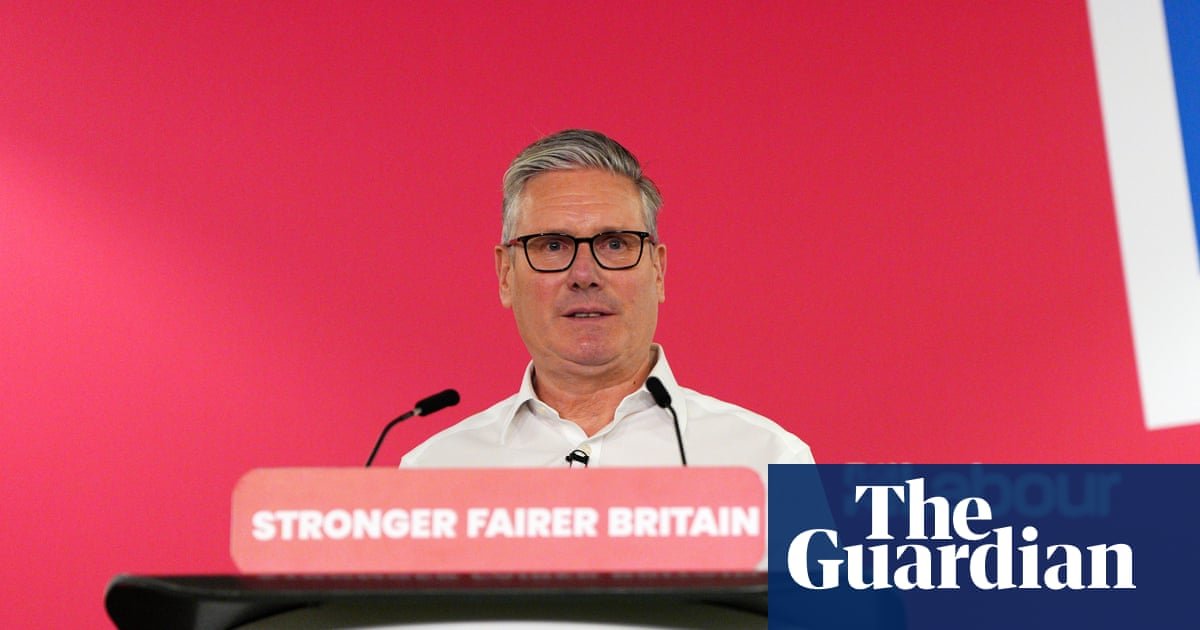
Good morning. Yesterday, Keir Starmer gave a speech which he hoped would draw a line under any potential moves within Labour to replace him, after the nation resoundingly punished his party at the ballot box.
However his words were not enough to quell disquiet. Pressure on the prime minister is growing, with more than 70 Labour MPs publicly calling for him to stand down, and two senior cabinet ministers believed to be among those telling him he should oversee an orderly transition of power.
For today’s newsletter, I spoke to the Guardian’s policy editor, Kiran Stacey, about what Starmer set out, how it landed with the colleagues most likely to replace him, and what the possible pathways forward are. First, this morning’s headlines.
Five big stories
-
UK politics | A newly elected Reform UK councillor has resigned after he allegedly celebrated on social media the rape of a Sikh woman in the Midlands, declared white people the “master race” and called Muslim people “rats”.
-
Iran conflict | Donald Trump has said the ceasefire with Iran is on “life support” and that he is considering restarting US navy military escorts of ships through the strait of Hormuz in an attempt to end the Iranian blockade.
-
Cost of living | Households cut back on their spending in April at the fastest pace in 18 months, as the conflict in the Middle East provoked fears of another cost of living crisis, a report from one of the UK’s biggest banks has suggested.
-
Hantavirus | A French woman who tested positive for hantavirus after she was evacuated from a cruise ship reported symptoms to doctors onboard but was told it was probably just anxiety, the Spanish health minister has said.
-
Health | Singing, painting or visiting a gallery or museum helps people age more slowly, according to the latest study to link taking an active interest in art and culture with improved health.
In depth: ‘This wasn’t a speech aimed at voters – it was aimed at Labour MPs’
The prime minister’s speech was “well put together, clear-eyed, and passionate”, says Kiran Stacey, but had one fundamental problem: “His policy solutions simply didn’t match the rhetoric.”
“When a prime minister stands up and says there is something big going on and they are going to address it, you expect the solutions to be big.” That did not appear to be the case in his speech.
What did Keir Starmer say?
A mix of personal reflection on last week’s election setbacks, the prime minister’s speech came with a warning that the British people would never forgive Labour if it descended into the leadership merry-go-round that characterised the last few years of the Conservative government, which made its way through three prime ministers in its final four years.
Starmer anchored the speech with three policy announcements. In a move to shore up his left flank, he announced legislation to bring British Steel into public ownership. In an appeal to those who resent Brexit, he promised a “big leap forward” in EU relations, including a youth experience scheme to restore a “sense of possibility”. And further, he pledged every young person struggling to find employment will get a guaranteed offer of a job, training or a work placement.
However, Kiran says there were echoes of previous disclosures, saying: “Starmer spoke about a youth guarantee scheme which has already been announced, some extra details on European negotiations which are already happening, and the nationalisation of British Steel which is, in effect, already nationalised.”
Starmer had a brief dig at the Green party leader Zack Polanski, but reserved his sharpest rhetoric for Reform UK’s Nigel Farage. He described the Clacton MP as “not just a grifter, he is a chancer”, and said Farage had “fled the scene” after Brexit had made Britain poorer.
“It sounded a lot, structurally and tonally, like his last conference speech,” Kiran notes. “This wasn’t a speech aimed at voters – it was aimed at Labour MPs. But if I were a Labour MP listening, I’d just think: ‘I’m pretty sure I’ve heard that speech before. Thanks, prime minister.’”
How did key Labour leadership contenders react?
Catherine West, the Labour MP who had surprised almost everyone by announcing a challenge to Keir Starmer’s leadership on Saturday, has changed course. Instead of an immediate change, she wants the prime minister to set a September timetable for his departure.
“She wants a confidence vote and is gathering names for an ‘orderly transition’ in September,” Kiran tells me. “That feels like the move the Andy Burnham camp has long wanted.”
“The one we are all watching today is health secretary, Wes Streeting,” he says. “Andy Burnham isn’t in parliament, and Angela Rayner still has tax issues and doesn’t seem to have the parliamentary support needed to win a contest. It depends on whether Streeting believes now is his moment.”
What lies ahead
On Bluesky, the political analyst Sam Freedman wryly observed: “At least three and maybe four years of the past decade have been spent with a PM grimly hanging to power having lost authority with their party.”
However, the Labour rulebook makes it difficult to unseat a party leader. Someone seeking to replace a sitting leader must secure the written support of 20% of the parliamentary party, which is 81 MPs. Alternate routes to replace him might include the notorious quiet word from the fabled “men and women in grey suits”, or a spate of cabinet resignations making governing publicly impossible, as happened to Boris Johnson in 2022.
So far, four government aides have quit their posts, while the Guardian understands that Yvette Cooper, the foreign secretary, and Shabana Mahmood, the home secretary, have told Starmer he should oversee an orderly transition of power. John Healey and David Lammy were also believed to have discussed the need for a “responsible, dignified, orderly” approach to what might follow. But several others have urged Starmer to fight on.
Starmer was steadfast that he would fight any leadership challenge. “I think he is serious,” Kiran tells me. “His side has been doing the polling, and they think they would win an internal election against Streeting.”
That would suit supporters of Burnham and Rayner, who would welcome a delay to any contest, rather than allow a swift Streeting coronation. “A lot of people who think Starmer should go might still back him if a leadership election comes very soon.”
Maybe I will leave the last word to my colleague Jessica Elgot, who yesterday evening posted these thoughts she had received from an anonymous Labour MP: “We have to face up to the fact every single one of them is fucking useless. Andy’s strategy has been a disaster. Angela bottled it. Ed clearly a hiding to nothing. Wes AWOL. God knows what Catherine West is doing. Not quite sure how we ended up here.”
And yet here we all are …
What else we’ve been reading
-
Crispin, the big-headed canary, is the latest in our The pet I’ll never forget series. He sounds as if he was a lovely creature. Patrick
-
Here’s a stunning gallery of once-grand abandoned movie theatres in North America, now repurposed or left suspended as hybrid ruins since their 1920s heyday – including one acting as a school bus parking lot. Martin
-
Amy Fleming has written a fascinating deep dive on the links between oral heath and the rest of the body. Patrick
-
Paul Sinclair recounts a frankly hilarious encounter with a rude record shop owner in Berlin, which took me right back to my own 1990s days behind the counter, swearing miserably at hapless customers in Soho. Martin
-
Do not miss the second episode of the Guardian’s series on the global dating crisis. This time, they are in the US. Patrick
Sport
Football | Spurs’ Mathys Tel scored the opener but conceded a penalty which allowed Dominic Calvert-Lewin to earn Leeds a 1-1 draw, leaving Spurs two points above the relegation zone.
VAR | The Premier League is to reject widening the scope of VAR next season after talks with the refereeing body Professional Game Match Officials.
Tennis | Iga Świątek produced a statement victory in a battle between two of the game’s best, mercilessly dismantling Naomi Osaka 6-2, 6-1 to return to the quarter-finals of the Italian Open.
The front pages
“Starmer’s survival on the line as cabinet ministers urge him to quit” is the Guardian’s front page today. The Times, in a similar vein, says “Cabinet turns on Starmer” while the Telegraph’s take is “Time to go, Cabinet tells Starmer”. The Daily Mail says “Starmer on the brink as Cabinet ministers tell him it’s time to go”.
The i Paper has “Starmer mutiny grows with Labour Party in open revolt against PM”. The Mirror runs with “Rebels turn on Starmer” and the Sun says “Starmer’s on the brink”. The FT’s headline is “Starmer ‘reset’ speech met with rising tide of MPs urging him to move aside”. Metro has “Starmer eyes British Steel as plots thicken”.
Today in Focus
Why does everyone hate Keir Starmer?
The Guardian columnist Aditya Chakrabortty on the Labour leader’s predicament – and if he may be the last prime minister of the two-party system.
Cartoon of the day | Pete Songi
The Upside
A bit of good news to remind you that the world’s not all bad
Many of us feel a lack of connection to those we live alongside. Annabel Lee once felt this way, estranged from the community in the Oxfordshire town where she lives. So, she started volunteering. From the parent-teacher association to the parkrun, Lee gave her time to those around her – and created the sense of community she had been looking for in the process.
Sign up here for a weekly roundup of The Upside, sent to you every Sunday
Bored at work?
And finally, the Guardian’s puzzles are here to keep you entertained throughout the day. Until tomorrow.
