


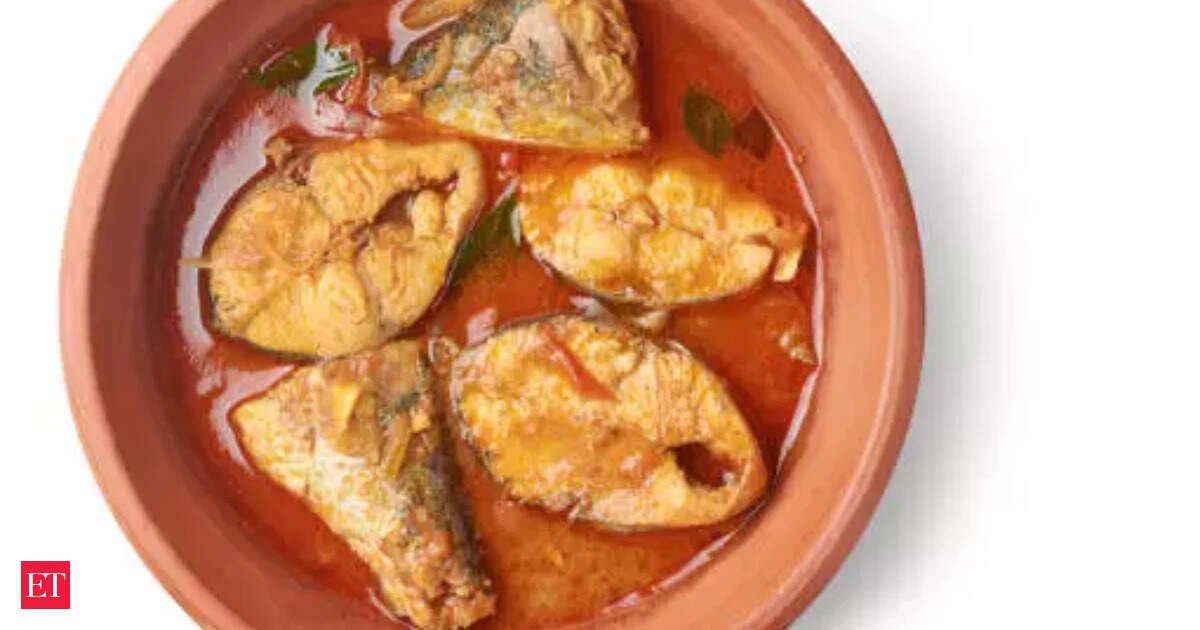
Across parts of Kolkata on Sunday, BJP MLAs including Dilip Ghosh, Agnimitra Paul and Tapas Roy hosted elaborate “fish festivals”, where party workers and local residents gathered for what was unmistakably a traditional Bengali Sunday lunch — plates piled with rice, fish curry and multiple varieties of fish preparations.
Also Read: Fish, meat & West Bengal elections: It’s about money and not politics
The events appeared carefully designed to puncture a long-running political attack by the Mamata Banerjee-led Trinamool Congress that a BJP government would interfere with Bengal’s culinary traditions, particularly the Bengali obsession with “maach-bhaat”.
At the heart of the menu was bekti drenched in rich gravy, alongside rohu, katla, daal cooked with fish head, fish fingers, paneer pakoda, sweets and curd. BJP workers and residents queued up at makeshift dining areas where rows of tables and chairs had been arranged for community-style eating that stretched well into the afternoon.
One of the most prominent events took place in Jorasanko, where newly elected BJP MLA Vijay Ojha personally served fish to attendees near Amherst Street police station.
Dilip Ghosh, who joined party workers for lunch, used the occasion to directly target the Trinamool government’s record on fisheries and food politics.“The BJP will be feeding Bengalis fish from Bengal, not Andhra,” Ghosh said.
He accused the previous government of failing to make Bengal self-sufficient in fish production over the last 15 years.
“Mamata Banerjee has been trying to mislead people by telling lies for a long time. We will not respond to those lies with words, but with actions. That’s why, after coming to office, BJP workers are first serving fish and rice to the people,” he added.
Party leaders repeatedly framed the outreach as both cultural reassurance and political symbolism.
Also Read: The Bengali factor: Jhalmuri, Durga Puja and other strategies in West Bengal’s battle for power
Tapas Roy said: “Mamata had deprived Bengalis of fish and rice. Trinamool extortionists were the ones who had fish. Now, BJP will ensure that fish reaches everyone’s plate. Bengalis can eat fish and eggs, whatever they want.”
Agnimitra Paul struck a more emotional note while defending Bengali food traditions.
“How will Bengalis live without fish? Just as fish cannot live without water, we too are Bengalis. Give us anything, even chicken-mutton, but without fish curry and rice, we won’t be able to survive,” she said.
Local BJP workers said the invitations were open to everyone, irrespective of dietary preferences.
“Most of the people in this area are non-vegetarian, while several are vegetarian as well. We invited everyone who wanted to participate, and the response has been pretty good,” one party worker said.
Political observers said the spectacle reflected the BJP’s broader attempt to recalibrate its cultural messaging in Bengal by embracing regional identity markers rather than appearing at odds with them.
In a state where fish is not merely food but a deeply embedded symbol of identity, memory and everyday culture, Sunday’s “fish festivals” became more than just celebratory meals — they doubled up as a carefully staged exercise in political signalling.
