


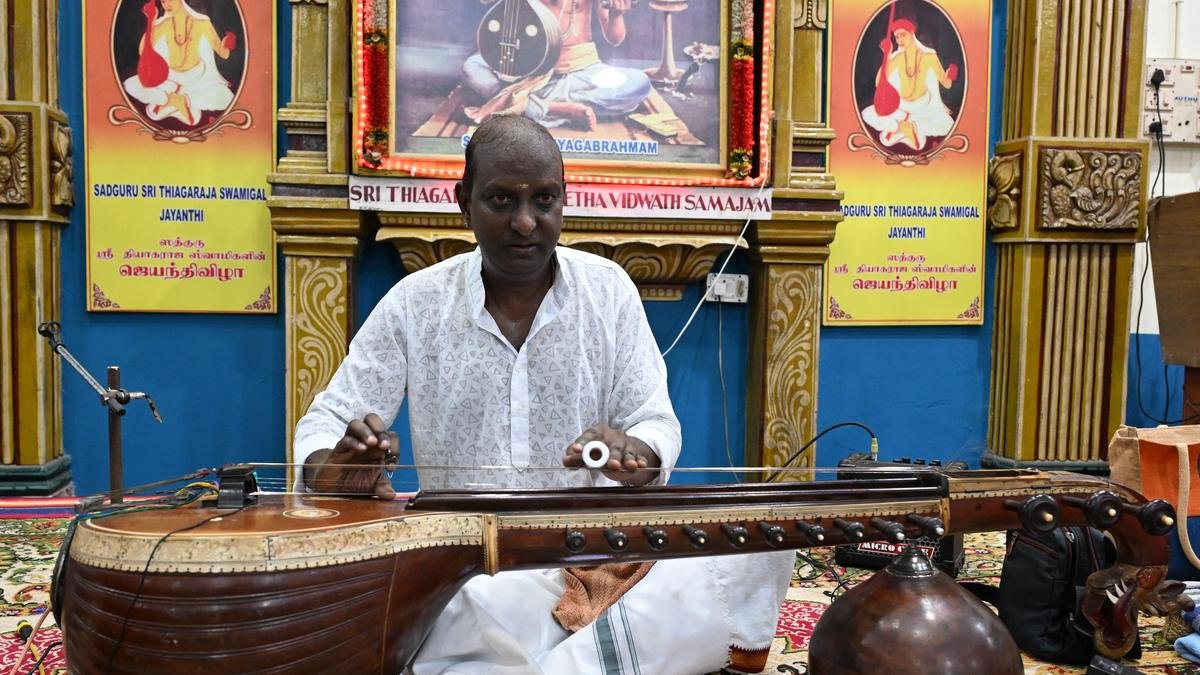
Allam Durgaprasad’s Tyagaraja Jayanti concert at Sri Thiagaraja Sangeetha Vidwath Samajam, Mylapore, Chennai.
| Photo Credit: M. Srinath
The Chitraveena is an ancient instrument first referenced in sage Bharata’s seminal treatise Natya Sastra two millennia ago. Sarangadeva’s magnum opus Sangita Ratnakara also alludes to this string instrument. Over the past century, it has borne different nomenclatures such as Gottuvadyam, Chitravina itself, Atichitraveena, Navachitraveena and Vichitraveena, with the last one prevalent in North India. It brings forth the nuanced tapestry of Carnatic music with remarkable organicity — the interplay of plucking and sliding hands seamlessly weaving tonal vitality with the signature gamaka embellishments. Today, a handful of dedicated practitioners are striving to preserve its legacy and sustain its relevance, yet the instrument continues to navigate a precarious existence.
The Atichitraveena concert by senior exponent Allam Durgaprasad, organised recently by Sri Thiagaraja Sangeetha Vidwath Samajam, Mylapore, for Tyagaraja Jayanthi, assumes significance in this context. The recital reaffirmed the instrument’s innate affinity for exploring the quintessential idioms and ethos of Carnatic music. It was built on the strength of popular kritis, melodic appeal, leisurely kalapramanam and a fine synergy with the co-artistes Usha Rajagopalan (violin) and B. Ganapathyraman (mridangam).
Durgaprasad commenced with the Kalyani Adi tala varnam ‘Vanajakshiro’ by Poochi Srinivasa Iyengar. Clear phrases marked the short Malayamarutam raga essay leading into ‘Manasa etulortune’ set to Rupaka tala. In this kriti, Tyagaraja admonishes the mind to not waste time but chant the ‘Rama nama’. The ultra-slow tempo — not usually employed for this kriti — and gamaka-laden sangatis offered a different listening experience. The swara passages at the pallavi opening were languid, yet expressive, following a brief shift to a brisker pace often adopted in the charanam.
The iconic ‘Nada tanum anisam’, in Chittaranjani — a nishada-antya raga derived from Kharaharapriya — unfolded in all its solemnity. ‘Teliyaleru rama’ in Dhenuka poignantly conveyed Tyagaraja’s pity for those oblivious to the virtue of piety and the path of devotion.
Allam Durgaprasad with Usha Rajagopalan (violin) and B. Ganapathyraman (mridangam).
| Photo Credit:
M. Srinath
Raga Gowrimanohari was delineated in some detail, with both Durgaprasad and Usha adeptly distilling its essence. ‘Guruleka etuvanti’ in Khanda Chapu, where Tyagaraja emphasises the indispensability of a guru’s grace, was played neatly, followed by kalpanaswaras on the pallavi line.
‘Sobillu saptaswara’ in Jaganmohini-Rupaka, another famous kriti extolling the glory of the musical notes, served as a pace-setter ahead of the main suite, Pantuvarali (Kamavardhini). The 51st Melakarta raga can evoke varied moods and Durgaprasad rightly chose to present its contemplative facet, considering the song that followed. Particularly striking were the measured sancharas traversing an octave and the fast-paced phrases towards the end. Usha’s response on the violin was an extension of the evocative arc. ‘Siva siva siva yenaraada’ stands as a rarity within Tyagaraja’s oeuvre. If his devotional outpourings are akin to a mighty river, then Rama bhakti can be likened to its main channel and salutations to other deities to its tributaries.
The composition is an outlier in another sense too — the opening lines of the pallavi, anupallavi and charanam share identical melodic contours. On an instrument, bereft of lyrics and vocal inflection, that sameness and repetition can induce ennui — a pitfall that a vocalist is likely to avoid. Another moot point is the suitability of an instrumental recital for a composer’s commemorative concert. Returning to the concert, an engaging swara segment gave way to a concise tani avartanam in Adi tala by Ganapathyraman, who lent a good hand throughout.
The concert concluded with ‘Meevalla gunadoshamemi’ in Kapi-Khanda Chapu, a stirring exhortation to embrace one’s flaws rather than deflect blame.
Published – May 05, 2026 04:24 pm IST
