


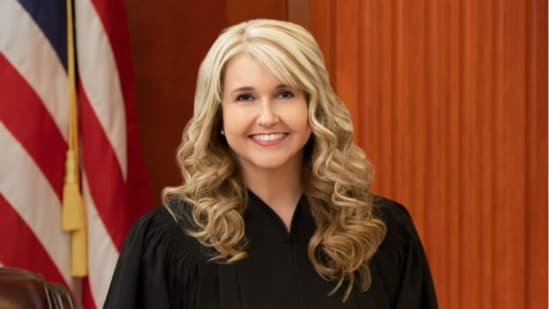
Utah attorney David Reynmann has come under fire after an ethics investigation involving former Utah Supreme Court Justice Diana Hagen. Hagen resigned this week amid allegations of an inappropriate relationship and undisclosed communications.

In her resignation letter, Hagen wrote, “As a public servant for twenty-six years, I am keenly aware that public service requires sacrifice. I have willingly accepted those sacrifices for the privilege of holding a position of public trust, where I could do my part to uphold the rule of law and protect the constitutional rights of every Utahn. ”
She added, “I also understand that public officials are rightly held to a higher standard and must accept a greater degree of public scrutiny and diminished privacy.”
Hagen’s ex-husband accused her of sending “inappropriate” texts to a lawyer, David Reynmann, who assisted in contesting a Republican-friendly redistricting that preserved Utah’s four red congressional seats.
Also Read : Miami ‘boat explosion’ update: Level 2 Mass Casualty Incident declared after 11 people hospitalized
5 things to know about allegations on David Reynmann and Diana Hagen
1. Who is David Reynmann? David Reymann is a veteran Utah attorney known for his work in constitutional law, election law, and redistricting-related litigation. He has represented clients in several politically sensitive legal disputes and has appeared in cases involving state governance and legislative boundaries.
Court filings and multiple media reports show that David Reymann played a prominent role in Utah’s high-profile redistricting litigation. He represented voting-rights groups challenging Republican-backed congressional maps before the Utah Supreme Court.
2. Allegations emerged during redistricting litigation. The controversy emerged after allegations surfaced claiming Reymann and Justice Hagen exchanged personal messages while Utah’s redistricting battles were underway.
The early reports, as cited by CBS News, show that the relationship between Diana Hagen and David Reymann, an attorney for Parr Brown, which represented the League of Women Voters of Utah, one of the plaintiff’s attorneys, claiming Republicans’ proposed congressional maps were unlawful, was being questioned by state legislators in April.
3. Hagen and Reymann previously denied the allegations. In April, the Utah Supreme Court released a statement on Hagen’s behalf, stating that she responded to her ex-husband’s accusations with “prompt, prudent, and transparent steps.”
She said, “My last involvement in the redistricting case was October 2024. I voluntarily recused myself from all cases involving Mr Reymann in May 2025, and my recusal was reflected in the Court’s September 15, 2025, opinion in League of Women Voters.”
According to KSL, the Judicial Conduct Commission, which is characterized on its website as an independent organization made up of several state legislators, judges, and members of the public, performed a preliminary investigation based on the allegation and decided not to take the case further.
4. What are the political implications? The allegations surfaced amid an ongoing dispute over Utah’s court-mandated congressional plan, which greatly favored Democrats in a GOP-majority district. CBS News characterized this as a new strategy used by the Trump administration to maintain Republicans’ tiny control in the U.S. House.
After the allegations surfaced, White House was keeping a careful eye on the controversy to investigate ethical issues about a connection between two important parties in the gerrymandering case
4. Hagen resigned before the disciplinary outcome. Hagen announced her resignation before any formal disciplinary decision became public. The Utah Supreme Court and state judicial authorities have remained relatively restrained in public comments.
Hagen expressed her desire to stay on the bench in her letter of resignation.
