


History is said to date to the first records about our species; everything before that is even more apocryphal, shrouded in the mists of prehistory.
Writing is what made the difference. And what a storehouse of information, emotion and biographical detail those early records are. At first, it was mainly data being preserved: accounts, stores, censuses of people and livestock, rules for traders, citizens and administrators. But even these tell intriguing stories.
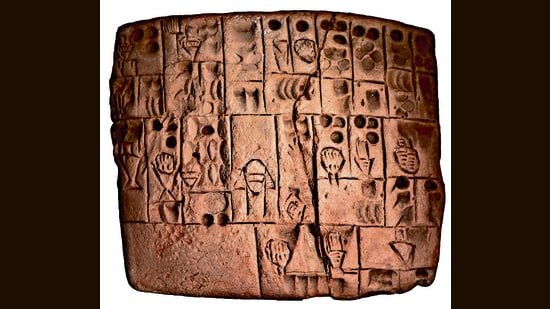
Among the earliest surviving pieces of writing is a sort of bar tab.
About 5,300 years ago, in the city of Uruk in present-day Iraq, a man named Kushim was in charge of a storage facility that contained nine cereals set aside for the making of beer, which was among the rations handed out to agricultural workers.
Kushim had to keep a highly complex log, so he used small clay tokens as memory aids, notes Assyriologist and historian Moudhy Al-Rashid, in her astonishing book, Between Two Rivers: Ancient Mesopotamia and the Birth of History (2025).
Such tokens “have been found at numerous sites throughout the ancient Middle East, from Turkey… all the way to Iran… As methods for counting and accounting, they may have been used as early as 7500 BCE,” she writes.
The earliest of these tokens date to about 200 years before the oldest surviving hieroglyphics. In place of letters and words, they used about 2,000 different signs.
“A boot might represent something like walking, a star might represent something divine, and the head of a bull might represent that animal,” Al-Rashid writes.
Then record keepers began to evolve a shared shorthand that could be inscribed with a reed stylus, rather than having to be stamped, on wet clay. Amid the dots and squiggles, cuneiform was born.
As the number of squiggles grew, the scribes who served as managers, accountants and administrators began to collate lists of signs, essentially creating the precursor to the dictionary. “The earliest surviving fragments of these lists come from about 3200 BCE,” Al-Rashid writes.
Even today, scholars are learning from these records found in the ruins of some of the world’s first cities. The lists, notices, classroom notes and letters hold within them evidence of some of the earliest recorded tales of personal tragedy, boredom, worker-overseer relations, and signs of what were perhaps the first great inequalities of wealth and power.
DOODLES FROM AN ANCIENT CLASSROOM
Let’s start with the classroom notes.
Clay tablets engraved by students in Babylon about 4,000 years ago depict what appears to be a class exercise: Draw the creation myth. Over and over, in different hands, the mother goddess Ninmah is shown using clay to create human beings.
A 1,000-year-old doodle on clay, meanwhile, is likely the earliest surviving record of a bored student. A clay tablet full of proverbs also holds what appears to be a child’s drawing of an angular, seated figure.
The proverbs are treasures too: “Who can compete with righteousness?” one queries, before adding, “It creates life.” Another appears to be a precursor to “the grass is greener…”: “You don’t speak of that which you have found. You talk only about what you have lost.”
Letters about kings, pleas for help, manuals on how to banish ghosts, as well as poems and fictional tales appear, all before 1500 BCE. Take a look.
A KING, A SERF AND A LETTER SUGGESTING UNREST
In a Babylonian missive dated to 1632 BCE, a man named Marduk-mushallim writes to his superior to report on the implementation of an order from the king (likely Ammisaduqa). According to Mushallim, the king wants to raise security levels around the city of Sippar-Yahrurum (to the north of Babylon), in part to protect livestock from hostile troops.
Marduk-mushallim warns that the orders are not being implemented. The city gate aren’t even being closed at night.
In a tone reminiscent of the millions through the ages who have sought to ingratiate themselves with their bosses, the letter hints that unrest could lead to the great state’s downfall.
A PLEA FROM A DISTRAUGHT MOTHER
What is thought to be a letter from about 1800 BCE preserves the plea of a possibly enslaved or indentured woman to her master, indicating that writing has always helped preserve the stories of those on the margins.
The woman writes about her absence from work as a result of the death of her unborn child. The foetus was seven months old, and now “nobody wants to take care of me,” she says. “Come visit me and let me see the face of my master.”
WHEN BANISHING A GHOST, DO NOT LOOK BEHIND YOU
A tablet from about 300 BCE spells out intriguing instructions for tricking a lonely ghost into leaving.
The ritual involves creating figurines of a man and a woman: “You dress the man in an everyday shift and equip him with travel provisions. You wrap the woman in four red garments and clothe her in a purple cloth. You give her a golden brooch…,” the tablet notes.
The rest of the process involves waiting for sunrise, luring the ghost with vessels of beer, and chanting prayers to the sun god.
The text ends with a warning: “Do not look behind you”.
BOUTS OF THE FLU; HALLEY’S COMET
Some of the discoveries preserve extraordinary moments in history.
In the autumn of 164 BCE, one tablet documents the sighting of what appears to be the long-tailed Halley’s Comet (the year is in keeping with its orbit too).
Some records point to early epidemics. “A diary from 567 BCE mentions a possible outbreak of ‘coughing’ and another mentions the ‘recovery of sick people in the land’ from an unnamed illness,” Al-Rashid writes.
Centuries later, a cuneiform sign from 323 BCE reads: “The 29th, the king died”. Cuneiform experts have deduced that the king in question here was Alexander the Great. And in this way, some really do live forever.
